Understanding FX Spreads: What the Bank Doesn’t Tell You
- The FX spread is the gap between the price at which you can sell a currency (the bid) and buy it (the offer) — and it is how market makers get paid.
- It is a markup, not a separate fee: a "zero commission" quote still earns the dealer money through the spread.
- Your spread is tailored to you — dealers vary it by trade size, relationship, sophistication, and even which way they think you will trade.
- A spread that looks tiny is real money: a 2-pip markup on a 1 million euro trade is about $200, and it scales linearly with size.
- Dealers' own published terms of dealing spell out that the price you get is an "all-in" markup they are not obligated to break down for you.
What is the spread in forex?
The difference between the bid (where you can sell) and the offer (where you can buy) for a currency pair. You cross that gap every time you trade, which is why it is the market maker's core source of revenue.
Is the spread a fee or commission?
Neither, technically. It is a markup baked into the price. That is why "no commission" advertising can be misleading — the cost is simply moved into a wider spread.
What is a pip?
The smallest standard increment of a currency price — usually the fourth decimal place (0.0001). Spreads and markups are measured in pips.
How much does a spread actually cost?
In dollar terms it depends on size. A 2-pip markup on €1 million of EUR/USD is roughly $200; the same markup on €10 million is roughly $2,000.
Why is my spread different from someone else's?
Because dealers price each customer individually, based on trade size, credit, relationship, how you trade, and how sophisticated you appear to be.
Do I ever see the "real" price?
Rarely. Retail customers are usually shown an all-in price with the markup already inside it, and often a one-way price that hides the spread entirely.
Is there any code of conduct dealers follow?
Yes — most reputable dealers commit to the FX Global Code, a voluntary set of good-practice principles (covering transparency, mark-ups, and handling of your information) maintained by the Global Foreign Exchange Committee. It is not law, but signing it is a public commitment you can ask about.
A quick-read summary of the full article below.
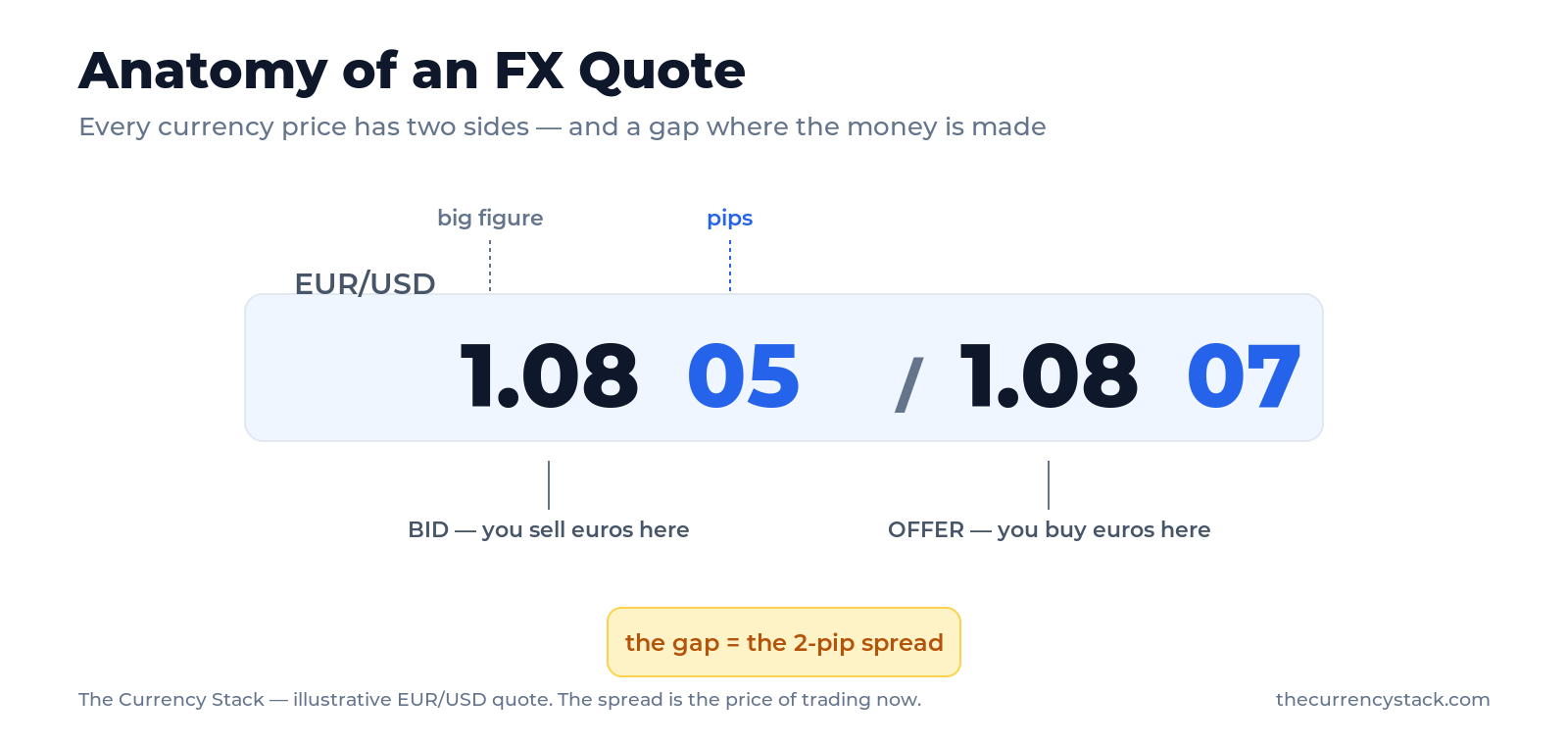
Look at any currency quote and you will see two numbers, not one. EUR/USD might read 1.0805 / 1.0807. The first is the price at which you can sell euros; the second is the price at which you can buy them. The tiny gap between them — here, two pips — looks like a rounding error. It is, in fact, one of the most quietly profitable numbers in finance, and understanding it is the difference between being a price-taker who never asks questions and a customer who knows exactly what they are paying for.
This is a tour of the FX spread: what it is, what it truly costs, why the spread quoted to you is not the spread quoted to the next customer, and — drawing on dealers' own published terms of dealing — the things a bank is under no obligation to tell you.
What Is an FX Spread?
Most currency prices are two-sided. The lower number is the bid — the price at which the market maker will buy the base currency from you. The higher number is the offer (or ask) — the price at which it will sell the base currency to you. The distance between them is the spread.
That spread is measured in pips. A pip is the smallest standard increment of most currency prices — normally the fourth decimal place, so 0.0001. In EUR/USD, a move from 1.0805 to 1.0807 is two pips. The leading digits that rarely change moment to moment (the "1.08") are called the big figure; dealers quoting quickly over the phone often say only the last two digits — "05, 07" — because everyone already knows the big figure.
Here is the key idea: the spread is not an accident of the market. It is the price of immediacy. A market maker stands ready to trade with you at any moment, taking the other side of your deal and warehousing the risk until it can offset the position. The spread is what it charges for that service — and, done at scale, it is how the entire market-making business is funded. In the wholesale interbank market, spreads for major currencies are tiny, often around a tenth of a percent. The further you sit from that wholesale core, the wider the spread you are shown — and the reason why is where this gets interesting.