What Are Stablecoins? Digital Dollars Explained
A stablecoin promises something deceptively simple: one token, one dollar, forever. Behind that promise sits a pile of reserves, a redemption desk, and a peg that has to be defended — and has sometimes been lost. Here is how digital dollars actually work.
The Currency Stack 17 August 2026 16 min read
Contents · 7 sections
- A stablecoin is a crypto token designed to hold a fixed value — almost always one US dollar — by holding reserves that back it.
- The market is roughly $300 billion as of mid-August 2026, and two issuers dominate it: Tether (USDT) and USD Coin (USDC) together account for around 85% of it.
- The peg is not magic: it holds because holders can redeem tokens for real dollars at par, and arbitrageurs profit from closing any gap.
- What backs them varies more than most people assume — Circle’s USDC sits almost entirely in short-term government paper and cash, while Tether’s reserves also include roughly $20 billion of gold and $7 billion of bitcoin.
- Pegs can and do break: USDC fell to about $0.87 in March 2023 when part of its reserves was trapped in a failed bank, and the algorithmic stablecoin TerraUSD went to nearly zero in May 2022.
What is a stablecoin?
A crypto token engineered to hold a steady value, usually exactly one US dollar. Unlike bitcoin, it is not meant to go up — it is meant to stay still, so it can be used as money rather than held as a bet.
What backs a stablecoin?
For the major ones, a pool of reserves: cash and short-dated US government debt, held by the issuer. The point is that every token in circulation has a real dollar-equivalent asset standing behind it.
How does the peg actually hold?
Through redemption and arbitrage. Large customers can hand tokens back to the issuer for dollars at par, so if the token trades below $1 it becomes profitable to buy it cheap and redeem it at face value — which pushes the price back up.
Are stablecoins the same as dollars in a bank?
No. They are a private company’s liability, not a bank deposit. US law now says so explicitly: payment stablecoins are not federally insured. You are relying on the issuer’s reserves and its willingness to redeem.
Do they ever break the peg?
Yes. USDC slipped to roughly $0.87 for a weekend in March 2023; TerraUSD, which held no real reserves, collapsed to nearly nothing in May 2022 and never recovered.
Is a stablecoin regulated?
Increasingly. The US GENIUS Act, enacted in July 2025, requires one-to-one reserves in cash and short-term Treasuries with monthly public disclosure. The EU’s MiCA regime has governed them since 2024 — and has already authorized USDC while USDT was delisted from EU-regulated exchanges.
What are they actually used for?
Moving dollars quickly across borders, holding cash between crypto trades, and — in countries with weak or restricted currencies — getting access to dollars at all.
A quick-read summary of the full article below.
A stablecoinGlossaryStablecoinA cryptocurrency designed to hold a steady value by referencing an external asset such as a national currency, typically backed by reserves or managed by an algorithm.Full entry → makes a promise that sounds almost too boring to be interesting: one token, one dollar, forever. No upside, no story, no chart to stare at. Yet this deliberately dull corner of crypto has grown into roughly a $300 billion market as of mid-August 2026 — and it is the part of the crypto world that has quietly become useful, moving dollars across borders at internet speed while the rest of the market argues about what bitcoin is worth.
But that simple promise hides a genuinely interesting question, and it is a question anyone who has studied currencies will recognize instantly: what actually holds a peg at one dollar? Not hope. Reserves, redemption, and arbitrageGlossaryArbitrageThe simultaneous purchase and sale of related instruments to profit from a price discrepancy with little or no net market risk.Full entry → — the same machinery that holds any pegged currency in place, run by a company instead of a central bank. This article is about that machinery: what a stablecoin is, what is really sitting behind it, and what happens on the days the peg does not hold.
What a Stablecoin Actually Is
Strip away the technology and a stablecoin is an old idea in new packaging: a claim on a dollar, issued by a private company, that circulates as if it were the dollar itself.
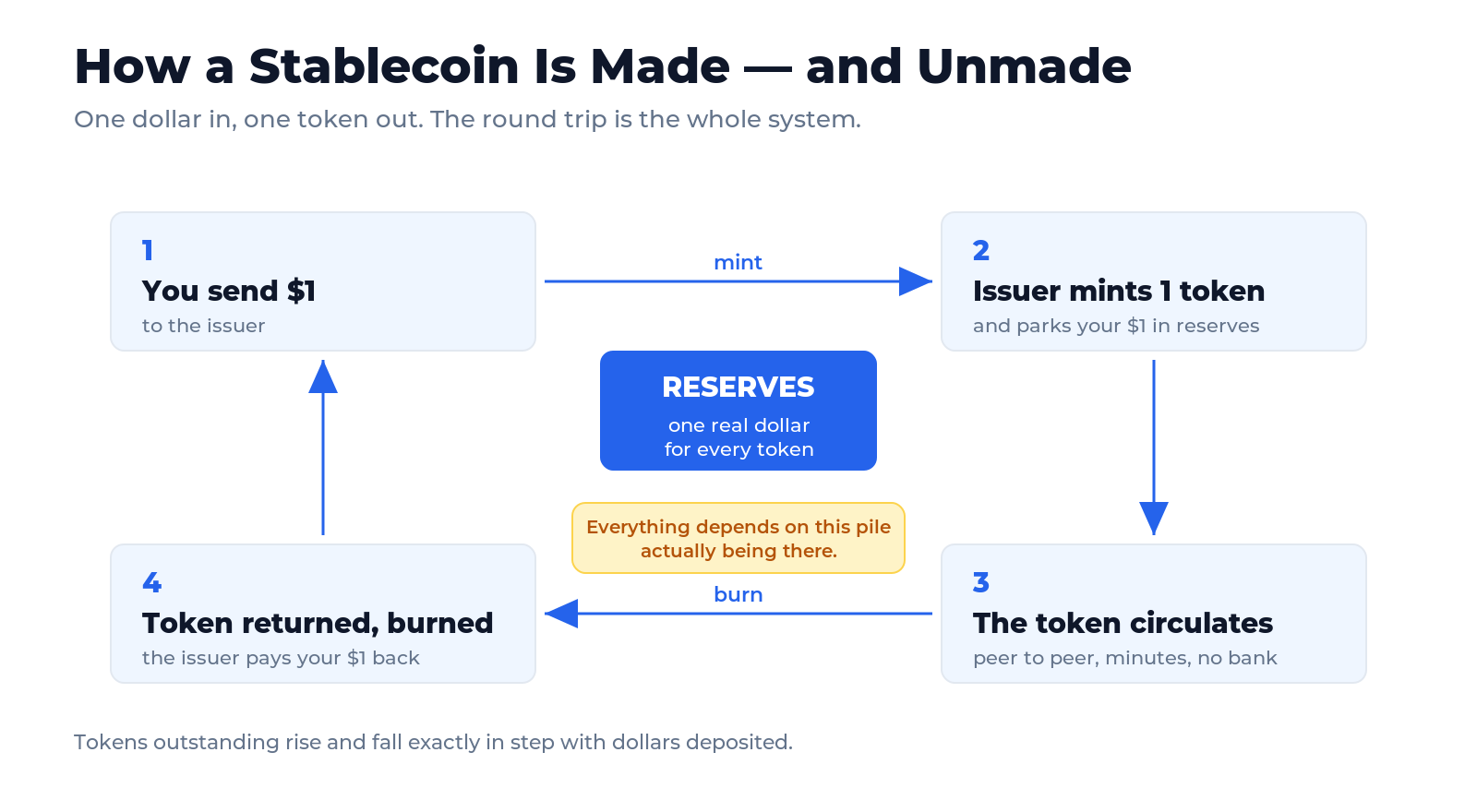
The mechanics are simpler than the jargon suggests. You give the issuer a dollar. The issuer creates — “mints” — one token and gives it to you, then parks your dollar in reserves. The token now travels on a blockchainGlossaryBlockchainA distributed ledger in which transactions are grouped into blocks and linked in a chronological, tamper-resistant chain maintained across many computers.Full entry →: you can send it to anyone, anywhere, in minutes, without a bank in the middle. When someone eventually wants the real dollar back, they return the token to the issuer, the issuer pays out and destroys — “burns” — the token. Tokens in circulation go up and down exactly in step with dollars deposited.
That round trip is the whole system. Everything else — the peg, the trust, the failures — follows from whether the issuer really holds those dollars and really hands them back on demand.
The scale is concentrated in remarkably few hands. Of roughly $300 billion outstanding in mid-August 2026, Tether (USDT) accounts for about $183 billion and USD Coin (USDC) about $72 billion — together around 85% of the entire market. This is not a diverse ecosystem; it is two large private issuers and a long tail.
And the flows are far larger than the float. Stablecoins moved a record $33 trillion in raw transfers during 2025, up about 72% on the year before — a number worth handling with care, because raw on-chain volume counts a great deal of machine traffic: bots, arbitrage loops, and value shuffling between exchange wallets. Strip that out and the adjusted figure for genuine user payments lands nearer $9–10 trillion. That is the honest number, and it is still enormous: a $300 billion pool of tokens settling close to ten trillion dollars of real payments a year is not a novelty. It is a payment system.
One detail in those flows is worth pausing on. USDC moved about $18.3 trillion in 2025 against USDT’s $13.3 trillion — even though USDC is barely a third of Tether’s size. The same dollars are turning over far faster. That gap is the clearest evidence of what each token is really for: USDC is being used to move money, while much of USDT is being held as a dollar substitute, sitting still in places where dollars are hard to come by.
Three Ways to Hold a Peg
Not every stablecoin keeps its promise the same way, and the differences matter enormously — as several billion dollars of losses have demonstrated.
Fiat-backed stablecoins are the dominant design and the easiest to understand: one token, one real dollar (or near-cash asset) in reserve. USDT and USDC both work this way, and the model accounts for roughly 84% of the market. The peg rests on the reserves actually existing and actually being redeemable.
Crypto-collateralized stablecoins back their tokens with other crypto assets instead of dollars, held in smart contracts rather than by a company. Because that collateralGlossaryCollateralAssets pledged to secure an obligation and reduce credit exposure in a trading relationship, such as cash or securities posted against derivatives positions.Full entry → is volatile, they must be over-collateralized — you might lock up $150 of crypto to issue $100 of stablecoin — with automatic liquidation if the cushion thins. DAI and its successor USDS (issued by Sky, formerly MakerDAO) are the best-known examples, together worth around $15 billion. The trade-off is that you avoid trusting a company, but you tie up far more capital than you issue.
Algorithmic stablecoins hold no meaningful reserves at all. They attempt to hold the peg with code and incentives — minting and burning a companion token to absorb selling pressure. The theory is elegant. The practice was catastrophic: TerraUSD (UST) used exactly this design, and when it slipped below a dollar in May 2022, the mechanism minted enormous quantities of its companion token LUNA to defend the peg, crushing LUNA’s price, which destroyed the very thing supposedly backing UST. The result was a death spiral that erased tens of billions of dollars within days and never recovered. The category never came back: pure algorithmic designs now account for well under $5 billion, and the survivors have retreated into hybrids that hold real reserves alongside the algorithm.
Practitioners have a name for the underlying constraint — the stablecoin trilemma. A design can have at most two of three properties: full collateral backing, capital efficiency, and decentralization. Fiat-backed tokens take backing and efficiency, and accept a central issuer you have to trust. Crypto-backed tokens take backing and decentralization, and accept the capital inefficiency. Algorithmic tokens took efficiency and decentralization — and gave up backing. The market has since voted, overwhelmingly, for backing.
The lesson is unglamorous but important: a peg backed by confidence alone is not a peg. It is a promise that works right up until the moment it is tested.
What’s Actually in the Reserves
Here is where the two giants diverge, and where “backed by dollars” turns out to be a phrase doing a lot of work.
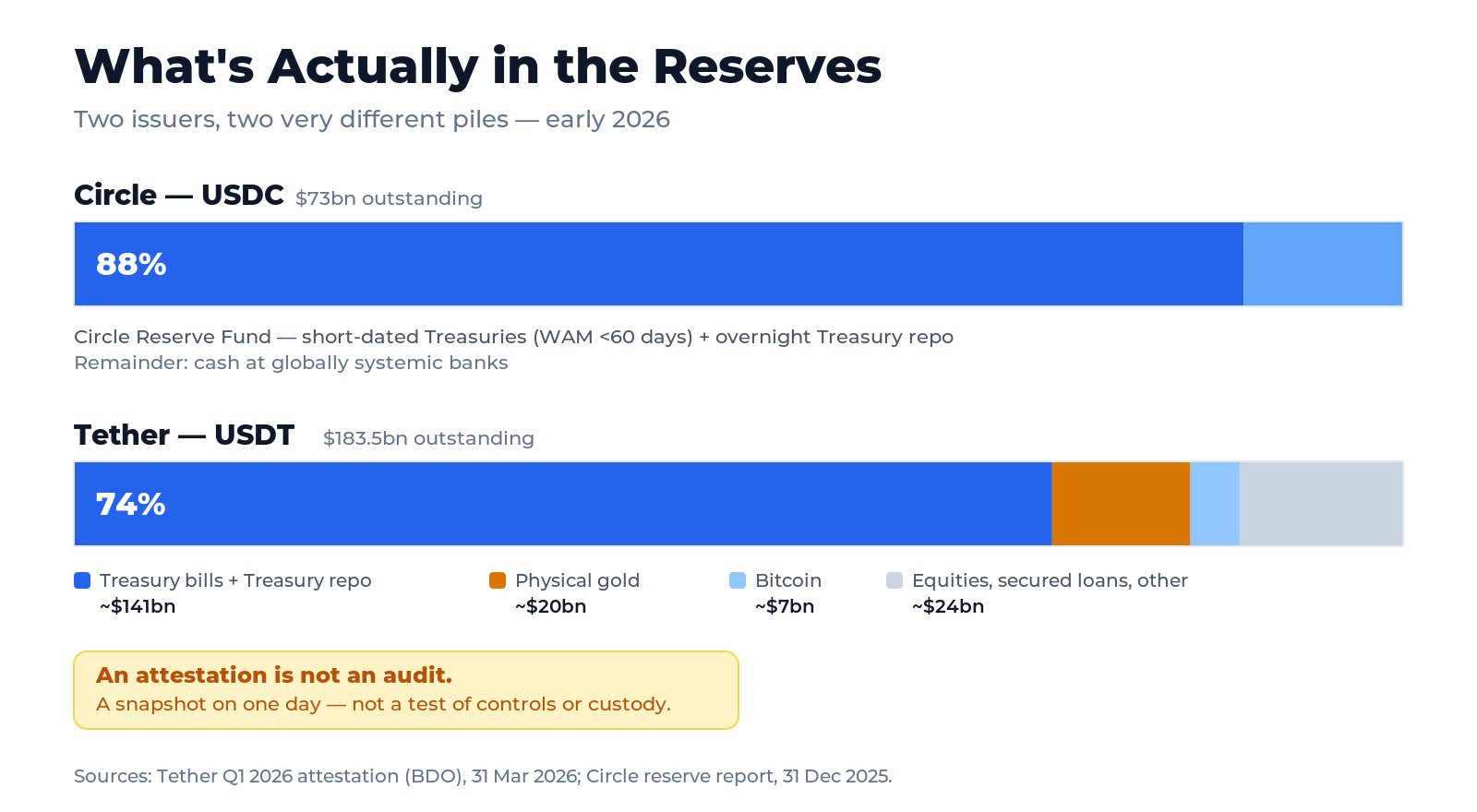
Circle’s USDC is the conservative one. As of the end of 2025, roughly 88% of its reserves sat in the Circle Reserve Fund — a government money marketGlossaryMoney MarketThe market for short-term borrowing and lending, typically with maturities of one year or less, including deposits, certificates of deposit, treasury bills, and commercial paper.Full entry → fund managed by BlackRock, holding US Treasuries with a weighted-average maturity under 60 days plus overnight repurchase agreements backed by Treasuries. The rest is cash held at banks, largely those designated globally systemically important. Circle publishes reserve holdings weekly, with a monthly attestation from a Big Four accounting firm, and as a US-listed public company it files with the SEC.
Tether’s USDT is a different animal. Its Q1 2026 attestation puts total assets at about $191.8 billion against roughly $183.5 billion of tokens outstanding. Of that, $117 billion sits in Treasury bills, with a further $24 billion in Treasury-backed repo — call it $141 billion, around three-quarters of the pile, in government paper. The rest is where it gets interesting: roughly $20 billion in physical gold, about $7 billion in bitcoin, and a few billion more in other investments, including some $3.4 billion of public equities, alongside secured loans and cash. The gap between assets and tokens — Tether’s “excess reserves,” a buffer against losses on those riskier holdings — stood at a record $8.2 billion at the end of March; by the Q2 attestation (30 June 2026) it had roughly halved, to about $4.1 billion. Its reserve reports come quarterly, from BDO.
The distinction is not academic. A dollar backed by a 60-day Treasury bill is backed by the most liquid, least volatile asset on earth. A dollar backed partly by gold and bitcoin is backed by assets whose price moves — which is precisely why the excess-reserve buffer exists.
Step back and the shape of the thing becomes clear: a large fiat-backed stablecoin is, functionally, a dollar money market fund running on blockchain rails. It takes in cash, buys short-dated government paper, issues redeemable claims against it, and keeps the interest. It is also why reserve quality is the whole ballgame: illiquid or opaque reserves fail precisely when they are needed most, in a panic, when everyone redeems at once.
And there is a subtlety worth internalizing, because it is the single most misunderstood point in this market: an attestation is not an audit. An attestation is a point-in-time snapshot in which an accountant confirms that, on one particular day, the reported reserves matched the books. It does not test internal controls, it does not examine custodyGlossaryCustodyThe safekeeping of assets on behalf of an owner, including the secure management of the private keys that control cryptocurrency holdings.Full entry → arrangements, and it says nothing about what happened to those assets on the other days of the quarter. Tether has never produced a full audit from a Big Four firm. That is not an accusation of wrongdoing — it is a description of how much, and how little, the disclosure actually proves.
Why the Peg Holds — and What Breaks It
A stablecoin’s peg is not enforced by the blockchain. It is enforced by arbitrage, and arbitrage only works if redemption works.
Suppose USDC drifts down to $0.99 on an exchange. A large customer with a redemption account can buy tokens at $0.99, hand them to the issuer, and receive $1.00 — a risk-free cent. That buying pressure lifts the price back toward a dollar. The reverse works above the peg. The peg, in other words, is held in place by people who can convert tokens into real dollars at face value and are motivated by profit to do so.
Anyone who has watched a pegged exchange rate will find this familiar. A currency peg holds while the central bank has the reserves to defend it and the willingness to convert at the stated rate. When the market doubts either, the peg is attacked and often breaks. A stablecoin is the same arrangement, with a company in the central bank’s chair — and no lender of last resortGlossaryLender of Last ResortThe central bank's role of lending to solvent institutions that cannot borrow elsewhere, typically during a panic.Full entry → behind it.
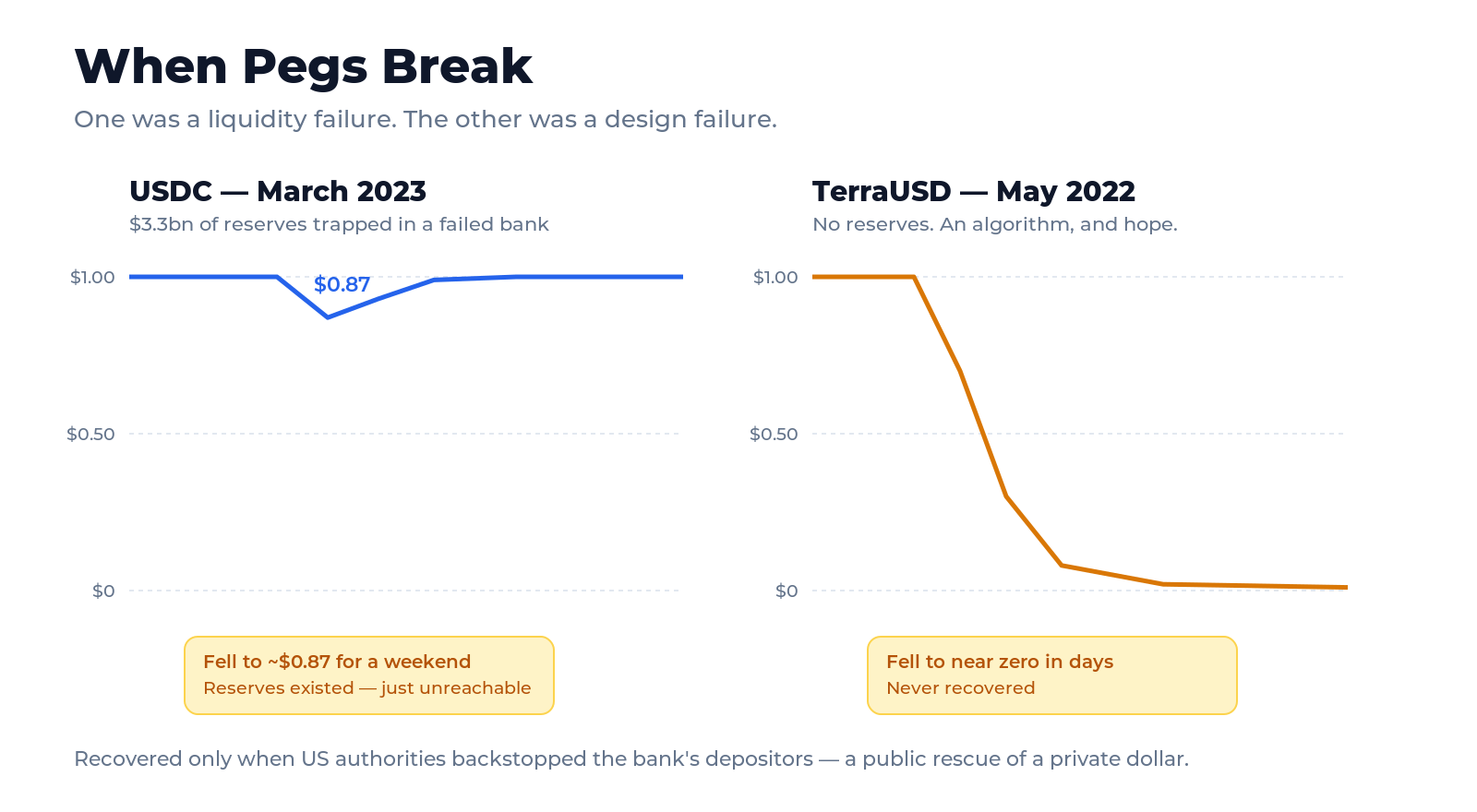
That is exactly what March 2023 demonstrated. Circle disclosed that $3.3 billion of USDC’s reserves were stuck at Silicon Valley Bank, which had just failed. The reserves were, in aggregate, fine — but a slice of them was frozen, and it was a weekend, so redemptions could not clear. ConvertibilityGlossaryConvertibilityThe degree to which a currency can be freely exchanged for other currencies without regulatory restriction.Full entry → broke, and with it the peg: USDC fell to roughly $0.87. It recovered only when US authorities invoked a systemic risk exception to guarantee SVB’s depositors — which is to say, the largest regulated dollar stablecoin was pulled back to its peg by a public backstop of a bank.
The contrast with TerraUSD is instructive. USDC broke because its reserves were temporarily unreachable; the assets existed. UST broke because there were no reserves to reach. One was a liquidity failure and recovered in days. The other was a design failure and never recovered at all.
Are They Regulated?
For most of their history, stablecoins grew in a regulatory gap. That has changed, and the practical answer today is yes — with the detail depending on where you are.
In the United States, the GENIUS Act, enacted in July 2025, created the first federal framework for payment stablecoins. Reserves must be one-to-one, with no fractional reserve, and the permitted assets are narrowly drawn: cash, deposits at insured banks, Treasury bills with 93 days or less to maturity, Treasury-backed repo, and money market funds holding only those things. Issuers must publish reserve composition monthly, examined by a registered accounting firm, and must honor redemption at par on demand — the mechanism the whole peg depends on, written into law. The Act also settles two questions worth knowing: compliant payment stablecoins are not securities, and they are not federally insured. That second point deserves its own sentence. A stablecoin is not a bank deposit, and the law now says so explicitly.
In Europe, MiCA has governed stablecoins since 2024. Dollar- and euro-pegged tokens are treated as e-money tokens, which can only be issued by an authorized bank or electronic money institution, and holders must be able to redeem at par, at any time. The effects were not theoretical: MiCA sorted the market. USDC obtained authorization; USDT did not, and was delisted from EU-regulated exchanges including Coinbase, Kraken, and Binance’s European arm. Europeans can still self-custody Tether, but licensed venues cannot offer it.
Read the GENIUS Act’s permitted-asset list back against Tether’s reserve mix and you can see the argument coming: gold, bitcoin, and equities are not on it. Where these rules push the money — and what that means for the dollar system, for governments outside it, and for the banks — is a bigger story, and we take it up in the companion piece linked below.
What Stablecoins Are Actually For
It is easy to be so absorbed by the plumbing that you miss why anyone bothers. Three uses do most of the work.
They are crypto’s cash. Most digital assets are priced and traded against USDT or USDC rather than against fiat directly, because getting real dollars on and off an exchange is slow and expensive. Stablecoins are the always-on liquidity that makes the market function — and they are the base asset underneath most decentralized finance lending and trading, the equivalent of cash in a traditional system. It is also why the float tracks crypto activity so closely: when the market cools, tokens are redeemed and the supply shrinks. That is exactly what mid-2026 has shown, with total supply contracting by roughly $10 billion from its May peak — the largest drawdown since the TerraUSD collapse.
They are a payments rail. Sending a stablecoin across a border is a blockchain transaction: minutes, at trivial cost, at any hour. Sending a dollar through correspondent banking is a chain of intermediaries: days, at real cost, on business days only. For remittances and business-to-business flows, that gap is the entire pitch — and the trillions settled in 2025 say the pitch is landing.
And in countries with weak or restricted currencies, they are simply access to dollars — a dollar-denominated balance you can hold on a phone without a US bank account. For the saver, that is an escape hatch from a currency losing value. For that country’s central bank, it is something closer to an emergency, and it is the subject of the companion article.
The Bottom Line
A stablecoin is a private dollar. It works — genuinely works — because reserves, redemption, and arbitrage hold a peg in place, the same way reserves and convertibility hold any currency peg. When those hold, a stablecoin is a fast, cheap, useful dollar. When any of them is doubted, it is a company’s promise trading at whatever the market thinks the promise is worth.Go deeperA members’ guide takes this furtherMembers get the full guides, plus daily market briefings.See membership
So the questions worth asking are not about the technology at all. They are the oldest questions in money, in new clothes: Who issued this? What is behind it? Can I get my dollar back, today, at par? Nineteenth-century Americans asked exactly those questions of the banknotes in their pockets. The blockchain is new. The questions are not.
The Currency Stack provides educational and research content only. Nothing here is financial, investment, or trading advice, or a recommendation to buy or sell any asset or to use any issuer or provider. Markets carry risk; do your own research and consider professional advice before acting.
Further reading: This explainer is part of our crypto and monetary-system series, and it has a companion: Private Dollars: What Stablecoins Mean for the Monetary SystemMembers’ guidePrivate Dollars: What Stablecoins Mean for the Monetary SystemRead the guide → takes up what private digital dollars do to central banks, the US Treasury market, and countries that don’t issue dollars. For the foundations, see the pillar guide What Is Cryptocurrency? (And How It Relates to Money) and What is Money? For how reserves and central banks defend a rate the traditional way, read What Moves Currency Prices?, and for the dollar system stablecoins are borrowing, What Is the FX Market and Why Does It Matter? Terms in bold are defined in our glossary. Sources: Tether Q1 and Q2 2026 attestations (BDO) and Circle reserve reports; the GENIUS Act (congress.gov) and the EU’s MiCA regulation; Artemis Analytics, a16z and Visa Onchain Analytics for transfer volumes; and the Federal Reserve’s FEDS Notes on the Silicon Valley Bank failure and stablecoins. Figures are date-stamped and move daily.