What Is an FX Swap? The Biggest Instrument in the Biggest Market
The most heavily traded instrument in the world's biggest financial market is one most people have never heard of. It is not a stock, a bond, or bitcoin. It is not even the spot currency trade we followed in What is Spot? It is the FX swap — roughly $4 trillion changing hands every day, about 42% of all foreign exchange turnover (BIS, April 2025).
The Currency Stack 9 July 2026 10 min read
Contents · 5 sections
- An FX swap is two trades in one contract: exchange two currencies now (the near leg) and reverse the exchange on a set future date (the far leg) — both rates fixed at the start.
- It is the most traded instrument in the world’s biggest market: roughly $4 trillion a day, about 42% of all FX turnover (BIS, April 2025).
- The price of a swap is the forward points — the gap between the spot and forward rates — and it is driven by the interest rate difference between the two currencies, not by anyone’s forecast.
- Economically, an FX swap is a collateralized loan: you borrow one currency and lend the other, which is why banks, funds, and corporates use it to raise cash and roll hedges.
- The market usually runs quietly, but in dollar squeezes — 2008, March 2020 — the cost of swapping into dollars can explode, which is why central banks keep emergency swap lines ready.
What is an FX swap in one sentence?
A single contract to exchange two currencies today and reverse that exchange on an agreed future date, with both exchange rates locked in from the start.
Is it a bet on where the exchange rate is going?
No. Because both legs are fixed at inception, there is no net exposure to the spot rate on the principal — the economics come from the interest rate difference between the two currencies.
What are forward points?
The amount added to (or subtracted from) the spot rate to get the forward rate. They reflect the two currencies’ interest rates for the period, a relationship called covered interest parity.
Is an FX swap the same as a currency swap or an interest rate swap?
No. An FX swap is two exchanges of principal and nothing else. A currency swap runs for years and also exchanges interest payments; an interest rate swap involves one currency and no principal exchange.
Who uses FX swaps?
Mainly banks managing funding, investors hedging foreign assets, and corporate treasurers moving cash between currencies — usually for a week to three months at a time, rolled over and over.
Why do FX swaps matter beyond the FX market?
The far legs add up to more than $80 trillion of dollar payment obligations that sit off balance sheet — a rollover machine that works smoothly until dollars get scarce.
A quick-read summary of the full article below.
The most heavily traded instrument in the world’s biggest financial market is one most people have never heard of. It is not a stock, a bond, or bitcoin. It is not even the spot currency trade we followed in What is Spot? It is the FX swapGlossaryFX SwapA transaction that buys one currency against another for spot value and simultaneously reverses the exchange for a later value date with the same counterparty.Full entry → — roughly $4 trillion changing hands every day, about 42% of all foreign exchange turnover (BIS, April 2025). Banks use it constantly. Global investors depend on it. And when it seizes up, central banks treat it as an emergency. This article explains what it is, how it is priced, and why an instrument this obscure sits so close to the center of the financial system.
Two Trades in One
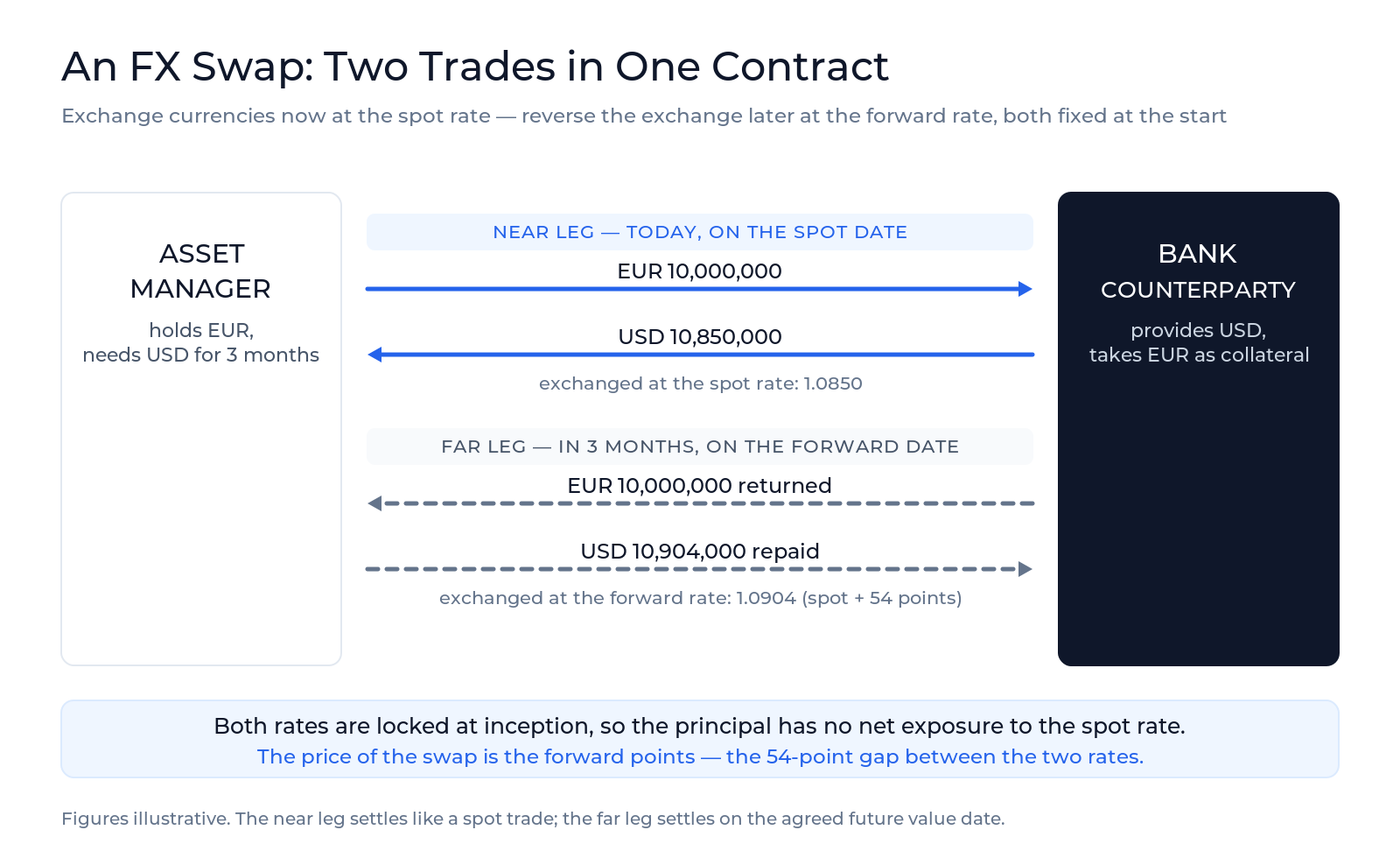
An FX swap is a single contract that bundles two currency exchanges. On the first date — the near leg, usually the spot date — you exchange one currency for another at the spot rate. On an agreed later date — the far leg — you reverse the exchange: same two currencies, opposite direction, at a forward rate fixed when the deal is struck. Dealers describe a swap by what happens to the base currency: a “buy and sell” or a “sell and buy.”
Suppose a European asset manager holds euros but needs dollars for three months. It enters a swap: sell EUR 10 million against dollars today at the spot rate, and buy the euros back in three months at the forward rate. It has dollars to use for the period, it knows to the cent what the round trip costs, and at maturity the currencies flow back the other way.
One detail of that example matters more than it appears. Both legs are dealt off the same spot rate — the near leg at spot, the far leg at that same spot adjusted by the forward points — so the euro principal sold today is the euro principal bought back later. Spot nets out, and what the dealer actually prices is the points. An outright forward works differently: it is spot plus points, with a spread taken on each, so building the same position out of two separate outrights means crossing the spot spread twice. That efficiency is one reason the interbank forward market runs on swaps rather than outrights.
Notice what is missing: a view on the exchange rate. Both rates were locked at the start, so if EUR/USD soars or slumps over those three months, the principal amounts of the swap do not care. This is the feature that surprises newcomers — the biggest instrument in the currency market is not a bet on currencies. What you do pay, or earn, is the gap between the two rates. That gap has a name.
Forward Points: The Price of Time
The forward rate is not a prediction. It is the spot rate plus (or minus) an adjustment called the forward points, and the points come almost entirely from one place: the difference between the two currencies’ interest rates for the period.
The logic is a no-free-lunch argument. Holding dollars for three months earns the dollar interest rate; holding euros earns the euro rate. If dollars yield 4.00% and euros 2.00%, then a forward rate that ignored the difference would hand out riskless profit — borrow the low-rate currency, swap into the high-rate one, collect the extra interest, and lock your exit with the forward. ArbitrageGlossaryArbitrageThe simultaneous purchase and sale of related instruments to profit from a price discrepancy with little or no net market risk.Full entry → forces the forward rate to a level that cancels the advantage. This relationship is called covered interest parity, and it means the currency with the higher interest rate must trade at a forward discount, and the one with the lower rate at a forward premium.
Put numbers on it. EUR/USD spot is 1.0850, dollar rates are 4.00%, euro rates are 2.00%, and the tenor is 90 days (all figures illustrative). The 2% annual gap over a quarter of a year is roughly 0.5% of the rate — about 0.0054, or 54 points in market language. The three-month forward is therefore about 1.0904. A trader quoting that swap quotes “54” — not the spot rate, not a forecast, just the price of time in the two currencies. Interbank dealers trade the points themselves and leave spot to the spot desk.
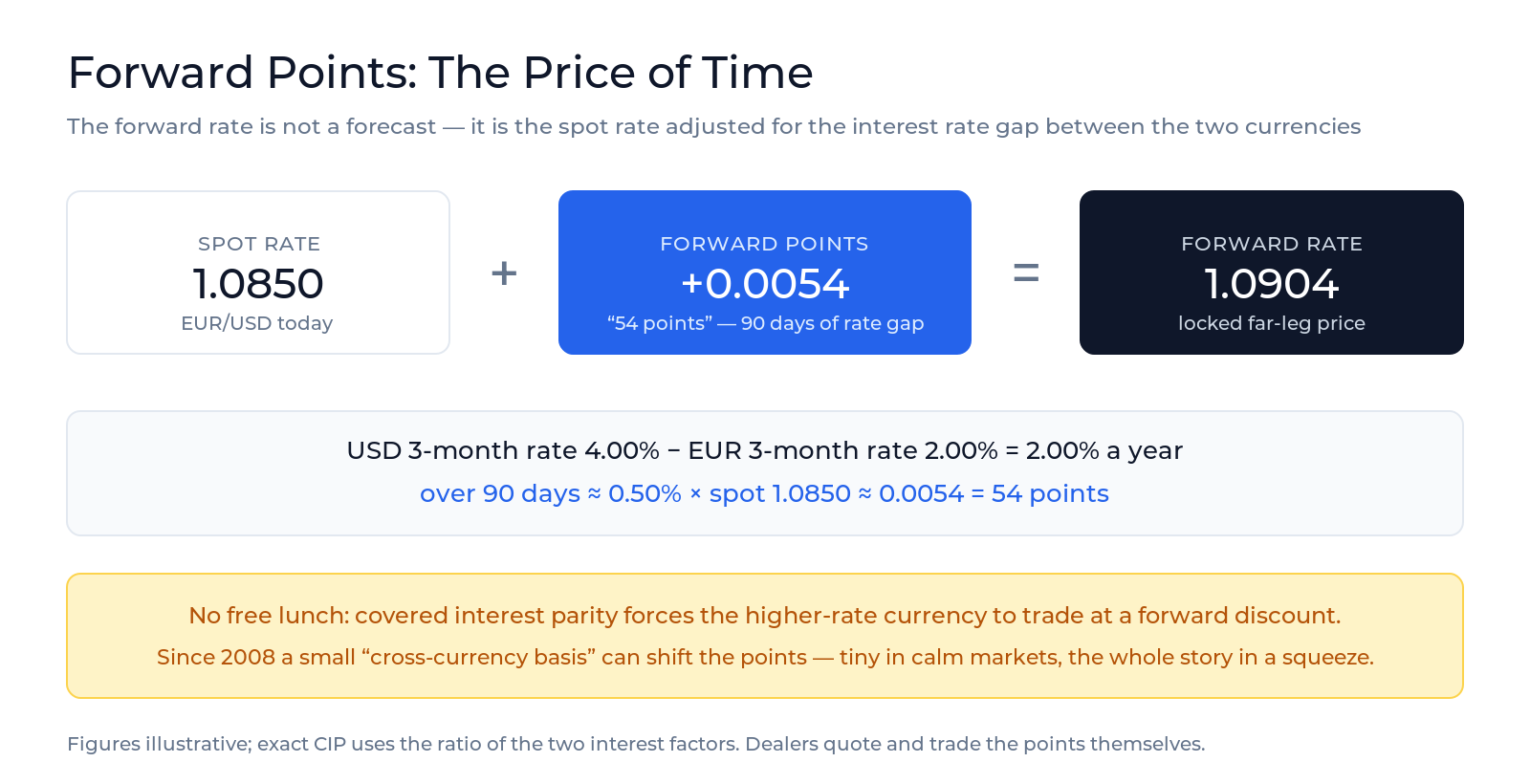
One refinement matters if you go deeper. Since the 2008 crisis, covered interest parityGlossaryCovered Interest ParityThe no-arbitrage relationship stating that the forward exchange rate must reflect the interest-rate differential between two currencies, so that hedged returns are equalized across them.Full entry → has not held exactly. The small, persistent deviation is called the cross-currency basis, and it appears because banks’ balance sheets are costly and because so many institutions want to borrow the same currency — usually dollars — through swaps at the same time. In calm markets the basis is a detail measured in fractions of a percent. In stressed markets it is the whole story, as we will see below.
A Loan in Disguise
Why is this the instrument banks trade $4 trillion of every day? Because an FX swap is, in economic substance, a collateralized loan. Swap euros for dollars and you have borrowed dollars for the period — with your euros posted as collateralGlossaryCollateralAssets pledged to secure an obligation and reduce credit exposure in a trading relationship, such as cash or securities posted against derivatives positions.Full entry →. That makes the FX swap one of the cheapest, most flexible funding tools in finance, and it explains who uses it.
Banks use swaps to manage day-to-day funding — raising a currency they need this week without buying it outright, and smoothing mismatches between the value dates of their positions. Asset managers, pension funds, and insurers use them to hedge foreign investments: a Japanese fund holding US Treasuries can swap yen for dollars and roll the swap every one or three months, insulating the position from the dollar’s ups and downs. Corporate treasurers park cash from one currency in another and bring it home later, or roll an existing hedge forward to a new date. In each case the attraction is the same — full use of a currency for a defined period, at a cost known in advance, with no lingering exchange rate exposure on the principal.
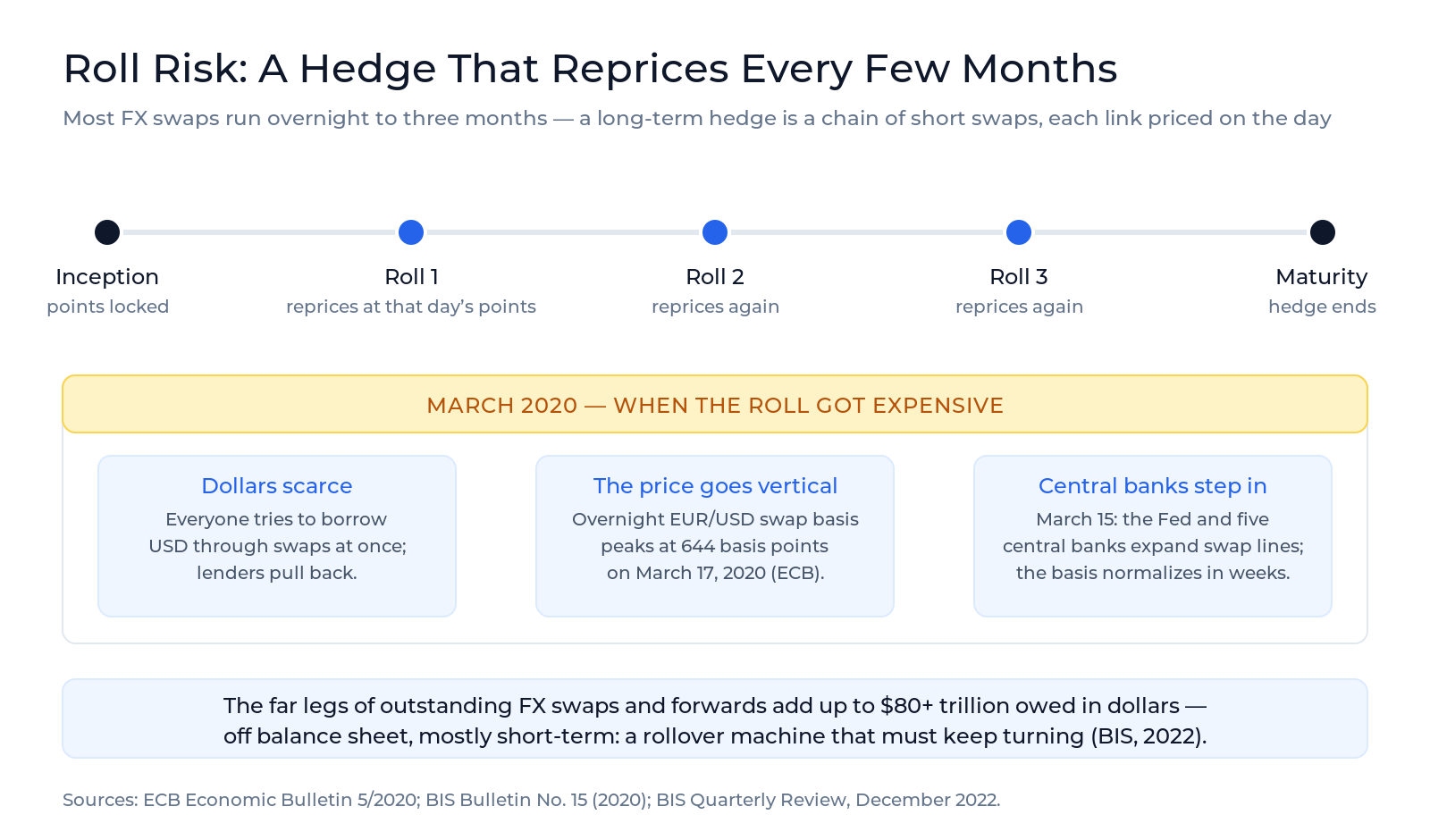
The fine print is that the cost is known in advance only until the next roll. Most swaps run from overnight to about three months, so a long-term hedge is really a chain of short swaps, and every link reprices at whatever the forward points are that day. Through the 2022–24 rate cycle, hedging costs swung materially as central banks moved — no crisis required. A rolling hedge is not a fixed-price product; it is a series of purchases of time, each at the market’s going rate.
Where It Breaks
The swap market’s weak point is that it assumes you can always roll. Almost always, you can. But the far legs of outstanding FX swaps, forwards, and currency swaps add up to obligations to repay more than $80 trillion of US dollars — a sum exceeding the stocks of dollar Treasury bills, repo, and commercial paper combined, most of it short-term, and none of it visible on balance sheets, because accounting rules treat the far leg as a derivative rather than debt (BIS, December 2022). The system depends on that mountain of borrowed dollars being rolled over, week in, week out.
In March 2020, as the pandemic hit, everyone wanted dollars at once and nobody wanted to lend them. The cost of borrowing dollars through the swap market — that cross-currency basis — exploded; the ECB recorded the overnight EUR/USD swap basis peaking at 644 basis points on March 17. For anyone rolling a hedge that week, the price of time had gone vertical. On March 15 the Federal Reserve and five other major central banks announced coordinated swap lines — arrangements that let foreign central banks borrow dollars and lend them on to their own banks — and within weeks the basis had normalized. The same tool had been built for the same reason during the 2008 crisis.
For a reader of this series, the point is not that FX swaps are fragile — it is that they are infrastructure. Like the settlement plumbing we traced in How a Spot FX Trade Really Works, the swap market works so reliably that it becomes invisible, and its stress episodes are rare enough to be forgotten. The professionals who use it well are the ones who price the roll rather than assume it.
The Bottom Line
An FX swap is two trades in one: exchange currencies now, reverse the exchange later, both prices fixed at the start. It is not a currency bet — it is a way to borrow one currency against another, which is why it quietly became the most traded instrument in the currency market. Its price is the forward points, set by the interest gap between the two currencies under covered interest parity, give or take a basis that only misbehaves when dollars are scarce. Understand that, and a large share of what banks, funds, and treasurers actually do all day — the $4 trillion that flows beneath the headlines — stops being mysterious.
Understanding the swap also completes a foundation. You now have spot (the price of currency today), the value-date machinery that settles it, and the instrument that moves currency through time. The natural next step in this series is the outright forwardGlossaryOutright ForwardAn agreement to exchange two currencies on a single future value date beyond spot at a rate fixed today.Full entry → and how businesses use it to fix tomorrow’s exchange rate today.
Further reading: Bank for International Settlements, “OTC foreign exchange turnover in April 2025” (Triennial Central Bank Survey, September 2025); Borio, McCauley, and McGuire, “Dollar debt in FX swaps and forwards: huge, missing and growing” (BIS Quarterly Review, December 2022); BIS Bulletin No. 15, “US dollar funding markets during the Covid-19 crisis” (2020); ECB Economic Bulletin 5/2020, “US dollar funding tensions and central bank swap lines during the COVID-19 crisis.” Previously in this series: What is Spot? and How a Spot FX Trade Really Works.