The FX Market: Interbank, Prime Brokers, ECNs and ‘Last Look’
The FX market isn't one pool but a layered hierarchy: a thin wholesale core of tier-1 banks and non-bank market makers sets the reference price, while everyone else reaches it through prime brokers, prime-of-prime providers, and ECNs. Here's how the layers fit together — and what "last look" really means.
The Currency Stack 21 June 2026 22 min read
Contents · 12 sections
- The Market That Isn’t One Market
- The Interbank Core and the Price “Spine”
- Prime Brokerage: Borrowed Credit, Borrowed Name
- Prime-of-Prime and the Path to Retail Access
- Electronic Networks and the Logic of Streaming Liquidity
- Managed Pools and the Mirage of Liquidity
- How a Trade Travels Through the Layers
- Last Look: The Price Maker’s Final Check
- Toxic Flow and Why Fills Depend on Footprint
- Firm Versus Last-Look Liquidity
- Is Last Look Fair?
- The Bottom Line
- The FX market is not one pool but a layered hierarchy — a thin wholesale core, a credit layer that controls access, and an outer fabric of electronic venues that redistribute the same liquidity many times over.
- A small group of tier-1 banks and non-bank market makers set the reference price — the “spine.” Everyone else reaches it through prime brokers, prime-of-prime providers, ECNs, and managed pools.
- “Last look” lets a liquidity provider take a brief final check — typically a few hundred milliseconds — before accepting or rejecting an order at its own quoted price.
- The same mechanics that keep spreads tight — internalization, last look, and flow segmentation — also make the market’s true depth harder to see.
- We map the whole stack, follow a single trade through it, and weigh the long-running argument over whether last look is fair.
How big is the FX market?
About $9.6 trillion a day in April 2025, by the Bank for International Settlements’ triennial survey — the largest financial market in the world. Spot alone runs near $3 trillion a day.
What is the interbank market?
The wholesale layer where the most credit-worthy banks and market makers trade with one another, largely on electronic order books. It is where the reference price is formed.
What does a prime broker do?
It lets a client trade in the prime broker’s name, extending its credit so the client can face the market’s core. The client posts collateral; the prime broker stands in the middle.
What is a prime-of-prime broker?
A firm that sits on top of a tier-1 prime broker and passes that access down to smaller brokers and funds who cannot meet a tier-1 bank’s requirements directly.
What is an ECN?
An electronic communication network — a venue where participants trade directly and anonymously, streaming executable prices that machines can react to in microseconds.
What is “last look”?
A brief window in which a liquidity provider rechecks the market after receiving an order and decides whether to accept or reject it at its quoted price. It is used in quote-driven streams, not on firm central order books.
Is last look allowed?
Yes, but it is governed. The FX Global Code (updated January 2025) says it should be used only for price and validity checks, with no trading on the client’s order information during the window.
A quick-read summary of the full article below.
Ask a newcomer where a foreign exchange (FX) trade goes and you will usually get a simple picture: “the market.” One vast pool, somewhere out there, where buyers meet sellers and a price appears. It is a useful fiction for a first lesson, and it is wrong in almost every detail. There is no single FX market. There is a layered system of venues, credit arrangements, and pricing conventions, stacked on top of one another, through which the same trade can look completely different depending on who you are and how you connect.
We have already followed a single deal from quote to settlement in How a Spot FX Trade Really Works. This piece zooms out from the trade to the plumbing around it: the interbank core where wholesale prices are made, the prime brokers and prime-of-prime firms who decide who is allowed in, the electronic networks that let machines trade against one another, and the quietly controversial practice — last lookGlossaryLast LookA liquidity provider's option to take a final check of the market before accepting or rejecting an order at a quoted price, typically within a brief delay.Full entry → — that lets a price maker change its mind a few milliseconds after you have hit its quote.
The Market That Isn’t One Market
FX is the largest financial market on earth. The Bank for International Settlements, which surveys it every three years, put global turnover at roughly $9.6 trillion per day in April 2025, up about 28% from 2022. That headline deserves a caveat the brand insists on: the April 2025 survey landed in a burst of tariff-driven volatility that inflated spot and forward activity, so part of the jump is event-driven rather than purely structural. Spot alone ran at about $3.0 trillion a day, roughly 31% of the total.
For decades, that turnover flowed through a tidy two-tier structure. A small club of dealer banks made prices to each other in an exclusive interbank market, and everyone else — corporations, asset managers, smaller banks — took prices from a dealer at a markup. The wholesale price and the customer price lived in separate rooms.
That structure has largely dissolved. By the 2013 BIS survey the inter-dealer share of turnover had fallen to around 39%, from roughly 63% in the late 1990s, and the trend has continued: in April 2025, “other financial institutions” — non-dealer banks, asset managers, hedge funds, and the proprietary trading firms that now make prices electronically — accounted for about 50% of all turnover, edging ahead of the inter-dealer segment at 46%. Risk no longer radiates out from a dealer at the center; it passes around a network in which banks and non-banks both quote and both take. Economists revived an old phrase for it: hot-potato trading, where a position is passed from hand to hand until someone is willing to hold it.
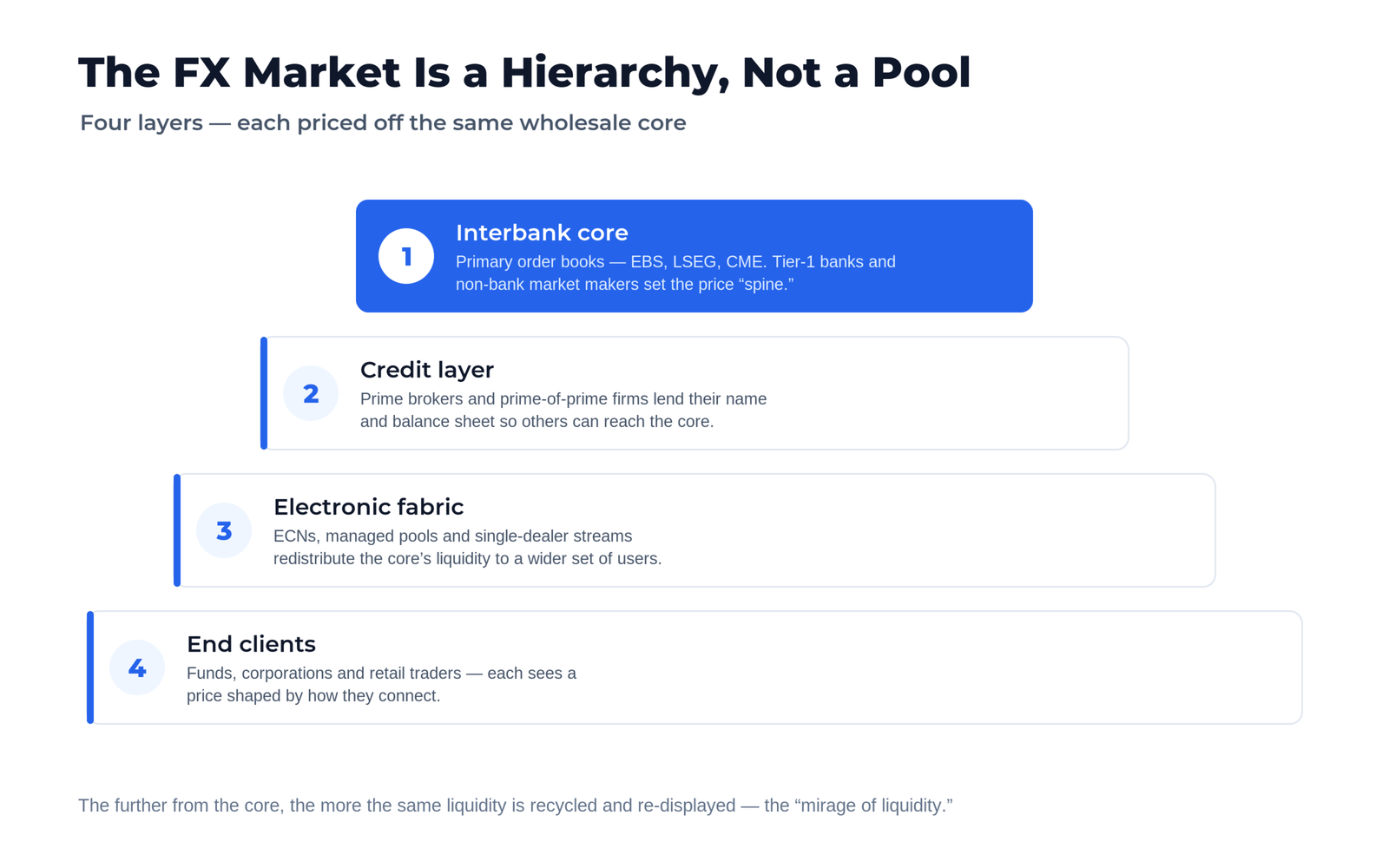
The result is not chaos but a hierarchy. To understand any FX price, you have to know which layer of that hierarchy you are looking at. The layers stack roughly like this:
- The interbank core — primary order books where tier-1 banks and major non-bank market makers trade and the reference price is set.
- The credit layer — prime brokers, and prime-of-prime firms beneath them, who lend their names and balance sheets so others can reach the core.
- The electronic fabric — ECNs, managed liquidity pools, and single-dealer streams that distribute and redistribute that core liquidity to a wider set of users.
- The end clients — funds, corporations, and retail traders, each seeing a version of the price shaped by how they connect.
The Interbank Core and the Price “Spine”
At the center sit the primary venues — the wholesale order books where the most credit-worthy market makers trade with one another. Historically these were two anonymous interbank matching systems: EBS, which concentrated liquidity in the euro, yen, and Swiss franc, and Reuters Dealing, which dominated in sterling and the Commonwealth currencies. After two decades of consolidation those franchises now sit inside larger groups — EBS within CME, and the old Reuters matching engine within LSEG — joined by the FX futures order book at CME.
What matters is not the brand names but the mechanism. These are central limit order books (CLOBs): every resting bid and offer is visible to participants, and trades match by strict price-then-time priority, exactly as on a stock exchange. Quotes here are firm — once you hit one, the trade is done, with no take-back. Because the most competitive wholesale liquidity gathers here, these books set the reference price — the spine — from which nearly every other FX price in the world is derived. When a bank quotes a corporate client, or a platform streams a price to a hedge fund, the number begins life as the top of book on a primary venue and is then adjusted.
The other defining feature of the modern core is internalizationGlossaryInternalizationA dealer's practice of offsetting one client's buy against another client's sell within its own book rather than hedging in the open market.Full entry →. A large dealer sees enormous two-way client flow: one client buying euros, another selling them. Rather than send each trade out to the market, the dealer can match offsetting flows on its own book and never touch an external venue. By the time of the 2013 survey, top banks were internalizing as much as 75% to 85% of their flow in the most liquid pairs. This is efficient — it reduces the dealer’s market impactGlossaryMarket ImpactThe effect a trade has on observable market prices, caused by aggressive client execution or by a dealer hedging in lit markets.Full entry → and keeps spreads tight — but it also means a growing share of the market’s true depth is invisible, sitting inside bank “e-books” rather than on any public screen.
Prime Brokerage: Borrowed Credit, Borrowed Name
There is an obvious problem with an interbank market built on bilateral credit. To trade on a primary venue you need credit relationships with the other participants — and a hedge fund, a proprietary trading firm, or a small regional bank has no chance of persuading the world’s largest dealers to face it directly. Prime brokerageGlossaryPrime BrokerageAn arrangement in which a large bank (the prime broker) lets a client trade in the bank’s name with multiple liquidity providers, then handles the credit, settlement, and clearing.Full entry → is the arrangement that solves this, and it is one of the quiet hinges of the whole system.
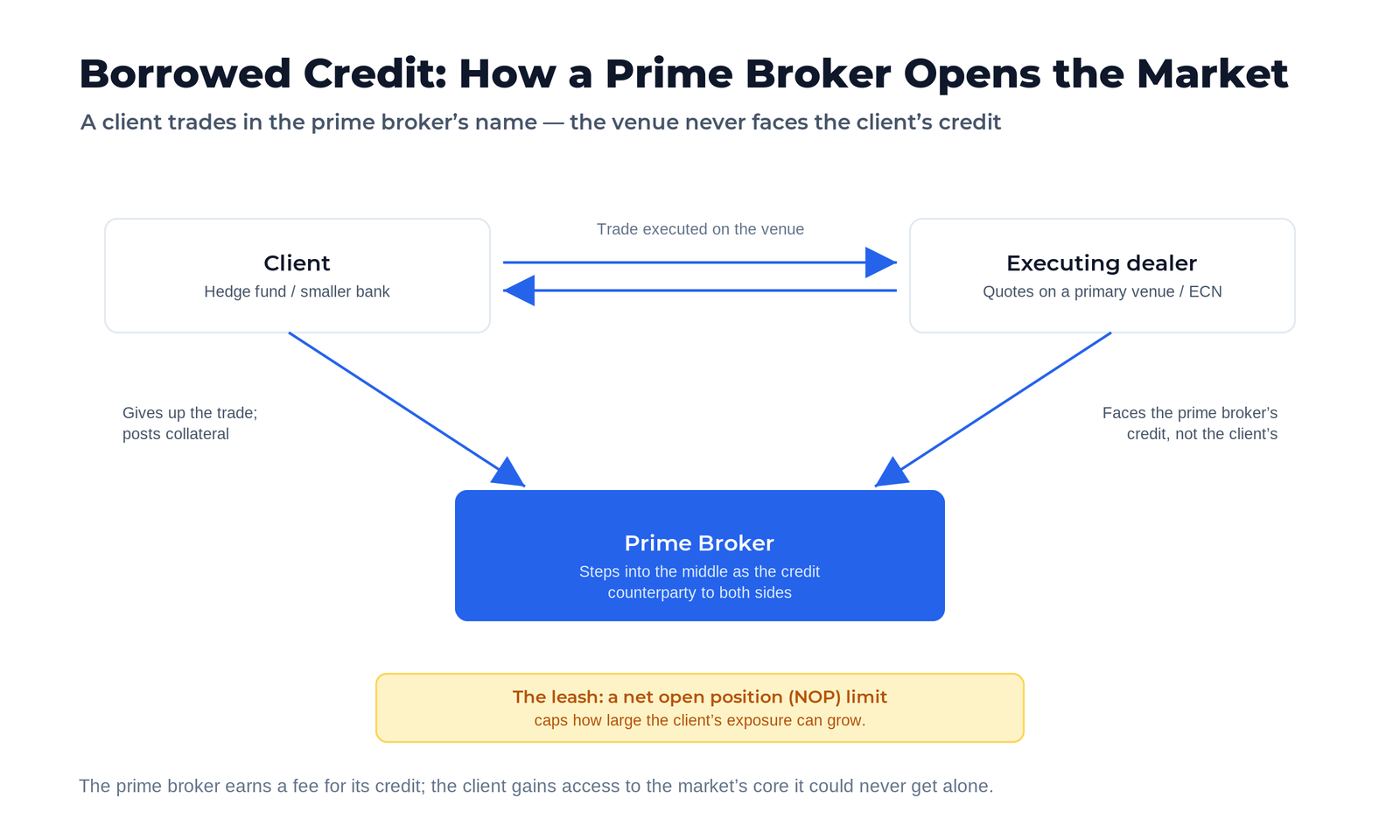
A prime broker is a large bank that lets a client trade in the prime broker’s name. The client executes on a primary venue or an electronic network as though it were the bank; the counterparties see and face the prime broker’s credit, not the client’s. Behind the scenes, the client has posted collateral and the trade is “given up” to the prime broker, which steps into the middle as the credit counterparty to both sides. Its role breaks down into three core functions:
- Credit intermediation — the client reaches tier-1 liquidity across many dealers and venues without needing a separate bilateral credit line with each one.
- Netting and settlement — the prime broker nets the client’s positions across venues and counterparties and manages the settlement, typically through CLS-linked processes (the payment-versus-paymentGlossaryPayment-Versus-PaymentA settlement mechanism in which the final transfer of one currency takes place if and only if the final transfer of the other currency also takes place, so the two legs of a trade settle simultaneously or not at all.Full entry → plumbing covered in the settlement article).
- Risk control — it sets limits per client, venue, and instrument, and can throttle or cut access if those limits are breached or the flow sours.
This single mechanism is what allowed non-bank firms to become serious FX market makers. It is also what made the buy-side’s electronic ambitions possible: by the 2013 survey, prime-brokered activity accounted for roughly 23% of UK and US volume — and about 38% of spot — concentrated in exactly the venues that had once been dealer-only. The prime broker controls the tap. It sets a net open positionGlossaryNet Open PositionA firm's aggregate open exposure in a currency or across currencies, reflecting the net of all long and short positions.Full entry → limit, capping how large a client’s aggregate exposure can grow, and can widen or withdraw access if a client’s risk profile sours. Borrowed credit comes with a borrowed leash.
One trend runs the other way. An asset manager big enough to command top-tier pricing may build direct bilateral connections to its liquidity providers under standard ISDA agreements, trading on an agency basis and avoiding the prime broker’s credit-intermediation cost altogether. Prime brokerage opened the market; for the very largest players, scale now offers an alternative to it.
Prime-of-Prime and the Path to Retail Access
If prime brokerage is the gateway to the core, it is a gateway with a high turnstile. After the Swiss National Bank abandoned its euro–franc floor in January 2015 — an event we return to below — large prime brokers grew markedly more cautious, pricing capital costs more aggressively and concentrating risk in fewer, larger relationships. The balance-sheet and operational thresholds for a direct tier-1 prime-brokerage relationship rose out of reach for most smaller funds and brokers.
That gap is filled by the prime-of-prime (PoP) firm. A prime-of-prime sits on top of one or more tier-1 prime brokers and redistributes that access downstream, aggregating liquidity from bank and non-bank providers and passing it to clients who could never clear a tier-1 bank’s bar on their own. The trade-off is straightforward: lower capital thresholds and smaller ticket sizes in exchange for another intermediary in the chain. In the library’s older vocabulary this was simply “a broker of a broker,” and the structure long predates the modern label.
This is also the layer where retail flow enters. A retail margin broker rarely faces the interbank market directly; it reaches liquidity through a prime-of-prime or aggregator, and its own ability to grow is capped by the net-open-position limit its prime broker grants. How a broker then handles the flow it takes on defines its business model:
- Agency, or “A-bookGlossaryA-BookBroker execution in which client trades are passed through to the wider market or to liquidity providers, the broker earning a spread or fee rather than holding the other side.Full entry →“ — the broker passes the client’s risk straight through to a liquidity providerGlossaryLiquidity ProviderA bank or non-bank firm that streams executable prices into the market, supplying the liquidity that brokers and clients trade against.Full entry → and earns a margin on the spread, taking no market position of its own.
- Principal, or “B-bookGlossaryB-BookBroker execution in which the broker takes the other side of a client's trade onto its own book rather than passing it to the market, profiting or losing as the client's positions move.Full entry →“ — the broker takes the other side of the client’s trade and warehouses the risk, becoming the client’s direct counterparty rather than a conduit.
Neither model is inherently good or bad; both are standard, and many brokers run a mix, warehousing some flow and hedging the rest. The point for an educated reader is structural awareness: the price you see at the retail edge has usually passed through an aggregator, a prime-of-prime, and a prime broker before it ever touches the spine — and each link shapes the spread, the fill, and what happens under stress.
Electronic Networks and the Logic of Streaming Liquidity
The order-book venues at the core were built for dealers. The wider electronic market grew up around a different model: the electronic communication network, or ECNGlossaryECNAn electronic communication network is a venue that matches buy and sell orders from many participants anonymously, displaying aggregated prices in a central order book.Full entry →. An ECN is a computer system that lets participants trade directly and anonymously away from a traditional exchange, posting and hitting prices inside, at, or outside the prevailing spread. In FX, ECNs were the doorway through which non-bank market makers and smaller institutions entered, almost always through a prime broker or prime-of-prime.
The reason ECNs mattered so much is bound up with how machines trade. An algorithm cannot work with a request-for-quote (RFQ) conversation, where a client asks several banks for a price and waits for replies; it needs continuous, executable streaming bids and offers it can react to in microseconds. ECNs provided exactly that. Once several venues were streaming prices, a trader could aggregate them into a single composite view — a “montage” of the best bids and offers across all of them — and a smart order router could sweep the top of book, taking liquidity from whichever venue showed the best price first.
Not all electronic venues work the same way. Broadly they fall into three families:
- Primary CLOBs (the EBS and LSEG order books) — firm, order-driven, used mainly by dealers and top-tier market makers.
- Secondary multi-dealer ECNs — a mix of anonymous order books, streaming quotes, and disclosed RFQ, serving banks, non-banks, and the buy-side.
- Execution-only venues — they match trades but provide no credit, so participants must bring their own prime brokerage or sponsored access.
AggregationGlossaryAggregationCombining price streams from several liquidity providers into a single consolidated view of the best available bid and ask.Full entry → and sweeping are powerful, but they create a subtle trap that the rest of this story turns on. When a client sweeps many venues at once, a price maker on each venue sees only its own slice of a much larger order. And when a maker is slightly slow to update a quote after the spine has moved, a fast counterparty can pick it off at a stale price before it can react — a form of latency arbitrageGlossaryLatency ArbitrageProfiting from small delays in price dissemination by acting on a stale quote before it updates, typically using fast raw data feeds and co-located systems.Full entry →. The faster and more fragmented the market became, the more exposed price makers were to being traded against on prices that were already out of date.
Managed Pools and the Mirage of Liquidity
Beyond the primary CLOBs sits a second tier of venues that look like exchanges but are not: managed liquidity pools such as the networks that grew out of Hotspot, Currenex, and FastMatch. These curate who sees what, matching takers to makers under flexible rules rather than a single transparent order book, so two participants on the same venue may be shown different liquidity. Crucially, every price in these pools is still derived from the same primary spine. They redistribute the core’s liquidity; they do not create new liquidity of their own.
This is the source of one of the most important — and least intuitive — facts about modern FX: most of the liquidity you can see is the same liquidity, shown many times. A study of liquidity-provider data found that roughly 80% of primary volume was supplied by about 20% of providers — on the order of five firms. Everyone else is, to varying degrees, recycling: sourcing a price from a genuine maker and re-displaying it. Multiply a handful of real makers across a dozen secondary venues, several stream types, and two or three regions, and you can manufacture well over a thousand apparent liquidity streams — all hinged on the same boundary price. Analysts call this the mirage of liquidity: depth that looks abundant until everyone tries to trade the same way at once, at which point it evaporates back to its few true sources.
For anyone trying to execute a large order well, this changes the goal. The aim is not to spray an order across as many venues as possible — that merely leaks information to the same few makers seen from different angles, who then widen their prices. The aim is to find counterparties with large internal books that can absorb the trade without pushing it back out onto the spine. Quality of liquidity, not quantity of venues, is what protects an execution.
How a Trade Travels Through the Layers
Put the layers together and you can trace the path a single institutional order takes — a journey hidden entirely behind a clean execution screen. Imagine a systematic fund selling euros against dollars:
- The fund’s execution system is connected to several ECNs and streaming venues, and its prime broker has granted it credit limits on each.
- The order is routed to one or more venues, where it meets prices streamed by liquidity providers — banks and non-bank market makers.
- A provider receives the order against its quote and may apply a brief last-look check before accepting; it then internalizes the risk against other client flow or hedges the residual back toward the interbank core.
- The fill is given up to the prime broker, which aggregates the fund’s positions across every venue it has touched.
- At day’s end the prime broker nets the positions and settles them, typically through CLS-linked payment-versus-payment.
Each link adds a constraint, a risk control, and a potential cost. It also explains the things that puzzle newcomers: why liquidity can vanish in seconds during a shock, why an order is sometimes rejected and re-priced, why slippageGlossarySlippageThe difference between the price a trader expects and the price at which an order is actually executed, arising when the market moves during the time it takes to route and fill the order.Full entry → appears on a “tight” quote, and why a margin callGlossaryMargin CallA demand for additional collateral when the value of a position moves against a trader and existing margin falls below the required level.Full entry → can arrive from a layer the trader never sees. The interface shows one price and one click; underneath runs the whole stack.
Last Look: The Price Maker’s Final Check
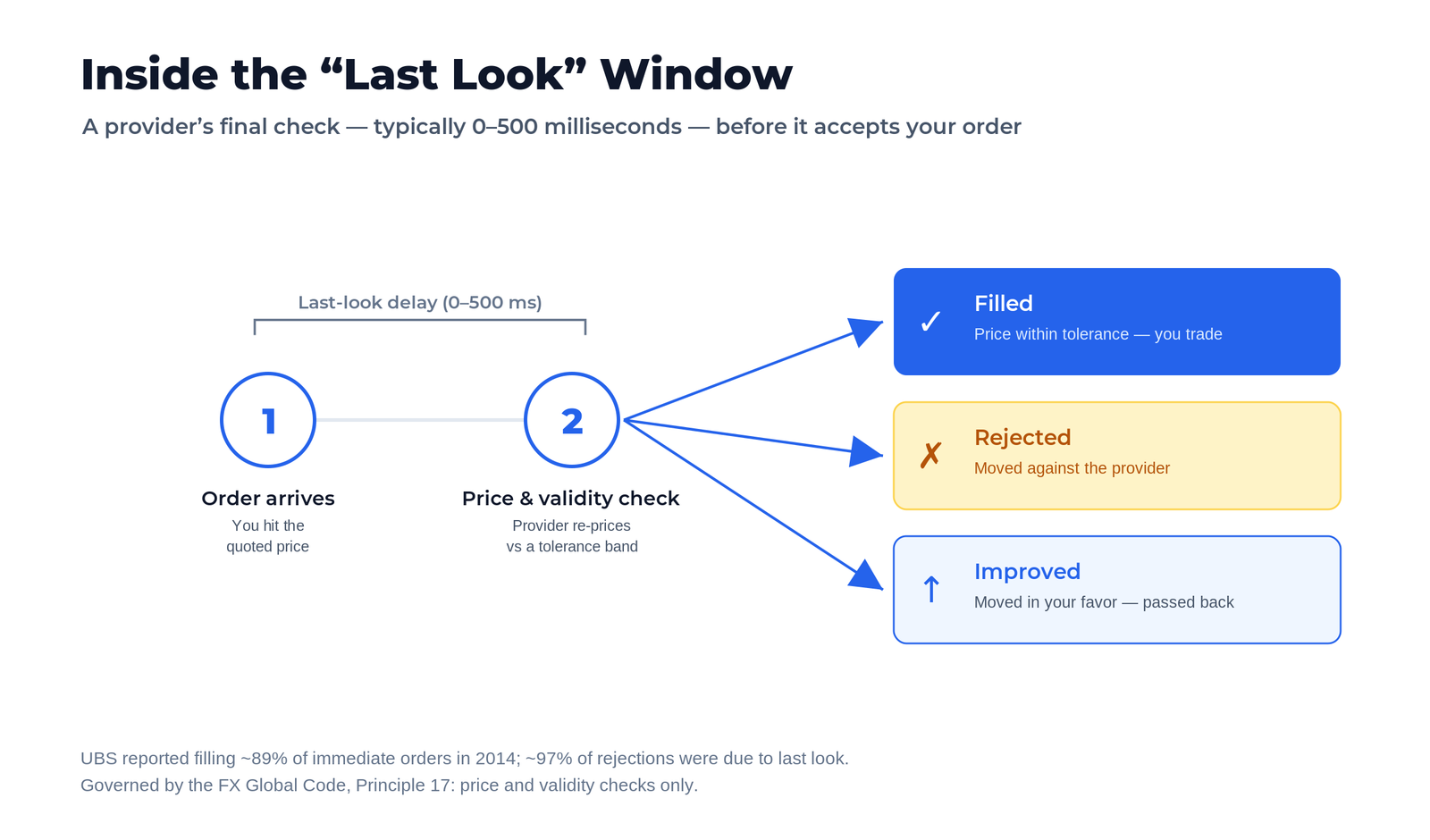
All of which brings us to the most contested mechanism in electronic FX. When a liquidity provider streams a price to thousands of clients at once, it faces a real danger: by the time a client’s order to trade arrives, the market may have moved, and the provider would be filling at a price that no longer exists. Last look is the provider’s answer. It is a brief, final check — a window of typically a few hundred milliseconds — during which the provider re-examines the market before deciding whether to accept or reject an order at its own quoted price. It belongs to quote-driven streams; it is not permitted on the firm central order books at the core.
The clearest public account of how this works comes from a 2016 disclosure by UBS, written after the FX-fixing scandal pushed dealers to explain themselves. An incoming order is queued for a last-look delay of between zero and 500 milliseconds. The provider sets a price tolerance for each client — a band, expressed as a fraction of the client’s spread, within which a move is tolerated. After the delay, the provider recalculates its price and compares it to the quoted one. For ordinary quoted orders the tolerance is symmetric: if the price has not moved beyond the band, the client is filled; if it has moved against the provider beyond the band, the order is rejected; and — this is the part critics often overlook — if it has moved in the client’s favor beyond the band, the improvement is passed back to the client. For limit orders the firm applied an asymmetric tolerance deliberately tilted toward the client, passing on all favorable moves.
The numbers from that disclosure show the practice’s real footprint. Across 2014, UBS reported filling about 89% of immediate orders, and roughly 97% of the orders it rejected were rejected because of last look. Fill rates varied sharply by how the client connected — higher through single-dealer platforms, lower through third-party aggregators where sweeping and latency arbitrage were most intense.
Toxic Flow and Why Fills Depend on Footprint
Last look does not operate in isolation; it is one lever in how liquidity providers sort the flow they receive. The industry’s blunt term for the flow it wants to avoid is toxic flowGlossaryToxic FlowTrading that predictably costs the market maker who fills it more than the spread earns, usually because prices move against the maker immediately after each fill.Full entry → — trading that systematically profits at the provider’s expense, usually because the counterparty is faster or better informed and tends to deal just before the price moves against the maker. Its opposite, “benign” flow, does not consistently run the provider over.
Providers and prime brokers tag and monitor flow by source, strategy, and venue, and they respond to what they observe. A counterparty whose trades carry little market impact tends to be rewarded with tighter spreads, higher fill rates, and shorter last-look delays; flow that looks toxic may be met with wider spreads, more rejections, or, in the extreme, removed altogether. In the retail world the same logic drives the warehousing decision: a broker analyzing which clients win and which lose can choose to internalize the losing flow rather than pay it away to a liquidity provider.
The lesson is not a tactic but a piece of literacy: in FX, the price and fill you receive depend not only on the headline terms of a venue but on how your own trading pattern is perceived by the firms on the other side. Execution quality is partly a function of footprint.
Firm Versus Last-Look Liquidity
Step back and the market offers two broad kinds of liquidity, and the choice between them is a trade-off between price certainty and spread. Firm liquidity is binding the instant you take it; last-look liquidity is cheaper on average but can be turned away. They sit at opposite ends of a spectrum that sophisticated users blend rather than choose between.
| Dimension | Firm liquidity | Last-look liquidity |
|---|---|---|
| Quote nature | Binding once hit; no take-back | Held briefly; can be accepted or rejected |
| Typical home | Primary CLOBs, some all-to-all ECNs | Many single-dealer streams, secondary ECNs, prime-of-prime feeds |
| Spread | Often wider, to compensate for fill risk | Often tighter for most flow |
| Fill certainty | High; rejection is rare | Lower; rejections and slippage possible |
| How the maker manages risk | Through spread, skew, and size limits | Through last look, plus spread and throttles |
| Transparency the client needs | Lower — behavior is simpler | Higher — to confirm last look is used fairly |
The reason both survive is that they suit different needs. Time-sensitive or benchmarked trades value the certainty of firm liquidity; lower-urgency flow can capture the tighter spreads of last-look streams, provided the rejections stay reasonable. Neither is “better” in the abstract — they are points on a curve.
Is Last Look Fair?
Last look sits on a genuine fault line, and the honest answer is that it is neither simply fair nor simply abusive — it depends entirely on how it is used. The providers’ case rests on three arguments:
- Tighter spreads for the many. Rejecting the small fraction of orders carrying the highest adverse market impact lets a provider quote tighter on everything else; a client can, in effect, choose a point on a trade-off between fill probability and spread.
- Pricing through chaos. When the Swiss National Bank abandoned its euro–franc floor in January 2015, prices gapped hundreds of points in milliseconds; a provider streaming the same quote to thousands of clients at once could be buried under one-directional flow, and without a final check it would simply stop quoting.
- A defense against latency arbitrage. The check guards against the picking-off of stale quotes that price aggregation makes possible.
The objection is equally clear. A last-look window is a free option for the price maker, exercised after the client has committed. If a provider applies tolerance asymmetrically — rejecting moves against itself while keeping moves in its favor — clients lose on both sides. Worse, the window is a span of time during which the provider has seen the client’s intention but has not yet dealt, which creates the temptation to trade on that information first.
This is where the market’s voluntary rulebook comes in. The FX Global CodeGlossaryFX Global CodeA voluntary set of global principles of good practice for the wholesale foreign exchange market, maintained by the Global Foreign Exchange Committee.Full entry →, first published in 2017 and most recently updated in January 2025, addresses last look directly in its Principle 17. The Code’s position is that last look should be used only for price and validity checks — confirming the price is still good and the trade is one the provider can settle — and for no other purpose. In particular, a participant should not use information from the client’s trade request to trade during the last-look window. The Code is not law; it has no statutory force and works through public statements of commitment. But it has become the reference standard against which conduct is judged, and it has pushed the worst versions of the practice toward the margins.
The Bottom Line
The single-pool picture of FX is not just a simplification; it hides the very things that determine the price you get. The market is a hierarchy: a thin core of primary order books where a handful of makers set the spine, a credit layer of prime brokers and prime-of-prime firms deciding who may reach that core, a web of electronic networks and managed pools that redistribute the same liquidity many times over, and — woven through all of it — pricing mechanics like internalization, last look, and flow segmentation that govern whether your order is filled, improved, or quietly turned away.
None of this is a reason for suspicion so much as a reason for literacy. The same structure that enables a free option like last look also makes possible the tight, deep, around-the-clock liquidity that lets a corporation hedge a payment or a fund rebalance a portfolio in seconds. The point of understanding the plumbing is not to distrust the tap, but to know which layer you are drinking from. Someone who grasps that an FX quote is a primary-venue price, adjusted for credit, recycled across venues, and subject to a final check, understands something that the click-and-it’s-done picture can never show — and that is the difference between using the market and reading it.
Further reading: Bank for International Settlements, “Triennial Central Bank Survey: OTC foreign exchange turnover in April 2025” and Rime & Schrimpf, “The anatomy of the global FX market” (BIS Quarterly Review, December 2013); UBS, “Liquidity and Transparency for Electronic Spot FX” (2016); Goldman Sachs and Morgan Stanley spot FX terms-of-dealing disclosures (2015–16); J.P. Morgan Asset Management, “FX Trading: Broker Panel” (2024); CitiFX, “State of the Retail Foreign Exchange Market” (2014); Global Foreign Exchange Committee, “FX Global Code” (updated January 2025), Principle 17 on last look. Previously in this series: How a Spot FX Trade Really Works, What is Spot?, and What is Money?
The Currency Stack provides educational and research content only. Nothing here is financial, investment, or trading advice, or a recommendation to buy or sell any asset. Markets carry risk; do your own research and consider professional advice before acting.