FX Instruments: The Complete Map — Spot, Forwards, Swaps, Options, Futures
People talk about "trading currencies" as if it were one activity. It is at least seven. Spot, forwards, FX swaps, currency swaps, options, futures and NDFs are different contracts with different rules about when money moves and whether you are obliged to go through with it — and the biggest of them is the one almost nobody outside the industry has heard of. Here is the whole map.
The Currency Stack 18 August 2026 18 min read
Contents · 12 sections
- What They All Have in Common
- Spot: The Price Everyone Quotes
- Outright Forwards: Fixing a Rate for Later
- Spot Is Just the Most Liquid Forward
- FX Swaps: The Biggest Instrument in the Market
- Currency Swaps: The One With the Confusing Name
- Options: Paying for the Right to Change Your Mind
- Futures: The Exchange-Traded Cousin
- Non-Deliverable Forwards: When You Cannot Move the Currency
- Telling Them Apart
- Which Ones Actually Matter to You
- The Bottom Line
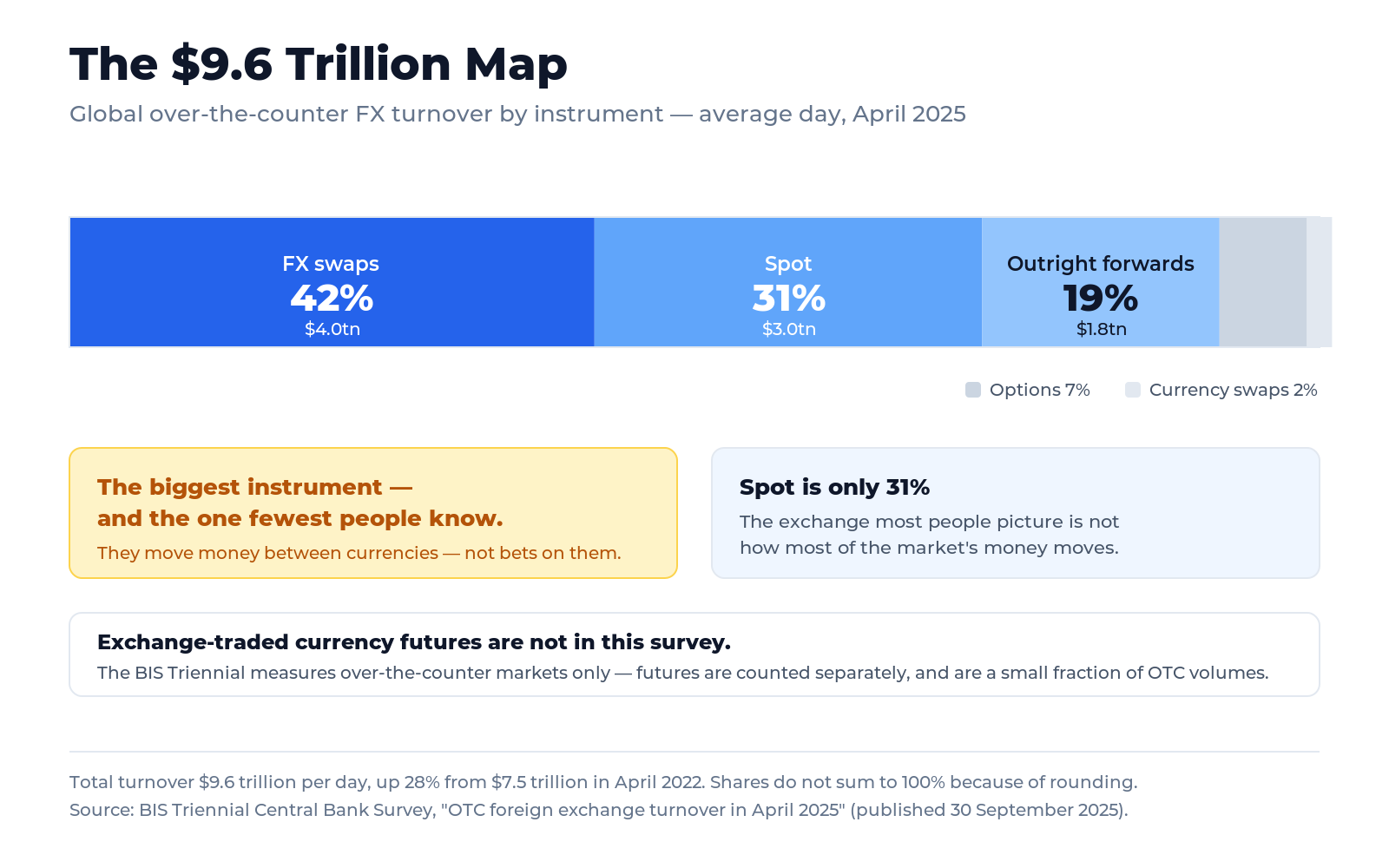
- The foreign exchange market is not one market but several instruments, and they are wildly unequal: FX swaps are 42% of turnover, spot is 31%, outright forwards 19%, options 7%, and currency swaps about 2% (BIS Triennial Survey, April 2025).
- Spot is the simple one — an exchange at today’s price, settling in two business days. It is the price you see quoted everywhere, and every other instrument is built on top of it. It is also, strictly, a future date: spot is best understood as the most liquid tenor on a continuous curve of value dates, not a separate category from forwards.
- Forwards and FX swaps are about time. A forward fixes a rate for a single future date; an FX swap bundles two exchanges in opposite directions, and exists mostly to move money between currencies for a while without taking a view on the rate.
- A currency swap is a different instrument despite the name — it exchanges principal and interest payments over years, and is how a company borrows cheaply in one currency and services the debt in another.
- Options are the only instrument that gives you a right rather than an obligation, which is why they normally cost a premium up front. Structures marketed as “zero cost” do exist — they do not remove the cost, they move it from cash into forfeited upside or accepted risk. Options turnover more than doubled between 2022 and 2025.
- Futures are the odd one out: exchange-traded, standardized, and margined daily rather than negotiated privately — and they are not even counted in the $9.6 trillion, because that figure measures the over-the-counter market only.
What are the main FX instruments?
Spot, outright forwards, FX swaps, currency swaps, and options trade over the counter; currency futures trade on exchanges. Non-deliverable forwards are a variant of the forward used where a currency cannot be freely delivered.
Which FX instrument is traded most?
The FX swap, at roughly $4 trillion a day — about 42% of all foreign exchange turnover. Spot, the one most people picture, is second at around $3 trillion.
What is the difference between a forward and a swap?
A forward is one exchange on one future date. An FX swap is two exchanges in opposite directions — money out now, money back later — so it moves currency temporarily rather than changing what you own.
What is the difference between a forward and a future?
Economically they do much the same job. A forward is a private contract negotiated to fit your exact amount and date; a future is a standardized contract traded on an exchange, cleared centrally and settled in cash daily.
Can you get an FX option without paying a premium?
Yes — structures like collars and participating forwards fund the option you want by selling one back to the bank, and are marketed as “zero cost.” No cash changes hands, but the cost has moved rather than disappeared: usually into a capped upside or a barrier.
Is spot really different from a forward?
Less than the usual explanation suggests. Spot settles two business days out, so it is a future date too. It is better understood as the most liquid tenor on a continuous curve of value dates — and the point from which every other date is priced.
Do I need to understand all of these?
No. Most people only ever touch spot. The rest of the map is worth knowing because it explains where the market’s real volume sits and why the price you see behaves the way it does.
Ask most people what happens in the currency market and they will describe one thing: someone swaps one currency for another at whatever the rate is today. That does happen. It is also less than a third of what the market actually does.
In April 2025, global over-the-counter foreign exchange turnover averaged $9.6 trillion a day, up 28% from three years earlier (Bank for International Settlements, Triennial Central Bank Survey, published September 2025). The survey splits that money across five kinds of contract, and they are nothing like equal in size. The instrument most people picture — a straightforward exchange at today’s price — accounted for 31% of it. The largest single instrument, at 42%, is one that most people outside the industry have never heard of.
This article is the map. It covers those five, plus two that sit outside the survey but belong on any honest chart of the market: exchange-traded currency futures, and the non-deliverable forwards used where a currency cannot legally leave the country. For each, the aim is what it is, what problem it solves, and how to tell it apart from its neighbors.
Every instrument here has, or will have, its own detailed guide on The Currency Stack — linked where it exists, flagged where it is still to come. This piece is the overview that connects them, not a substitute for any of them.
What They All Have in Common
Before the differences, the thing that unites them. Every FX instrument is a contract to exchange one currency for another at an agreed rate. That is the whole family resemblance.
What separates them comes down to three questions:
When does the money actually move? Today, in two days, in three months, or never at all?
Are you obliged to go through with it? Every instrument except the option is a binding commitment. An option is a right you may simply decline to use.
Who stands behind the contract? Most FX is traded over the counterGlossaryOver-the-CounterTrading conducted directly between two parties rather than on a centralized exchange, abbreviated OTC. The FX and bullion markets are predominantly over-the-counter, offering flexibility in size, terms, and value dates.Full entry → — bilaterally, between two named parties who each carry the risk that the other fails to deliver. Futures are the exception: they trade on an exchange, and a clearing house steps into the middle of every trade.
Hold those three questions in mind and the rest of the map reads itself.
Spot: The Price Everyone Quotes
Turnover: about $3 trillion a day, 31% of the market.
A spot trade is an agreement to exchange two currencies at today’s rate, with the money changing hands almost immediately — for most currency pairs, two business days later, a convention written as T+2GlossaryValue DateThe date on which the two currencies (or other assets) in a transaction are actually exchanged and settled, as distinct from the trade date on which the deal is agreed.Full entry →.
That two-day gap is a leftover from the days of telex confirmations, and it survived because the plumbing behind it still needs the time. Not every pair follows it: USD/CAD settles the next business day. It is also possible to deal for value today or value tomorrow instead — hold that thought, because it matters more than it sounds.
Spot matters out of proportion to its 31% share, because it is the reference price on which every other instrument is built. A forward rate is the spot rate adjusted for interest rates. An option’s value depends on where spot is now and where it might go. When you read that “the euro fell today,” you are reading the spot market.
The mechanics are in What is Spot?, and a single trade is followed from execution to settlement in How a Spot FX Trade Really Works.
Outright Forwards: Fixing a Rate for Later
Turnover: about $1.8 trillion a day, 19% of the market — and the fastest-growing instrument in the 2025 survey, up 60%.
A forward is a spot trade with the settlement date pushed out. You agree today on a rate and an amount, and the exchange happens on an agreed future date — a month, six months, a year from now. Nothing moves in the meantime.
The reason they exist is straightforward. A manufacturer owing a supplier €5 million in ninety days has a problem that has nothing to do with manufacturing: if the euro strengthens, the bill grows. A forward fixes the rate now. The company has not made or lost money on the currency — it has stopped caring what the rate does, which is the entire point.
The part that trips people up is the rate itself. A three-month forward is almost never the same as spot, and the difference — the forward pointsGlossaryForward PointsThe amount added to or subtracted from the spot rate to arrive at a forward exchange rate, quoted in pips.Full entry → — is not a prediction. It is the interest rate difference between the two currencies over that period, held in place by arbitrage. So the misconception worth shedding immediately: a forward showing the dollar weaker in six months is not the market forecasting a weaker dollar. It is telling you dollar interest rates are higher.
Forwards get their own guide, and forward points a separate oneMembers’ guideForward Points: Why Forwards Aren’t a ForecastRead the guide → after that, because the arithmetic rewards a slower walk than a map can give it. Both are in the works.
Spot Is Just the Most Liquid Forward
Here is a way of seeing this that you will not often find in textbooks, and that makes considerably more sense once you have met both instruments.
We described spot as “today’s price” and a forward as “a price for later.” That is the conventional split, and on inspection it is not true — because spot settles in the future as well. T+2 is two business days from now. Nothing about it is immediate.
Once you notice that, the boundary between the two categories dissolves. What actually exists is a single continuous line of value dates:
- Value today — settles the same day
- Value tomorrow — settles the next business day
- Spot — two business days out, for most pairs
- One week, one month, three months, one year — the forward dates
Every one of those is the same kind of contract: an agreement to exchange two currencies on a date. The only point on the line that is not in the future is value today. On that reading, spot is not a different instrument from a forward — it is one particular tenor on a continuous curve, and what makes it feel special is that it is overwhelmingly the most liquid point and the one the market has agreed to quote from.
Nor is the convention universal, which is the clearest evidence that it is a convention rather than a category: USD/CAD settles the next business day, and a handful of pairs settle same day. “Spot” means whatever each market has agreed is standard for that pair.
What genuinely distinguishes spot, then, is not its date but its role. It is the point on the curve from which every other date is priced. A one-month forward is spot plus a month of interest-rate differential; value tomorrow is spot minus a day of it. The differential is measured outward from spot in both directions, which makes spot the anchor of the curve rather than merely its busiest point.
This detour earns its place twice over. It disposes of the forward-as-forecast idea more thoroughly than any warning can: if a forward is just spot slid along a dated curve by an interest differential, there is no room in it for an opinion about the currency. And it makes the largest instrument in the market immediately intelligible — because once you can see the curve, an FX swap is simply the trade of two points on it at once.
FX Swaps: The Biggest Instrument in the Market
Turnover: about $4 trillion a day, 42% of the market — the most traded FX instrument in the world.
Here is the one that surprises people. The largest instrument in the largest financial market is not spot — it is the FX swap, and it solves a problem most retail traders never have.
An FX swap is two exchanges in one contract, running in opposite directions — in the language of the previous section, two points on the value-date curve traded at once. You exchange currencies on the near date and agree simultaneously to reverse that exchange later at a rate fixed today. Money goes out, money comes back.
The effect is that you have borrowed one currency and lent another for a defined period without ever taking a view on the exchange rate. Both legs are agreed at the outset, so the spot rate can do whatever it likes in between and your principal is unaffected. What you are exposed to is the interest rate differential, not the currency.
That is why banks and corporate treasurers use swaps constantly — to fund a position in a currency they do not hold, to move cash across currencies for a few days, to roll an existing forward. It is a funding tool wearing an FX costume, and it is the reason the market’s headline turnover is so enormous relative to actual international trade. Its share is falling, incidentally, from 51% in 2022 to 42% in 2025, not because swap volumes shrank but because everything else grew faster.
The full treatment is in What Is an FX Swap? The Biggest Instrument in the Biggest Market.
Currency Swaps: The One With the Confusing Name
Turnover: about 2% of the market.
The instrument most often mistaken for an FX swap is the currency swap, and the two are genuinely different animals that happen to share most of a name. Getting them mixed up is the single most common vocabulary error in this corner of the market, so it is worth separating them properly.
An FX swap, as we just saw, is two exchanges of principal and nothing else. No interest changes hands. It typically runs for days or weeks, and it lives on a bank’s funding desk.
A currency swap exchanges principal and a stream of interest payments, in two different currencies, usually over years rather than days. You swap principal at the start, pay interest in one currency while receiving it in the other for the life of the deal, and swap the principal back at maturity. It is not a funding trick; it is a way of changing the currency of a long-term liability.
The classic use is a company that can borrow most cheaply in one currency but earns its revenue in another. A European firm might find the deepest, cheapest market for its bond is in dollars — but it has no dollar income to service that debt. A currency swap converts the whole obligation, principal and coupons together, into euros. The company gets the cheap funding without inheriting a decade of currency risk.
Its 2% share of daily turnover understates its importance. These are long-dated contracts: they are struck once and then sit outstanding for years rather than being traded and re-traded, so they generate little daily volume relative to how much of the world’s cross-border debt they quietly restructure. The pricing of that market — the cross-currency basisGlossaryCross-Currency BasisThe persistent gap between the forward price implied by covered interest parity and the price actually quoted in the FX swap market.Full entry → — is where a great deal of the plumbing of the global dollar system becomes visible, and it gets its own guide.

Options: Paying for the Right to Change Your Mind
Turnover: 7% of the market — and more than double its 2022 level, the fastest-growing instrument by proportion.
Every instrument so far is a commitment: whatever the rate does, both sides must deliver. An option breaks that symmetry. It gives the buyer the right, but not the obligation, to exchange currencies at an agreed rate. If the market moves in their favor they let it lapse and deal at the better rate; if it moves against them they exercise.
That is obviously a better deal than a forward, which is why it is not free. The buyer pays a premiumGlossaryPremiumThe condition in which a currency's forward rate is more favorable than its spot rate, so that forward points are added to spot.Full entry → up front, and that premium is the price of optionality. A forward costs nothing to enter but binds you; an option costs money and leaves you free. Neither is the “right” answer.
One qualification, because it is widely misunderstood: a structure can be arranged so that no premium is paid at all — you fund the protection you want by selling an option back to the bank. Collars and participating forwards work this way, and they are marketed as “zero cost.” The premium genuinely is zero. The cost is not: it has moved out of cash and into a capped upside, or a barrier that can remove your protection when you most need it. A dedicated options guide, coming shortly, takes these structures apart properly — including what each one actually costs you when it is not costing you cash.
Two pieces of vocabulary carry most of the weight. A call is the right to buy a currency; a put is the right to sell it. And what drives the price is volatility — how much the market expects the rate to move — which is why option traders describe themselves as trading volatility rather than currencies.
That options turnover doubled between 2022 and 2025 is worth noticing: it is consistent with a period in which participants were paying up for protection against large moves rather than simply fixing a rate and hoping.
Futures: The Exchange-Traded Cousin
Currency futures do roughly the same economic job as a forward — fix a rate for a future date — but they live in a different world. A forward is negotiated privately: any amount, any date, with each side carrying the other’s credit risk. A future is standardized: fixed contract sizes and fixed expiry dates, take it or leave it. You cannot have a future for €4,317,000 maturing on the third Tuesday of next month.
What you get for that rigidity is a clearing house that steps in as counterparty to both sides, so you are not relying on a stranger’s creditworthiness, and positions marked to market dailyGlossaryMark-to-MarketThe practice of revaluing a position at current market prices to determine its present worth and any unrealized profit or loss.Full entry → against a margin deposit rather than accumulating until maturity.
One point of housekeeping that trips up anyone comparing figures: the $9.6 trillion quoted throughout this article does not include currency futures at all. The BIS survey measures over-the-counter markets; exchange-traded futures are counted separately, and are a small fraction of OTC volumes.
Futures versus forwards is a subject in its own right, and a forthcoming guide takes it further than a map can.
Non-Deliverable Forwards: When You Cannot Move the Currency
One variant earns a place on the map because it is the standard tool for a whole category of currencies.
Some currencies cannot be freely moved across borders, because their governments restrict it — so a forward in them cannot be settled by delivery. The market’s answer is the non-deliverable forwardGlossaryNDFA non-deliverable forward is a cash-settled forward contract used where physical delivery of a currency is restricted or not possible.Full entry →, or NDF: a forward that is never delivered. At maturity the agreed rate is compared with an official fixing rateGlossaryFixingAn official or market reference exchange rate published at a set time, used to settle contracts such as non-deliverable forwards and to value portfolios.Full entry →, and one party pays the other the difference in a freely traded currency, usually dollars.
Nobody ends up holding the restricted currency; they end up holding the profit or loss they would have made. That is how a meaningful share of emerging-market currency exposure gets priced and hedged. NDFs have their own guide coming — the fixing mechanism deserves more room than a map allows, because it is where the disputes happen.
Telling Them Apart
The distinctions matter more than the definitions, so here they are side by side:
| Instrument | Money moves | Obligation? | Traded where | Share of OTC turnover |
|---|---|---|---|---|
| Spot | Once, in ~2 business days | Binding | Over the counter | 31% |
| Outright forward | Once, on a future date | Binding | Over the counter | 19% |
| FX swap | Twice, opposite directions | Binding | Over the counter | 42% |
| Currency swap | Principal plus interest, over years | Binding | Over the counter | ~2% |
| Option | Only if exercised | Buyer’s choice | Over the counter | 7% |
| Currency future | Cash, daily, via margin | Binding | Exchange | Not in this survey |

Which Ones Actually Matter to You
This is a question about relevance, not about what anyone should do with their money.
If you are converting money — an overseas invoice, property abroad, sending money home — you are dealing in spot, and what will cost you most is not the instrument but the margin built into the rate you are quoted. That is a different subject, covered in Understanding FX SpreadsMembers’ guideUnderstanding FX Spreads: What the Bank Doesn’t Tell YouRead the guide →.
If you are running a business with foreign currency exposure, forwards are built for your problem, and options are the alternative when you want protection without giving up the upside.
If you are studying the market itself, the swap is the one to understand — 42% of the world’s largest market runs through it, and its behavior under stress is where the plumbing of the global dollar system becomes visible.
And if you are simply trying to make sense of the price on your screen: spot is the tail being wagged. The rate you watch sits underneath four trillion dollars a day of funding activity that has nothing to do with anyone’s opinion of the currency.
The Currency Stack provides educational and research content only. Nothing here is financial, investment, or trading advice, or a recommendation to buy or sell any asset or to use any instrument. Markets carry risk; do your own research and consider professional advice before acting.
The Bottom Line
The phrase “trading currencies” hides more than it reveals. There is no single act of trading currencies — there is a family of contracts that answer different questions, and the question each one answers is what determines its shape.Go deeper2 members’ guides take this furtherMembers get the full guides, plus daily market briefings.See membership
Spot answers what is it worth now. Forwards answer what will it cost me later. Swaps answer how do I hold this currency for a while without owning it. Options answer how much would certainty cost, and can I keep the upside. Futures answer how do I do this without trusting my counterparty.
Seen that way, the market’s strange proportions stop being strange. The instrument that dominates is not the one that expresses a view on currencies — it is the one that moves money between them. Most of the $9.6 trillion is not speculation about where the euro is going. It is the world’s financial plumbing, running.
Further reading: This is the map; the detail lives in the guides it points to. Start with the pillar What Is the FX Market and Why Does It Matter? for the market these instruments trade in, then What Is an FX Swap? for the 42%. For spot, see What is Spot? and How a Spot FX Trade Really Works; for what the quoted rate is costing you, Understanding FX Spreads; and for why spot moves at all, What Moves Currency Prices? Terms in bold are defined in our glossary. Sources: Bank for International Settlements, “OTC foreign exchange turnover in April 2025” (Triennial Central Bank Survey, published 30 September 2025) for all turnover figures and instrument shares; instrument definitions and conventions from ACI and dealer training material, CME currency futures documentation, and NDF product disclosure material.