Toxic Flow: Why Your Broker Cares Who You Are
- "Toxic flow" is an economic judgment, not a moral one: it is trading that predictably costs a market maker money faster than the spread can compensate — and every serious liquidity provider runs machinery to detect it.
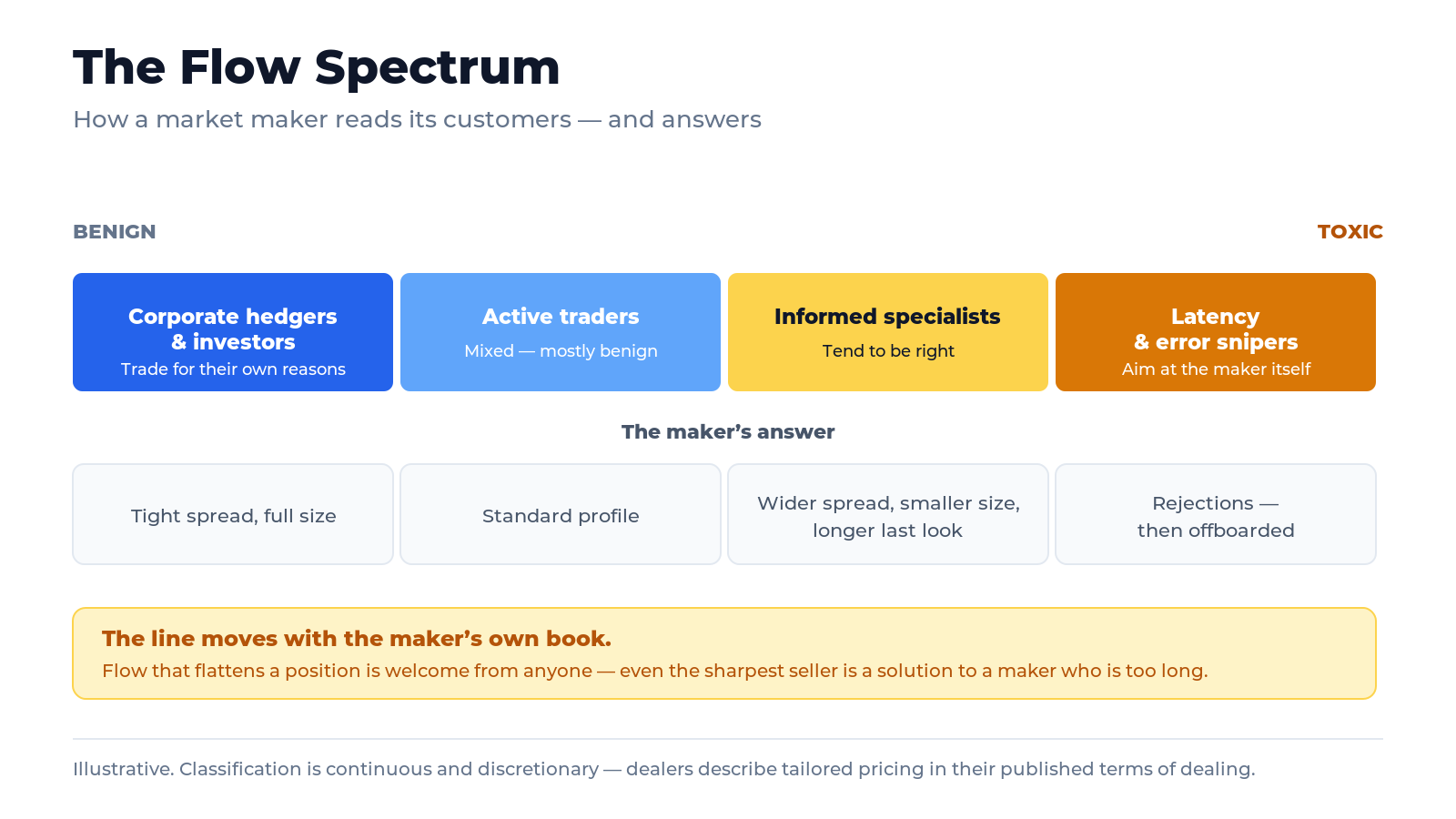
- There is no bright line. Toxicity is a sliding scale of tolerance, judged on two axes: how much the flow costs the maker, and whether the damage looks deliberate or accidental.
- The classic varieties are latency arbitrage (hitting stale quotes), sniping off-market rates from a misfiring pricing engine, sweeping the same duplicated liquidity across many venues at once, and simply knowing something the maker's price doesn't yet reflect.
- Dealers say openly, in their published terms, that they analyze your trading history and set your spread, your liquidity, and your last look settings accordingly. Your "price" is really a profile — and the maker's own inventory decides, moment to moment, what your flow is worth against it: even sharp flow is welcome when it flattens the book.
- The academic evidence agrees: on the dominant interdealer platform, the price impact of a trade varies measurably with who is trading — specialists and arbitrageurs move prices more than everyone else.
What is toxic flow?
Trading that systematically costs the market maker who fills it more than the spread earns — usually because the market keeps moving against the maker immediately after the trade.
Is toxic flow illegal?
Almost never. Most of it is legal trading that is simply faster or better informed than the price it hits. Exploiting a clearly erroneous price can breach a venue's rules, but the everyday forms are just sharp.
How does a dealer know my flow is toxic?
By measuring what the market does right after your trades — the mark-to-market test. If prices consistently run against the dealer after filling you, your flow is expensive to hold, and your profile changes.
What happens when I'm classified as toxic?
Wider spreads, smaller streamed size, longer last look delays, more rejections — and in the limit, the dealer stops quoting you altogether.
What is last look?
A market maker's final check between receiving your order and filling it: a brief pause in which the price is revalidated against a tolerance. It exists in large part because of toxic flow.
Does this affect ordinary retail traders?
Mostly indirectly. Retail-sized flow is rarely toxic, but the costs of defending against sharp flow are baked into everyone's spread — and a consistently sharp customer of any size will see their treatment change.
Is toxic flow bad for the market?
It is contested. It forces makers to defend themselves, which can widen spreads; it also forces pricing engines, feeds, and risk systems to get better. Both things are true at once.
A quick-read summary of the full article below.
Two customers send an identical order — buy one million euros against dollars — to the same dealer in the same second. One is filled instantly, at a price a tenth of a pip inside anyone else’s. The other gets a wider quote, or a pause, or a polite rejection. Nothing about the orders differs. The difference is the sender.
To understand why, you have to see the trade from the other side. A market maker who streams continuous two-way prices is running an open invitation: anyone with a connection may deal on the quoted price, in the quoted size, at any moment. The spread is the fee for that immediacy — and it is a thin one. In the wholesale market it might be a fraction of a pip, a return the maker only earns if it can offset the risk before the market moves. Whether that works depends almost entirely on who just dealt. Most customers trade for reasons that have nothing to do with the next thirty seconds of price action, and their business is comfortably profitable to fill. A small minority trade precisely because of the next thirty seconds — because they know, or can see, something the maker’s price does not yet reflect. Filling those trades loses money with mechanical reliability.
The industry’s name for that second kind of business is toxic flow — and the machinery built to find it, price it, and defend against it explains more about the modern FX market than almost any other single idea. It is why your spread is not the next customer’s spread. It is why “last look” exists. And it is why the most useful question a trader can ask is not “what is the price?” but “what does my counterparty think of me?”
What Toxic Flow Actually Is
Start with what it is not: a moral category. Nothing about toxic flow requires bad faith, and most of it is entirely legal. It is an economic category, defined from the market maker’s ledger: flow is toxic to the extent that filling it predictably costs more than the spread earns.
The standard way to see it is the mark-to-market test. Take every trade a customer does with you, and plot the market’s move against your position in the seconds and minutes afterward — one minute, two, four. For most customers the line wanders: sometimes the market drifts against you after their trades, sometimes in your favor, and on average the spread you charged covers the noise. For a certain kind of customer the line does not wander. It marches, immediately and consistently, against you. Every fill is followed by the market confirming that the customer was right and your price was wrong. In the language of market microstructure this is adverse selection — being systematically chosen against — and a market maker can read it off a chart.
What makes the concept slippery is that there is no bright line where sharp becomes toxic. Practitioners describe it as a sliding scale of tolerance, judged on two axes at once: the financial cost to the maker, and the intention behind it — whether the pattern looks like a deliberate strategy aimed at the maker’s weaknesses or an accident of how the customer happens to trade. A pension fund that occasionally deals just before a big move is unlucky or well-timed; a counterparty that only ever appears in the two hundred milliseconds when your quote has gone stale is running a strategy. The cost may even be similar. The classification — and the response — will not be.