What Moves Currency Prices? Rates, Risk, and Macro
- A currency’s exchange rate is just a price, and like any price it is set by supply and demand — the real question is what shifts that balance.
- Three broad forces move FX: risk sentiment, interest rate differentials, and macroeconomic fundamentals.
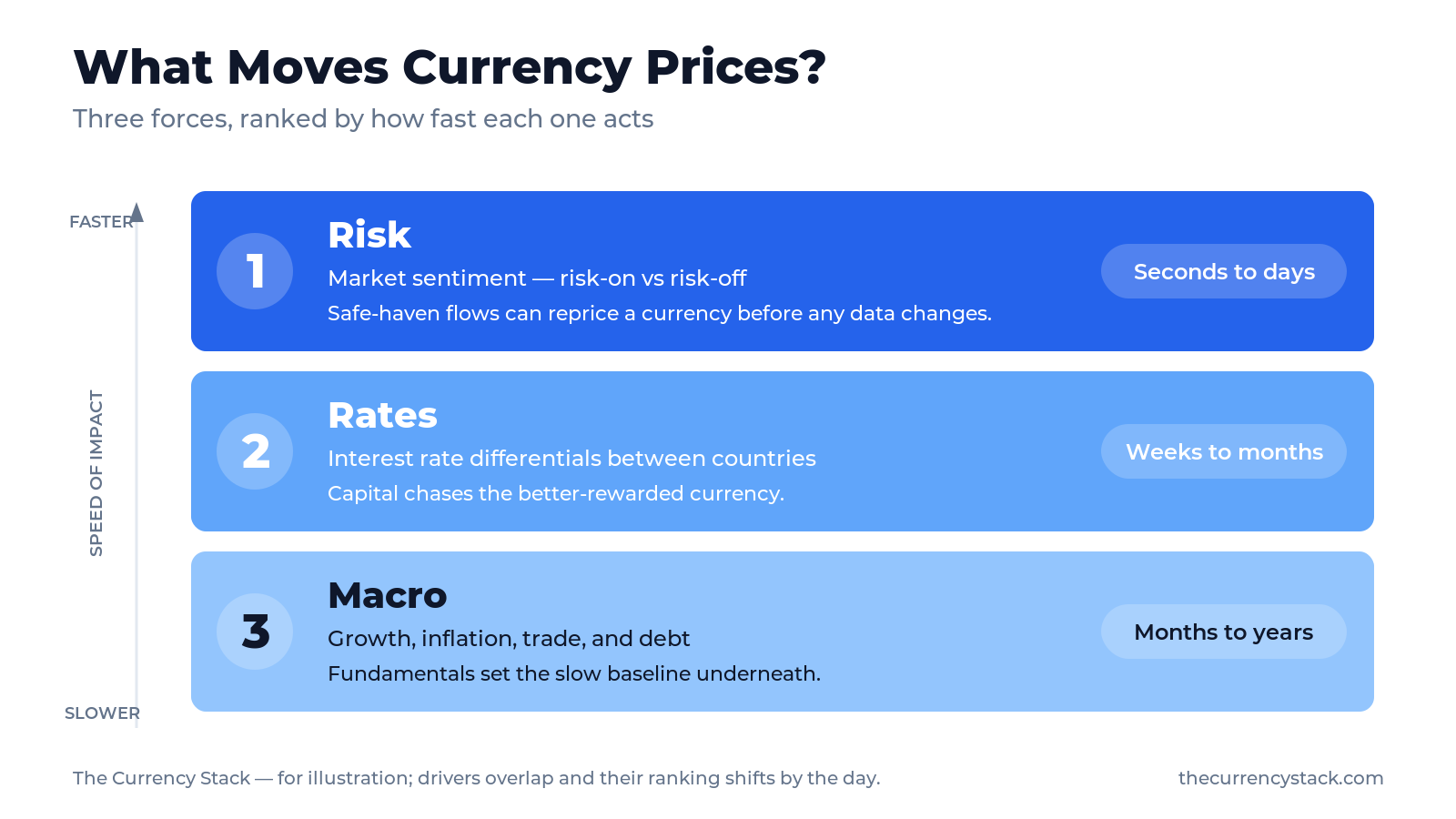
- These forces work on different clocks — risk can move a currency in seconds, rate expectations over weeks, and macro fundamentals over months and years.
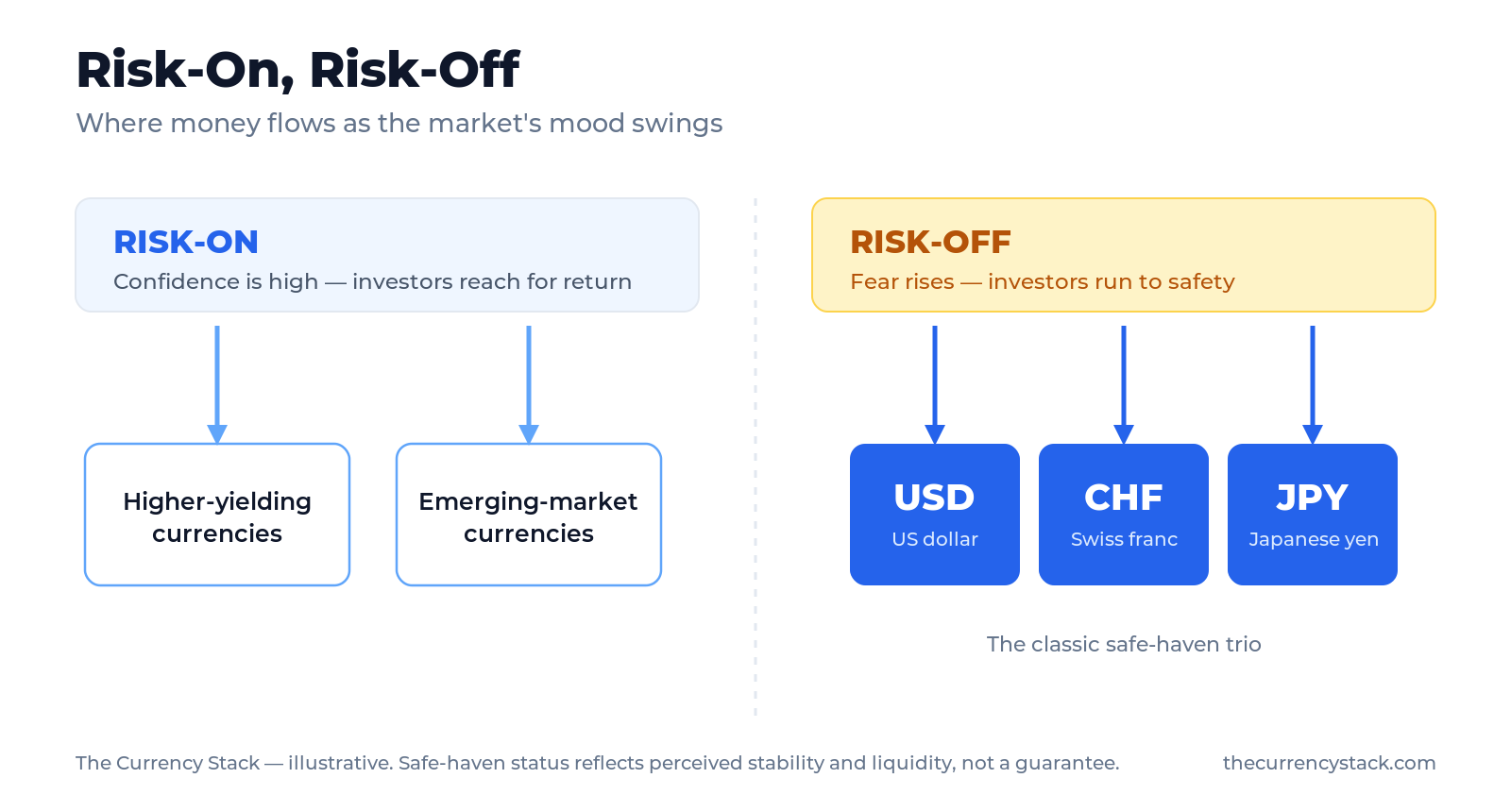
- In “risk-off” moments, money tends to flow toward safe-haven currencies such as the US dollar, Swiss franc, and Japanese yen.
- What is already expected is usually already in the price — so it is the surprise, not the news itself, that moves the market.
What actually sets an exchange rate?
Supply and demand for one currency against another. Everything else — rates, data, headlines — matters only because it changes how much of a currency people want to hold versus sell.
What moves currencies fastest?
Shifts in risk appetite. A sudden crisis or a shock headline can reprice a currency in seconds, long before any economic fundamental has changed.
Why do interest rates matter so much?
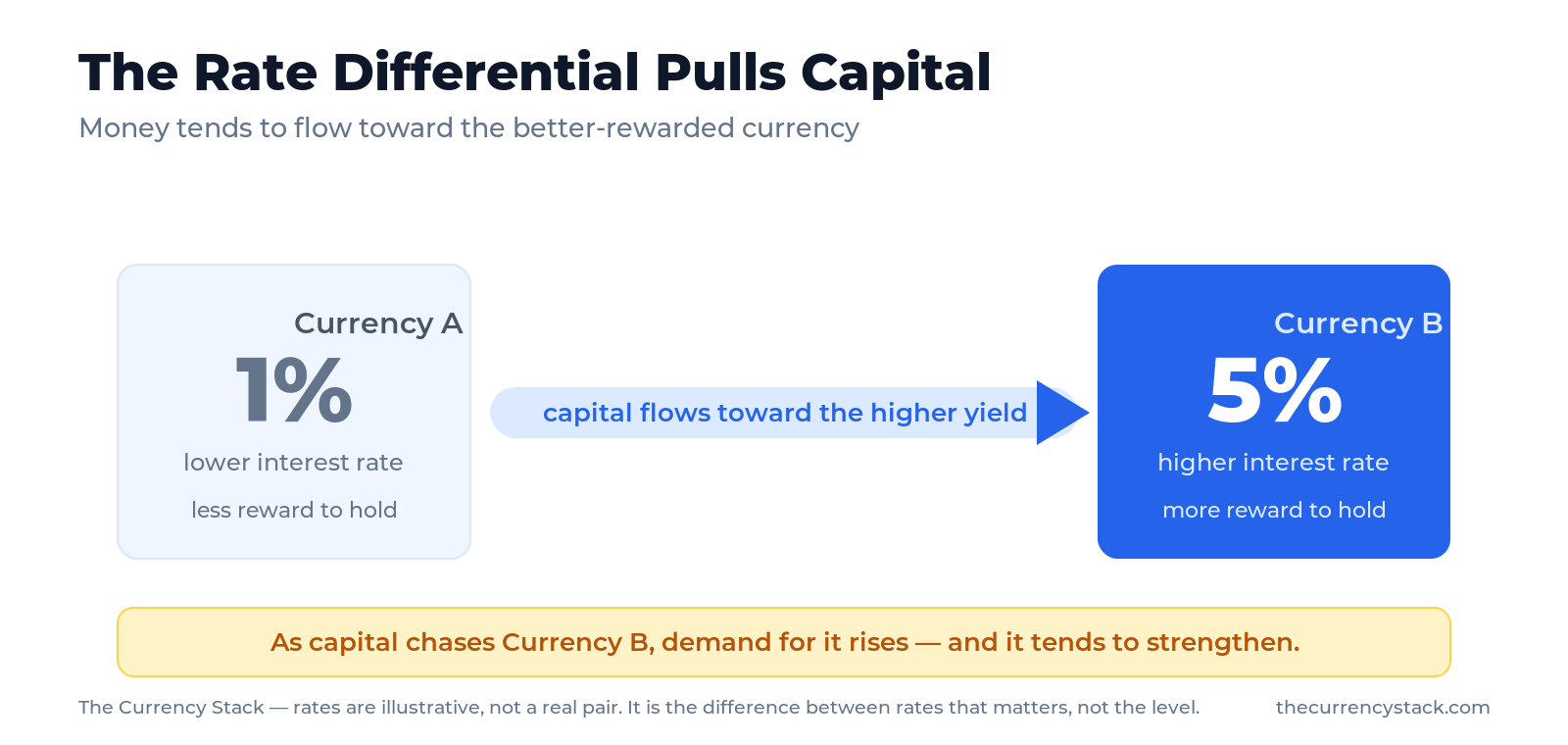
A higher interest rate is a bigger reward for holding a currency, which can attract foreign capital. It is the difference between two countries’ rates — the differential — that matters, not the level alone.
What is a safe-haven currency?
One that investors buy when they are nervous, because it is seen as stable and liquid. The US dollar, Swiss franc, and Japanese yen are the classic examples.
If the news is good, why did the currency fall?
Because the good news was expected and already priced in — a pattern traders call “buy the rumor, sell the news.” Markets move on the gap between expectation and reality.
Can governments move their own currency?
Yes. Central banks can intervene by buying or selling their currency and, more powerfully, by setting interest rates — though direct intervention is hard to sustain over the long run.
A quick-read summary of the full article below.
Open a currency app on any given morning and the euro is worth a fraction of a cent more against the dollar than it was the night before. By lunchtime it has given the move back. Multiply that by every hour of every day, across dozens of currencies and trillions of dollars, and you have the foreign exchange market — the largest financial market on earth, turning over roughly $9.6 trillion a day as of the most recent global survey (BIS, April 2025). Yet for all that scale, most people have never stopped to ask a simple question: what actually makes one currency rise and another fall?
The honest answer is that a lot of things do, and they rarely agree. But the forces that move exchange rates can be sorted into a small number of buckets — and, more usefully, ranked by how fast and how forcefully each one tends to act. This guide walks through them, from the fundamentals that grind slowly in the background to the sentiment that can move a currency before you have finished reading a headline.
A Currency Is a Price — and Prices Move on Supply and Demand
Start with the most basic idea, because everything else hangs off it. An exchange rate is a price: how much of one currency it takes to buy another. When EUR/USD is quoted at 1.28, it costs 1.28 US dollars to buy one euro. And like any price in any market, it is set where supply meets demand.
That reframing is powerful, because it turns a vague question (“why is the dollar strong?”) into a precise one (“why do more people want to hold dollars than sell them right now?”). One useful way to picture it: a currency’s strength is a kind of proxy share price for the country behind it. When a country’s assets — its stocks, bonds, property, and businesses — look attractive, foreign investors have to buy the local currency to buy those assets, and demand for the currency rises. When the same country looks risky or overvalued, investors sell those assets, supply of the currency rises, and it weakens.
So the real work is figuring out what shifts that balance of supply and demand. Three forces do most of the shifting: risk, rates, and macro.
Risk: The Fastest Mover
The quickest way to move a currency is to change how safe investors feel. Market sentiment — the collective mood swinging between appetite for risk and aversion to it — can reprice a currency in seconds, long before any hard economic number has changed.
The mechanism has a name traders use constantly: risk-on and risk-off. When confidence is high (risk-on), investors reach for higher-yielding and emerging-market currencies, accepting more risk in exchange for more return. When something frightens them — a geopolitical shock, a banking scare, a crisis nobody saw coming — they flip to risk-off and pull their money toward safe-haven currencies: assets seen as stable, liquid, and dependable in a storm. The classic trio is the US dollar, the Swiss franc, and the Japanese yen. In a genuine panic, the dollar in particular can strengthen sharply not because the American economy suddenly improved, but simply because the world wants dollars when it is scared.
This is why risk sits at the top of the hierarchy for short-term moves. Fundamentals take time to change; a mood can change in an instant.
Rates: The Reward for Holding a Currency
The second great force is interest rates — but with an important twist. What matters is not the interest rate of one country in isolation, but the differential: the gap between two countries’ rates.
The logic is straightforward. An interest rate is the reward for holding money in a currency. If deposits in one currency pay 5% and deposits in another pay 1%, an investor earns more by holding the higher-yielding currency — all else being equal. So when a central bank raises rates, or is expected to, capital tends to flow toward that currency in search of the better return, pushing it up. Cut rates, and the currency tends to weaken as that reward shrinks.
Central banks set these rates deliberately, usually to manage inflation at home rather than to steer the currency. When prices are rising too fast, a central bank may raise rates to cool the economy; the currency effect is often a side consequence. But because markets are always trying to anticipate the next move, currencies respond less to today’s rate than to where traders think rates are heading. Rate expectations, not just rate levels, do the work.
The pursuit of interest rate differentials has a name of its own — the carry trade — where investors borrow in a low-yielding currency to hold a higher-yielding one and pocket the difference. It is one of the most powerful flows in the market, and a strategy substantial enough to deserve its own treatment. The key point here is simply that the rate differential is a magnet for capital, and capital flows move exchange rates.
Macro: The Slow Tide
Beneath the daily churn of risk and rates runs a slower current: macroeconomic fundamentals. These are the big, structural measures of a country’s economic health — growth (GDP), inflation, employment, the trade balance, and government debt. They rarely move a currency in a single dramatic lurch, but over months and years they shape the overall demand for it.
The connections are intuitive once you look at them. Strong, sustained growth tends to attract investment and support a currency. Persistent inflation erodes a currency’s purchasing power and, if left unchecked, tends to weaken it — which is exactly why central banks watch inflation so closely when setting rates. A country that runs a large trade deficit, importing far more than it exports, has to fund that gap, which over time can weigh on its currency. The relationship between prices in different countries even has a formal name — purchasing power parity, the idea that identical goods should cost the same everywhere once you account for the exchange rate. It rarely holds precisely in the short run, but it exerts a gravitational pull over the long run.
Macro fundamentals are the tide, not the waves. They tell you the direction the water is moving over the season, even as risk and rates splash it back and forth by the hour.
The Hierarchy: Risk, Then Rates, Then Macro
Here is the part that ties it together and that many introductions miss. These three forces do not act on the same timescale, so ranking them by speed is more useful than treating them as a flat list.
In the short term, risk sentiment usually dominates — it is the most immediate and the most violent. Over the medium term, interest rate differentials tend to take over as the steadier driver, pulling capital toward the better-rewarded currency. And over the long term, macroeconomic fundamentals quietly set the baseline that everything else oscillates around. Risk, then rates, then macro — fastest to slowest.
That ordering is a lens, not a law. There are days when a single inflation print overwhelms everything, and stretches when nothing matters but the next central bank meeting. But as a mental model for making sense of why a currency is moving today, it is hard to beat: ask first whether the mood has changed, then whether rate expectations have shifted, and only then reach for the deeper fundamentals.
Expectations Beat Reality: Why Priced-In News Doesn’t Move the Market
One pattern confuses newcomers more than any other. Good news comes out — strong jobs, cooling inflation, a rate hike everyone wanted — and the currency falls. What happened?
The answer is that markets are forward-looking. Prices already reflect what participants collectively expect. If a piece of news arrives exactly as anticipated, it is already priced in and should barely move the market at all. What moves prices is the surprise — the gap between what was expected and what actually happened. News that lands worse, or better, or simply different from expectations carries the punch.
Traders capture this in a well-worn phrase: buy the rumor, sell the news. Positions build up in anticipation of an event; when the event finally arrives and confirms what everyone assumed, those positions are unwound, and the currency can move in the “wrong” direction. Events like a major election or a referendum are textbook cases — the outcome matters far less than how far it diverges from what the market had already assumed. Understanding this one idea explains a large share of the moves that otherwise look irrational.
When Governments Step In: Intervention and Policy
Currencies are not left entirely to the market. Governments and central banks care about their exchange rate — a currency that rises or falls too far, too fast can hurt exporters, stoke inflation, or destabilize an economy — and they have tools to influence it.
The bluntest tool is direct intervention: a central bank buying or selling its own currency in the market, sometimes through partner banks. With large enough reserves, these interventions can briefly dwarf every other participant. But intervention is difficult to sustain — a central bank has only so much firepower against a market this size — so it is often a short-term signal rather than a lasting fix. The more durable lever is monetary policy itself, especially interest rates, which is why central bank meetings and the economic data that shapes them are among the most closely watched events on any trading calendar.
The Human Layer: Herds, Greed, and Fear
Finally, sitting on top of all these mechanisms is something less tidy: human psychology. Markets are made of people (and the algorithms people build), and people are not perfectly rational.
Herd behavior is real — when everyone appears to be buying, buying feels safe, and the crowd’s momentum can push a currency further than fundamentals justify. Fear and greed amplify moves in both directions, sometimes far past what the underlying story warrants. And the constant stream of news, speeches, and social-media chatter feeds that psychology in real time. None of this replaces risk, rates, and macro — but it explains why currencies overshoot, reverse, and occasionally behave in ways no economic model would predict. The market is a voting machine in the short run and a weighing machine in the long run, and the votes are cast by nervous, hopeful humans.
The Bottom Line
Currencies move because the balance of who wants to hold them and who wants to sell them is always shifting — and three forces do most of the shifting. Risk sentiment moves fastest and hardest, interest rate differentials pull capital over the medium term, and macroeconomic fundamentals set the slow baseline underneath. Layer on the fact that markets price the expected and react to the surprise, add the ever-present tug of human psychology, and you have a framework that turns the daily blur of exchange rates into something you can actually reason about.
You will not predict the next move from this — nobody reliably can — but you will understand what to look at, and in what order. And that is the difference between watching a currency chart as noise and reading it as a conversation about risk, reward, and the health of nations.
The Currency Stack provides educational and research content only. Nothing here is financial, investment, or trading advice, or a recommendation to buy or sell any asset. Markets carry risk; do your own research and consider professional advice before acting.
Further reading: This article is part of our FX market structure series. Start with the pillar guide, What Is the FX Market and Why Does It Matter?, then see how the market’s plumbing shapes those price moves in The FX Market: Interbank, Prime Brokers, ECNs and ‘Last Look’. To meet the instrument built directly on the interest rate differentials discussed here, read What Is an FX Swap? Terms in bold are defined in our glossary. Sources: practitioner FX training materials, The Currency Stack market-structure notes, and the Bank for International Settlements Triennial Central Bank Survey, April 2025, for the $9.6 trillion daily-turnover figure.