Gold and Precious Metals: Why They Still Matter
- Precious metals — gold, silver, platinum, and palladium — are the only assets that have served as money across essentially all of recorded history, and gold still functions as a reserve asset for central banks today.
- Gold stopped being the anchor of the currency system in 1971; since then it has traded as an independent asset — one that hit an all-time high above $5,400 per ounce in January 2026.
- Central banks bought 863 tonnes of gold in 2025 (World Gold Council) — a fourth consecutive year of historically heavy official buying.
- The heart of global trading is the London OTC market (“loco London”), where metal changes hands in dollars per troy ounce and settles T+2, much like a currency.
- Gold is mostly monetary; silver is half industrial; platinum and palladium are mostly industrial — which is why their prices behave differently.
Why does gold still have value?
For the same reasons it became money in the first place: it is durable, divisible, portable, and scarce — and thousands of years of collective belief have made that value self-sustaining. Central banks reinforce it by holding gold as a reserve asset.
How is the gold price set?
By continuous trading in the global OTC market and on futures exchanges, benchmarked twice daily by the LBMA Gold Price electronic auction in London. It is quoted in US dollars per troy ounce.
What actually moves the gold price?
Three forces dominate: real interest rates (gold pays no interest, so it shines when rates are low), the US dollar (gold is priced in it), and demand for safety — from investors and central banks alike.
Is silver just cheaper gold?
No. Roughly half of silver demand is industrial — electronics, solar panels, medicine — so silver behaves partly like a metal commodity and partly like a monetary asset, which makes it more volatile than gold.
Do precious metals pay interest?
Holding metal earns nothing and costs money to store and insure — that is the trade-off for an asset with no issuer and no default risk. (Large holders can lend metal to earn a lease rate.)
A quick-read summary of the full article below.
Every other form of money in use 5,000 years ago is gone. The cowrie shells, the barley, the bronze knives, the empires that issued them — all gone. Gold is still here. It trades around the clock in a global market, sits in the vaults of every major central bank, and in January 2026 touched an all-time high above $5,400 per troy ounce. No other asset has anything like that record of survival.
This article is the front door to our precious metals coverage: why gold and its siblings have endured, what actually moves their prices, and how a market that predates every stock exchange on Earth operates today.
The Oldest Asset Still Standing
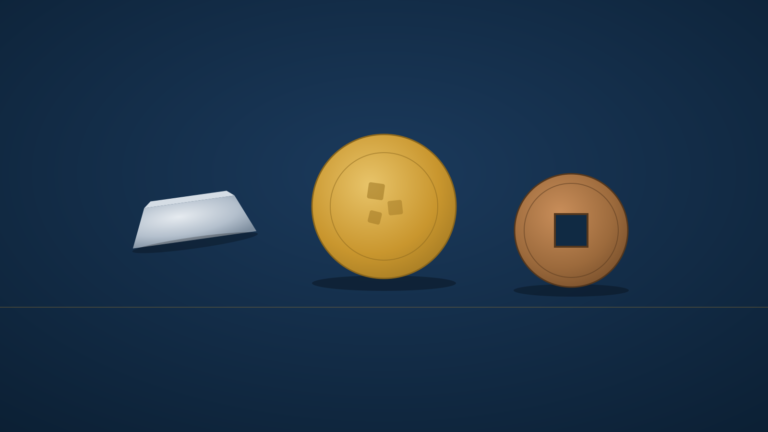
In Silver, Gold, and the Birth of Exchange we traced how weighed silver became history’s first money of account and how Lydia struck the first trusted coins. The reasons metals won that role are the same tests we applied in What is Money?: good money must be durable, portable, divisible, uniform, and scarce. Gold passes every test almost perfectly — it does not corrode, a small amount carries great value, it can be divided and re-melted without loss, every ounce is identical, and the entire stock ever mined would fit in a cube roughly 22 meters on a side.
For most of recorded history, gold and silver were not backing for money. They were money. That only ended within living memory.
From Money to Asset: Gold After 1971
Under the classical gold standard and then the postwar Bretton Woods system, currencies were defined in terms of gold — the dollar itself was convertible at $35 per ounce. When the United States suspended convertibility in 1971, the last link between the world’s money and metal was cut. Currencies floated, as we saw in What Is the FX Market?, and gold became something new: an independent asset, freely priced, answering to no government.
Its price has behaved accordingly — long quiet stretches punctuated by dramatic repricings. Gold spiked to $850 an ounce in the 1980 inflation panic, languished for two decades, then climbed through the crises of the 2000s. The most recent chapter has been the steepest: gold peaked above $5,400 per ounce in January 2026, with the LBMA price averaging a record $4,873 in the first quarter (World Gold Council data). Whatever else that move reflects, it is not the behavior of a relic.
What Moves the Price
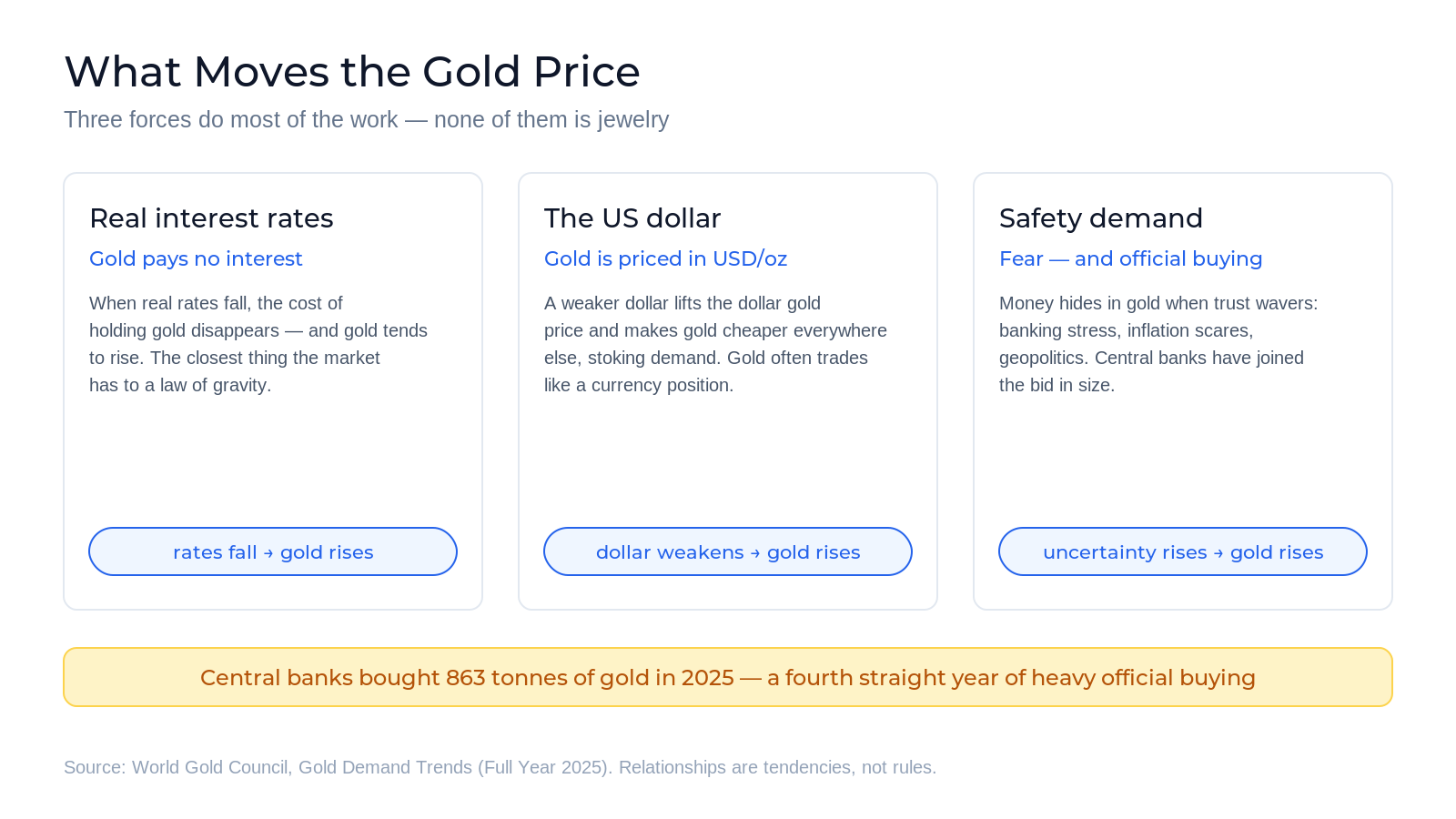
Three forces do most of the work, and none of them is jewelry.
Real interest rates. Gold pays no interest — its oldest criticism and its defining trade-off. When cash and bonds pay well after inflation, holding gold has a real cost; when real rates fall, that cost disappears and gold tends to rise. This inverse relationship with real yields is the closest thing the gold market has to a law of gravity.
The dollar. Gold is priced in US dollars per troy ounce, so a weaker dollar mechanically lifts the gold price for dollar-based observers and makes gold cheaper for everyone else, stoking demand. Gold often behaves like a currency position — a bet against paper money in general and the dollar in particular.
Fear — and official buying. Gold is where money hides when trust wavers: in banks in 2008, in currencies during inflation scares, in geopolitics whenever it darkens. The most striking recent buyer has been central banks themselves, who purchased 863 tonnes in 2025, the fourth consecutive year of historically elevated official demand (World Gold Council, Gold Demand Trends). Institutions that can print money choose to hold the one monetary asset nobody can print. Their reasons — sanctions insurance, reserve diversification — get a full article later in this series.
How Gold Actually Trades
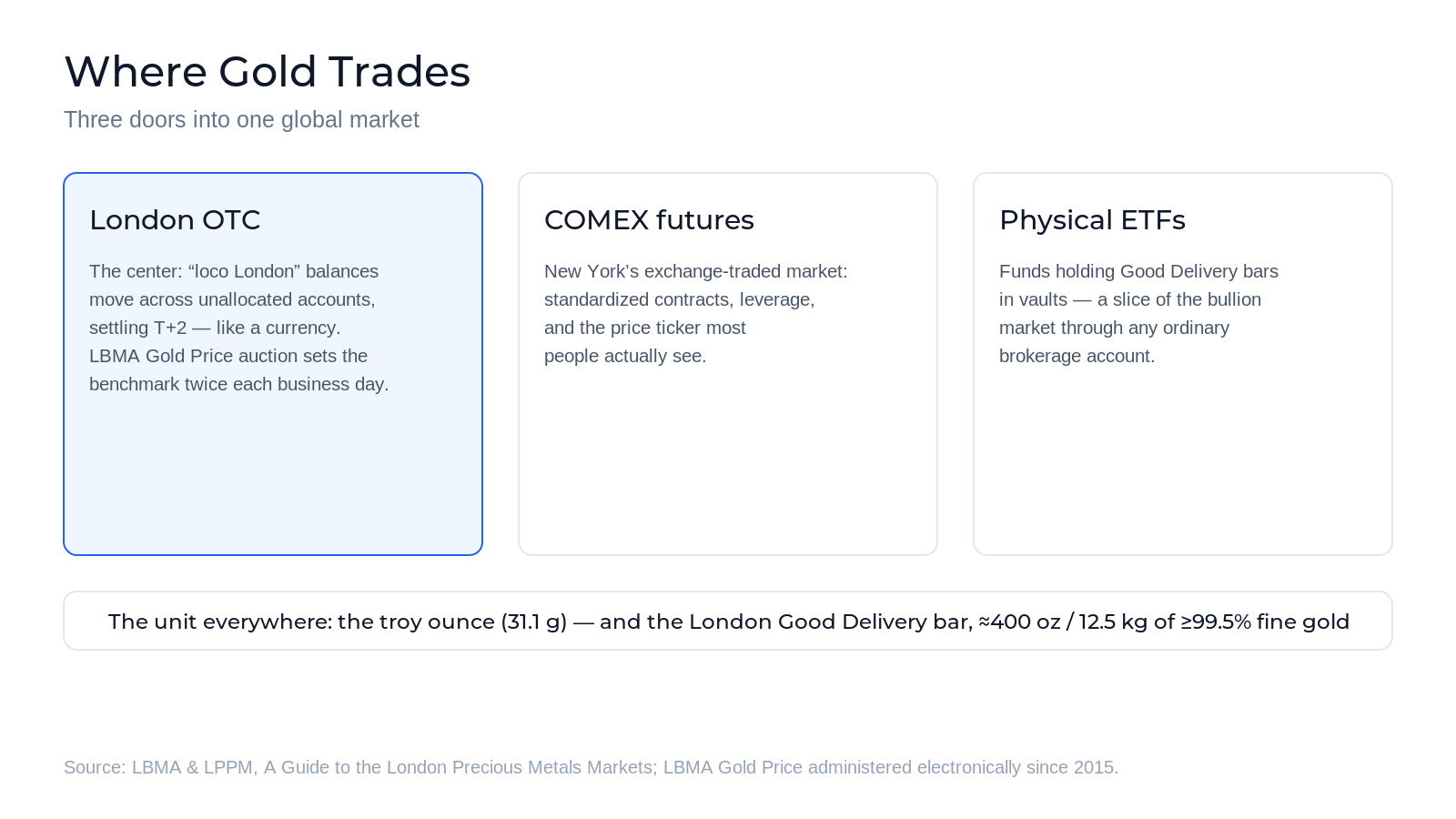
The center of the world’s gold market is not an exchange but a network — the London OTC bullion market, whose conventions come from the LBMA (London Bullion Market Association). Metal is quoted in US dollars per troy ounce (31.1035 grams) and settles two business days after the trade, exactly like the currencies in What is Spot? The standard of quality is the London Good Delivery bar — roughly 400 ounces of at least 99.5% fine gold, the 12.5-kilogram brick of every vault photograph.
Most trading never touches a bar. Balances move across unallocated accounts — claims on a dealer’s general gold stock that function like a currency account balance, transferred by book entry through London’s clearing system. (An allocated account, by contrast, holds specific numbered bars in custody — the distinction matters enough to get its own article.) Twice each business day, the LBMA Gold Price — an electronic auction that replaced the century-old telephone “Gold Fixing” in 2015 — publishes the benchmark used in contracts worldwide.
Around that OTC core sit two other venues. Futures on COMEX in New York provide leveraged, exchange-traded exposure and the price ticker most people see. Exchange-traded funds hold physical bars and let anyone with a brokerage account own a slice of a vault. Three doors into the same market — a structure we will map properly in a dedicated article.
Silver, Platinum, and Palladium
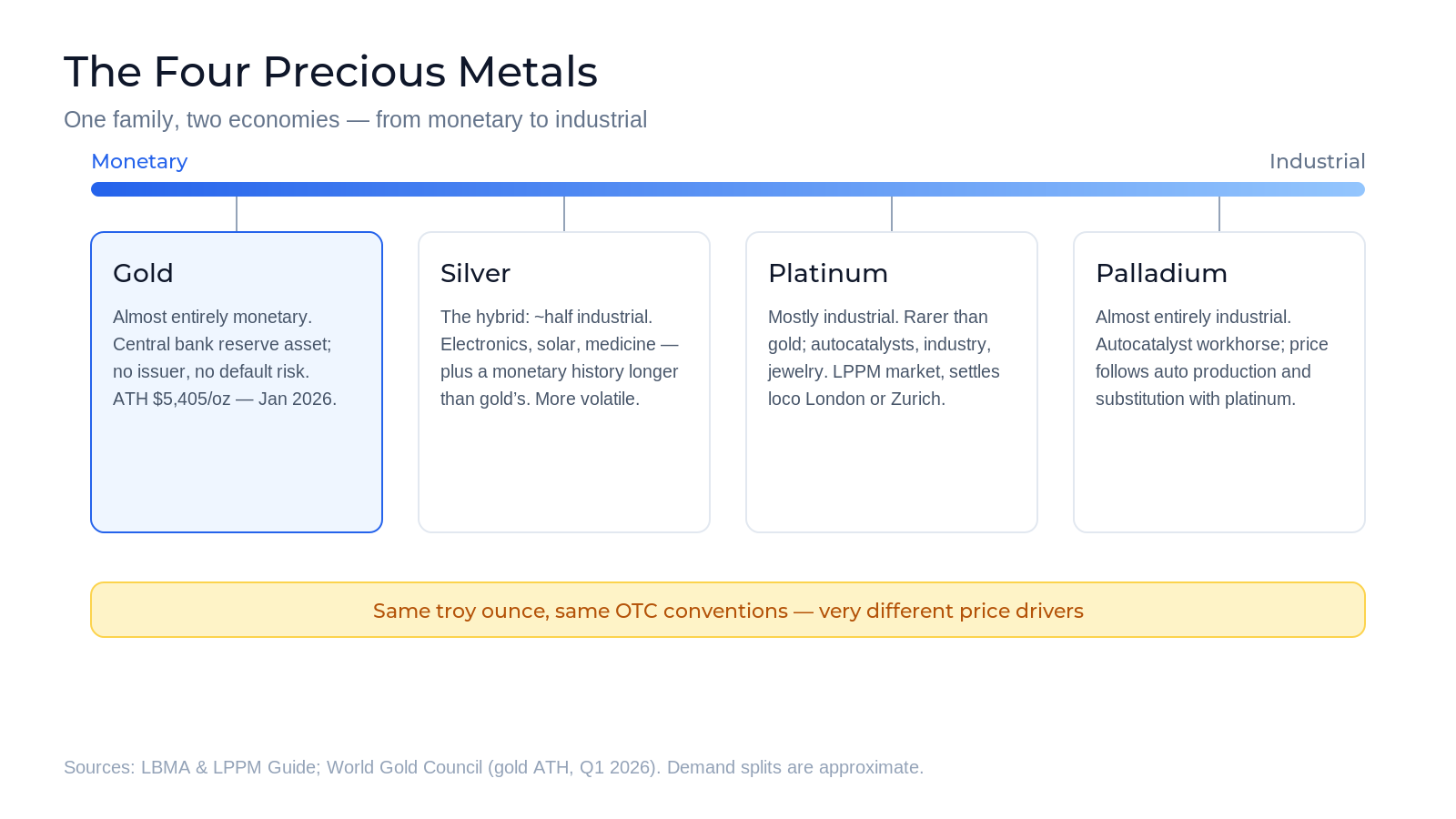
Gold’s siblings share its chemistry but not its economics.
Silver is the hybrid. It was money for longer than gold in more places — the word for “money” and “silver” is the same in dozens of languages — but today roughly half its demand is industrial: electronics, solar panels, batteries, medical applications. Silver therefore trades partly as a monetary asset that follows gold and partly as an industrial commodity that follows the economy, which makes it markedly more volatile than gold in both directions.
Platinum and palladium sit at the industrial end of the spectrum. Rarer than gold, they earn their keep in catalytic converters, industrial processes, and jewelry; their prices track auto production and substitution between the two metals more than monetary conditions. Their trading conventions mirror gold’s — the same troy ounce, the same OTC structure — but their home market is coordinated by the LPPM and settles loco London or Zurich.
Why They Still Matter
Strip away the mystique and precious metals offer one thing no financial asset can: value with no issuer. A bond is a promise; a deposit is a claim on a bank; a banknote is a liability of a central bank. A bar of gold is nobody’s promise — a bearer asset with no counterparty to default, which is precisely why it works as insurance against the failures of promises. That is what central banks are buying, and it is why gold reliably attracts money when confidence in institutions is the thing being repriced.
The cost of that insurance is equally plain: metal earns nothing, and storing and insuring it costs something. Whether and how much of it belongs in any portfolio is a personal decision that depends on circumstances — this site teaches how the market works and leaves the deciding to you. What the long record shows is narrower but solid: precious metals behave differently from stocks, bonds, and currencies, and that difference is durable, because it rests on five thousand years of the deepest habit in finance.
The Bottom Line
Gold and its siblings are the last physical survivors of money’s long history — commodity money that outlived its own monetary system and found a second life as the world’s neutral asset. The market that prices them is a hybrid of ancient and modern: troy ounces and Good Delivery bars on one hand, electronic auctions, futures, and ETFs on the other, with London’s OTC network still at the center.
This article opens our metals coverage — how the London market works from the inside, what allocated and unallocated really mean, how the price benchmarks are set, and what drives silver’s split personality all get their own deeper treatments in the articles ahead. The starting point is simply this: in a financial system built entirely on promises, the oldest asset on Earth endures because it isn’t one.
Further reading: LBMA & LPPM, “A Guide to the London Precious Metals Markets”; World Gold Council, “Gold Demand Trends” (Full Year 2025 and Q1 2026). Price figures as of early July 2026. In this series: Silver, Gold, and the Birth of Exchange, What is Money?, What is Spot?, and What Is the FX Market and Why Does It Matter?