What Is the FX Market and Why Does It Matter?
- The foreign exchange (FX) market is where the world’s currencies trade against one another — it sets the exchange rates behind every cross-border payment, investment, and vacation.
- It is the largest financial market on Earth: about $9.6 trillion changed hands per day in April 2025 (BIS), up 28% from 2022.
- There is no central exchange. FX trades over the counter, through a global network of banks and electronic platforms, around the clock from Monday in Asia-Pacific to Friday evening in New York.
- The US dollar is on one side of 89.2% of all trades — the market’s “vehicle currency.”
- Most turnover is not tourists or importers: it is banks, funds, and companies managing funding, risk, and investments across borders.
Is the forex market the same as the stock market?
No. Stocks trade on centralized exchanges with listed prices; currencies trade over the counter, directly between banks and electronic platforms, with no single official price. You also never “own” a currency the way you own a share — every FX trade is one currency exchanged for another.
How big is the FX market?
Roughly $9.6 trillion in average daily turnover as of April 2025, according to the Bank for International Settlements — more than any other financial market in the world.
When is the forex market open?
Around the clock, five days a week. Trading follows the sun: it opens Monday morning in Asia-Pacific, rolls through London — the largest trading hub — and closes Friday evening in New York.
What is the most traded currency?
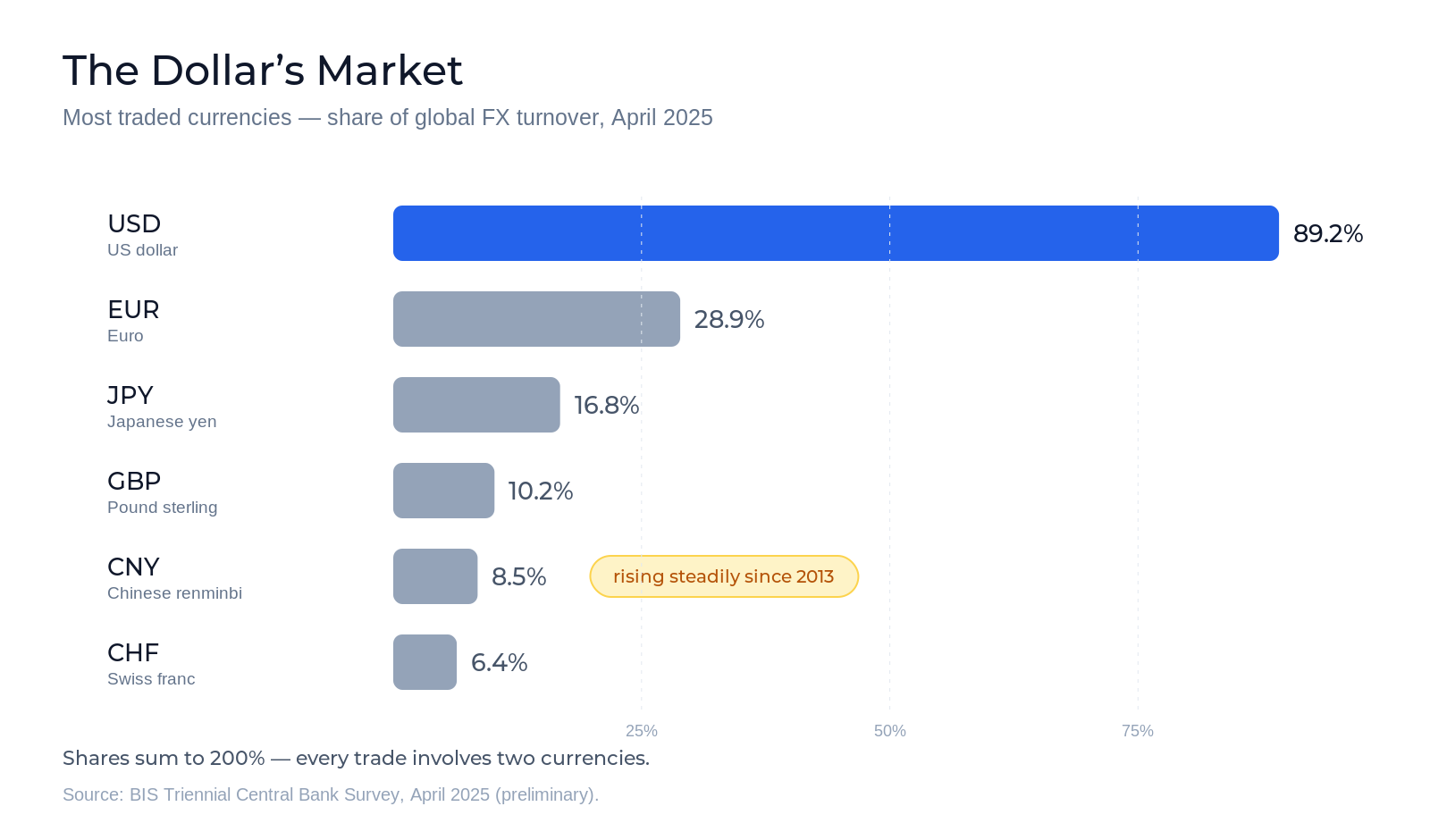
The US dollar, on one side of about 89% of all trades. The euro (28.9%) and the Japanese yen (16.8%) are next.
Why do exchange rates matter to me?
They shape the price of imported goods, the cost of travel, the value of overseas investments in your pension or index fund, and — through inflation — even interest rates at home.
A quick-read summary of the full article below.
The world’s biggest market has no address. There is no trading floor to visit, no opening bell, and no closing price read out on the evening news. Yet it turns over roughly $9.6 trillion every trading day — a figure so large it is genuinely hard to picture, and one that dwarfs every other market on the planet.
If you have ever changed cash at an airport, bought something online from a foreign store, or held a fund that owns overseas stocks, you have used this market — almost certainly without noticing. This article is a guided tour of the foreign exchange (FX) market: what it actually is, how big it really is, who trades it, and why it quietly matters to almost everyone.
The Market Where Money Itself Is Traded
The foreign exchange market — FX to professionals, forex in retail circles — is where currencies trade against one another. The product is money itself: dollars for yen, euros for pounds, pesos for francs. The price at which one currency exchanges for another is the exchange rate — and like any price, it moves constantly with supply and demand.
Currencies are quoted in pairs, using three-letter ISO codes. When you see EUR/USD at 1.10, it means one euro costs 1.10 US dollars. The first currency in the pair is the base currency — the thing being bought or sold — and the second is the quote currency, the money it is priced in. Dealers quote a two-way price: a slightly lower rate at which they will buy the base currency and a slightly higher one at which they will sell. The gap between the two is the spread, and it is how market makers earn their keep.
Here is what makes FX unusual among the big markets: there is no exchange at the center of it. Currencies trade over the counter (OTC) — through a sprawling, decentralized web of banks, dealers, and electronic platforms transacting directly with one another. When a headline says “the euro fell today,” there is no single official price behind that statement. There is a consensus, woven in real time from millions of individual trades happening across the globe.
How Big Is $9.6 Trillion a Day?
Nobody runs the FX market, but somebody does count it. Every three years, the Bank for International Settlements (BIS) — often described as the central bank for central banks — coordinates a census of FX trading across 52 jurisdictions. It is the closest thing the market has to an official measurement.
The most recent survey, taken in April 2025, put average daily turnover at $9.6 trillion — up 28% from $7.5 trillion in 2022. The trend has pointed one way for decades: $5.3 trillion a day in 2013, $6.6 trillion in 2019, $7.5 trillion in 2022, and $9.6 trillion now. One honest caveat, which the BIS itself makes: April 2025 was an unusually turbulent month, with trade-policy announcements driving a surge in activity, so the snapshot may flatter the underlying trend a little. Then again, the 2022 survey coincided with the volatility that followed the invasion of Ukraine — census months are rarely quiet.
To put $9.6 trillion in perspective: the world’s actual trade in goods and services requires only a small fraction of that currency conversion. The overwhelming majority of FX turnover is financial — banks managing funding, investors hedging portfolios, and traders adjusting positions. That is not a flaw in the system. It is what a deep, liquid market looks like, and it is precisely that depth that lets a company or a traveler convert money instantly at a fair price.
One Market, Many Instruments
“The FX market” is really a family of related instruments, all built on the same underlying exchange rates.
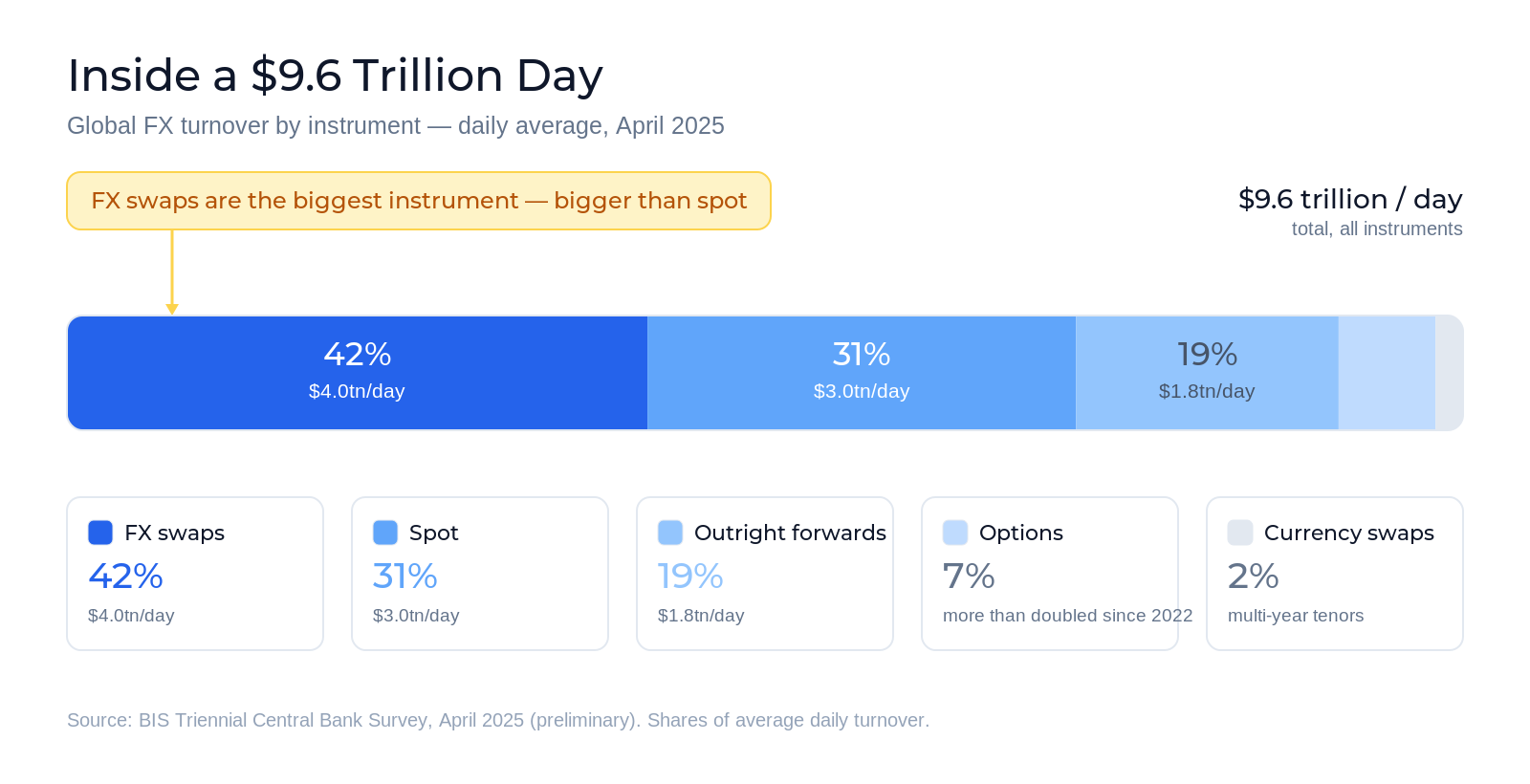
Spot is the one most people picture: two parties agree to exchange currencies at today’s rate, with settlement — the actual delivery of the money — typically two business days later (T+2; USD/CAD is a one-day exception). Spot made up about 31% of turnover in April 2025, some $3 trillion a day. We cover it in depth in What is Spot? and walk through the life of a trade in How a Spot FX Trade Really Works.
The biggest instrument, though, is one most newcomers have never heard of. FX swaps — a spot exchange and a reverse forward exchange stitched into a single contract — accounted for 42% of all turnover, about $4 trillion a day. They are the market’s funding workhorse: banks and investors use them to borrow one currency against another for days or weeks at a time.
Outright forwards (19%) lock in an exchange rate for a future date — the classic hedging tool for a company that knows it must pay a supplier in another currency next quarter. Options (7%) grant the right, but not the obligation, to exchange at a set rate; their turnover more than doubled between 2022 and 2025. Currency swaps (around 2%) do what FX swaps do, but over years rather than days.
The Dollar at the Center
Add up the currencies on both sides of every FX trade and the shares total 200% — every transaction involves two currencies. Measured that way, the US dollar was on one side of 89.2% of all trades in April 2025. The euro was next at 28.9%, the Japanese yen at 16.8%, sterling at 10.2%, the Chinese renminbi at 8.5% — continuing a steady climb that began over a decade ago — and the Swiss franc at 6.4%.
The dollar’s dominance is not just about the size of the US economy. The dollar is the market’s vehicle currency — the common intermediary through which less-traded currencies exchange. A company converting euros to Mexican pesos will rarely find a deep, direct EUR/MXN market; instead, its bank routes the trade through two liquid ones, EUR/USD and USD/MXN. Because so many trades take this route, all ten of the most traded currency pairs involve the dollar, and EUR/USD alone — the market’s flagship pair — accounts for roughly 21% of global turnover.
Two Hubs, Not One
That routing logic explains the dollar’s share, but it does not make the dollar the only hub. Vehicle currencies are also regional. Inside Europe, a trade between two non-euro currencies — Swedish kronor into Norwegian kroner, say — is more likely to be built from EUR/SEK and EUR/NOK than from the dollar pairs. In the Swedish market, EUR/NOK is the fourth most traded spot pair, while USD/NOK does not make the top ten at all.
Sweden shows the split neatly. In April 2025, the krona–euro pair accounted for 20.4% of all spot turnover booked in Sweden, comfortably ahead of krona–dollar at 12.7%. Turn to FX swaps and the ranking flips: dollar 26.6%, euro 13.4%. The reason is what each instrument is for. Spot largely serves trade and hedging, which in Sweden points at Europe. FX swaps are funding instruments, and short-term funding is raised in dollars almost everywhere.
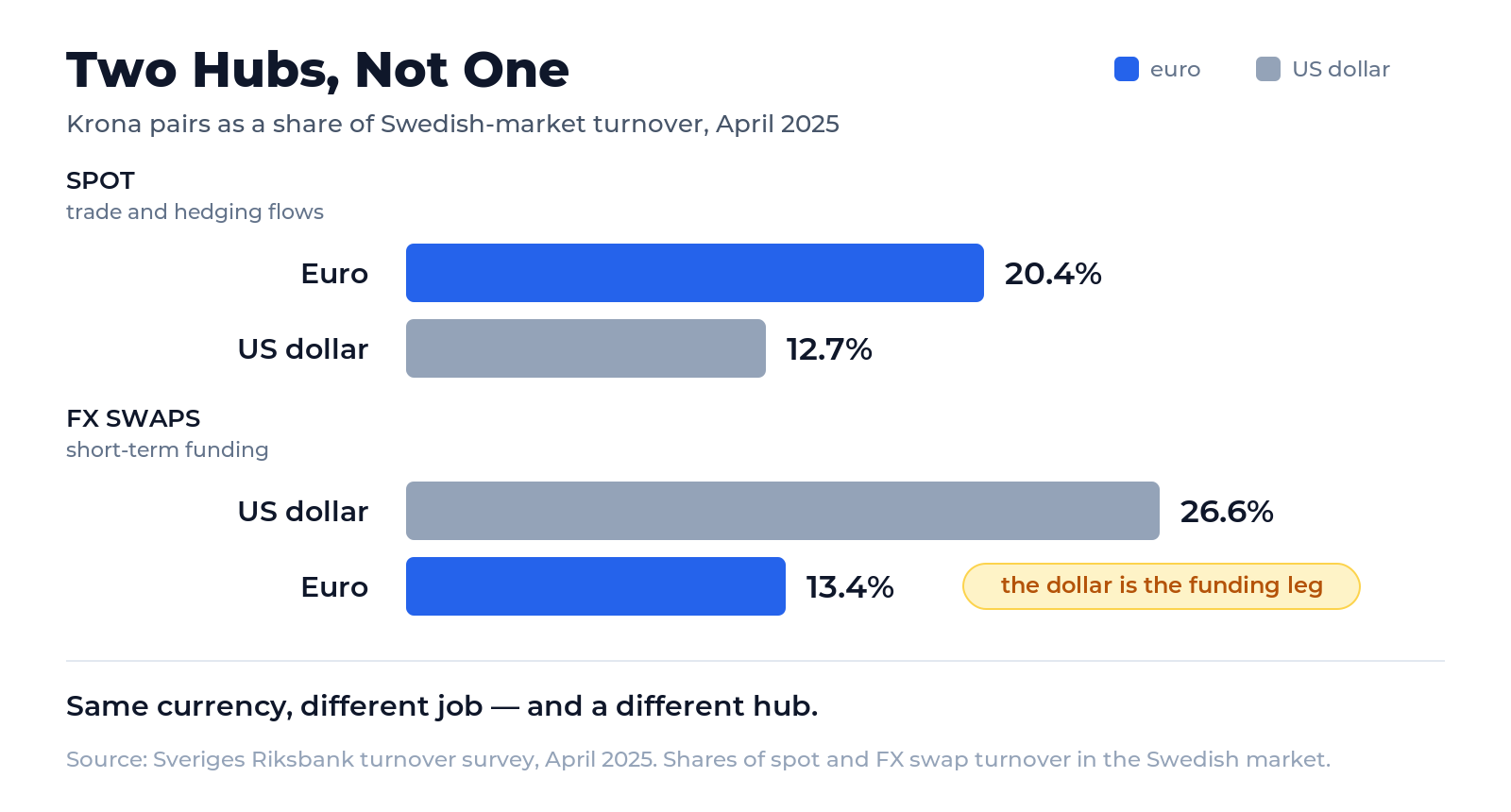
The dollar’s grip is stronger than the regional story suggests once you leave the Nordic spot market, though. Across all Norwegian krone trading worldwide, the dollar sits on 67% of turnover against the euro’s 25%, and even in NOK spot the dollar leads, 54% to 36%. Norges Bank points to the reason: the dollar swap market is an important funding source for Norwegian banks. So the honest version is not that the euro has displaced the dollar in Europe. It is that “which currency is on the other side?” has two answers, and which one applies depends on what the trade is for.
A Market That Follows the Sun
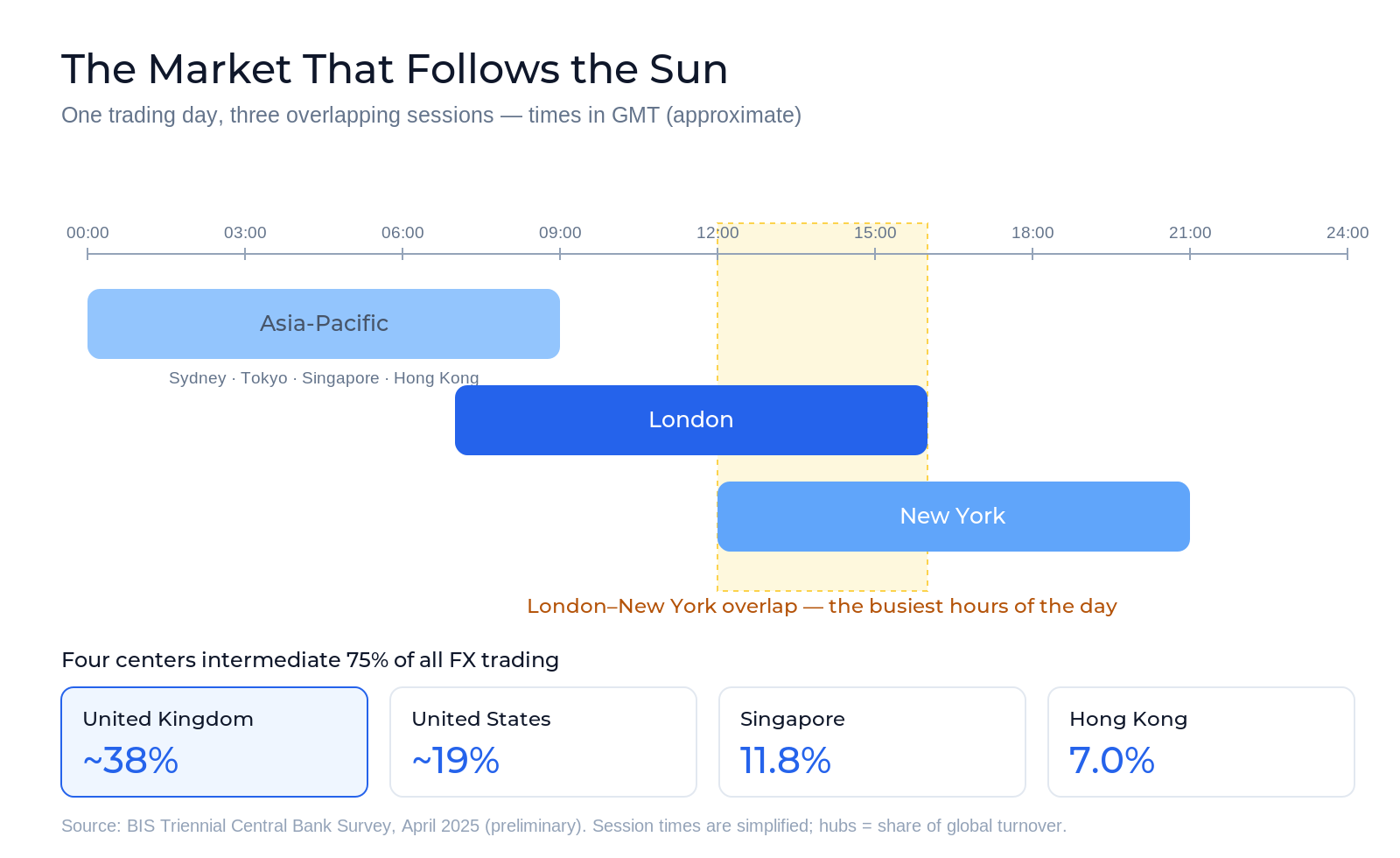
The FX market never closes during the week because it is never in one place. The trading week opens on Monday morning in Asia-Pacific, rolls west through Tokyo, Singapore, and Hong Kong, hands off to London — still the single largest hub, home to roughly 38% of global trading — overlaps with New York through the afternoon, and finally goes quiet when the US East Coast winds down on Friday evening.
Four centers dominate: the United Kingdom (~38%), the United States (~19%), Singapore (11.8%, and growing fast), and Hong Kong (7.0%) together intermediate three quarters of all FX trading. But the market is genuinely global in a way few others are — 63% of turnover crosses a border between counterparties, a share no national stock market comes close to.
Who Actually Trades It
At the center of the market sit the dealers — large banks that quote prices to everyone else and trade heavily among themselves. This inter-dealer trading made up 46% of global turnover in April 2025.
The other half — slightly more, at 50% — is trading between dealers and other financial institutions: smaller banks, asset managers, pension and insurance funds, hedge funds, high-speed principal trading firms, and central banks. This is the segment that has grown fastest, reaching $4.8 trillion a day in 2025. Central banks deserve their own mention: they hold and manage foreign exchange reserves and occasionally intervene in the market, though day to day they are a small share of the flow.
Then come the non-financial customers — companies paying invoices, repatriating profits, and hedging future revenues — and, at the retail end, individual traders accessing the market through brokers. Each participant has a different reason to be there: payment, hedging, funding, investment, or speculation. How all these layers plug together — the interbank core, prime brokers, ECNs, and the controversial practice of “last look” — is a story of its own, and we tell it in our deep dive on FX market structure (members).
Why It Matters Beyond the Trading Desk
It is tempting to file the FX market under “things that matter only to bankers.” The opposite is true — the exchange rate is arguably the most consequential price in any economy, because it is a price that sits inside other prices.
When a currency weakens, imported goods cost more, and that feeds inflation — which in turn shapes the interest rate you pay on a mortgage or earn on savings. When it strengthens, exporters’ goods become more expensive abroad, and jobs and profits shift accordingly. The overseas earnings of the companies in your index fund, the value of any foreign assets in your pension, the cost of your next trip abroad — all of them move with exchange rates set in this market, every second of the trading week.
And beneath all of that sits the plumbing: every cross-border transaction — every import, export, foreign investment, and remittance — requires one currency to become another. The FX market is where that happens. None of this requires you to trade currencies yourself — and nothing here is a suggestion that you should. But whether you ever place a trade or not, you live in a world priced through this market.
The Bottom Line
The foreign exchange market is the meeting point of all the world’s monies — the mechanism that connects a dollar-based economy to a euro-based one, a yen-based one, and every other. It has no headquarters and no official price list, yet it clears $9.6 trillion a day with remarkable reliability, around the clock, almost entirely out of public view.
If money is a society’s operating system — a theme we explored in What is Money? — then the FX market is the protocol that lets the world’s different versions of it talk to each other. Most people will never trade in it. Everyone lives with its output. Understanding how it works is the first step to understanding how the global economy actually fits together — and it is where the rest of our FX series begins.
Further reading: Bank for International Settlements, “OTC foreign exchange turnover in April 2025” (Triennial Central Bank Survey, September 2025); Sveriges Riksbank, “The Riksbank’s survey of turnover in the Swedish foreign exchange and derivatives market” (September 2025); Norges Bank, “Activity in the Norwegian foreign exchange and derivatives markets in 2025” (December 2025). In this series: What is Money?, What is Spot?, How a Spot FX Trade Really Works, What Is an FX Swap?, and the members-only deep dive The FX Market: Interbank, Prime Brokers, ECNs and “Last Look”. Figures are daily averages for April 2025 unless noted.