A Brief History of Money: From Cowrie Shells to Crypto
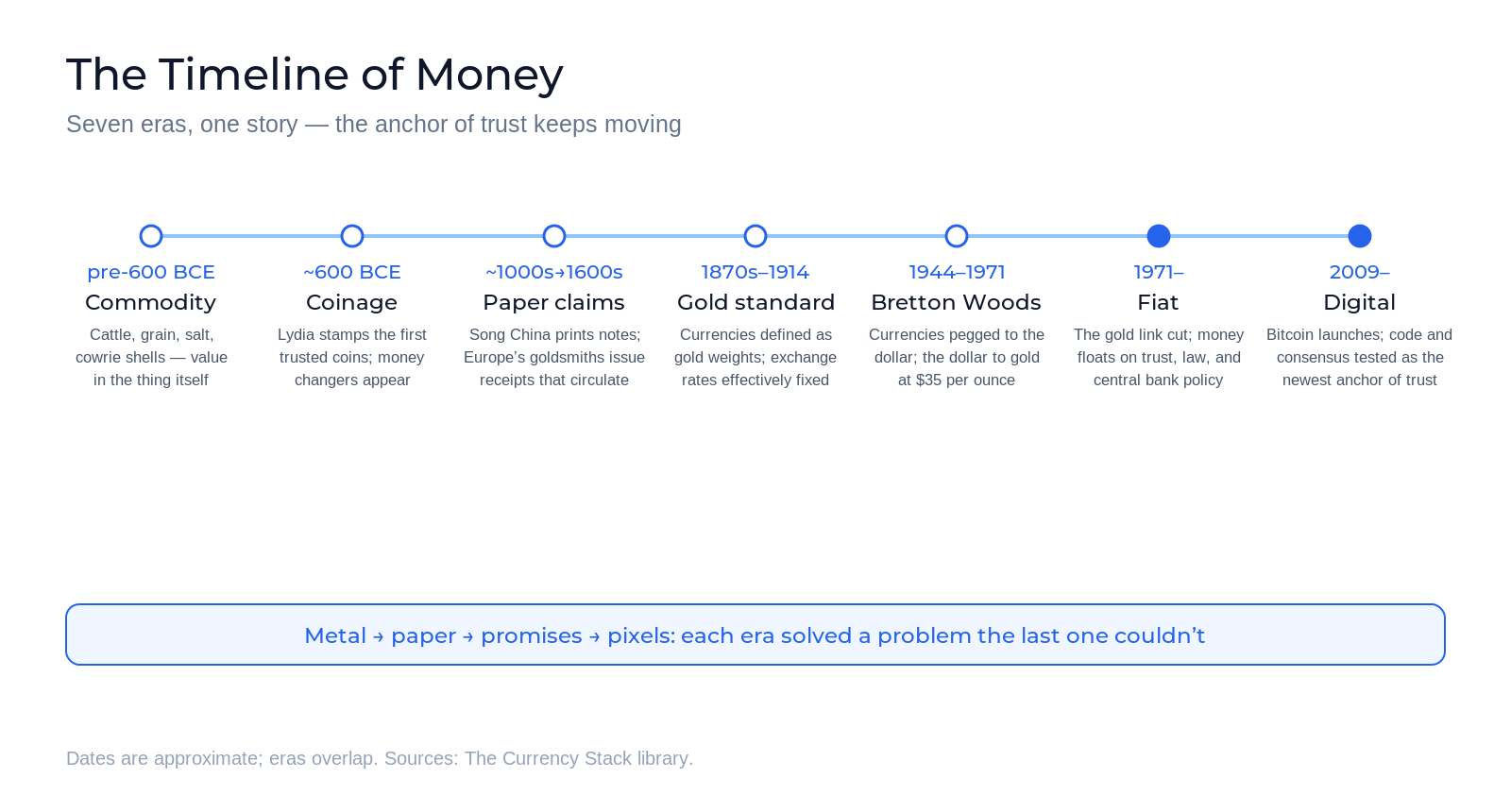
- Money evolved in stages — commodity money, coinage, paper claims, the gold standard, fiat currency, and now digital money — each solving a problem the previous form couldn’t.
- Gold and silver won the role early because they are durable, divisible, portable, and scarce; standardized coinage (Lydia, ~600 BCE) made trust portable.
- Paper money began as receipts for metal held elsewhere — in Song-dynasty China and with Europe’s goldsmith bankers — before becoming money in its own right.
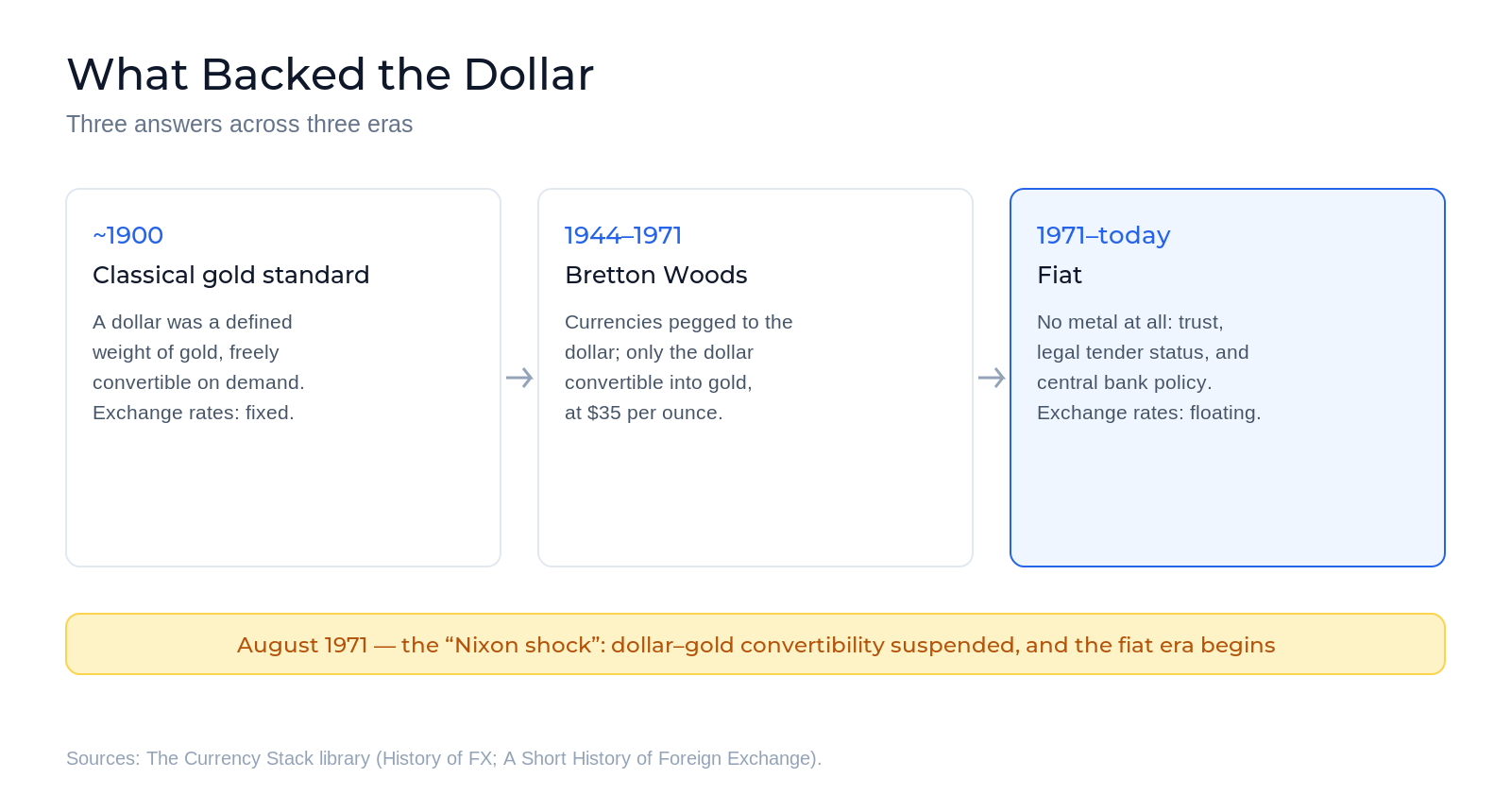
- The gold standard (1870s–1914) and Bretton Woods (1944–1971) tied currencies to gold; when the US cut that link in 1971, money became fiat — backed by trust and law rather than metal.
- The newest chapter is digital: most money is already electronic bank entries, and since 2009 cryptocurrencies have tested whether code and consensus can replace institutions as the anchor of trust.
What was the first money?
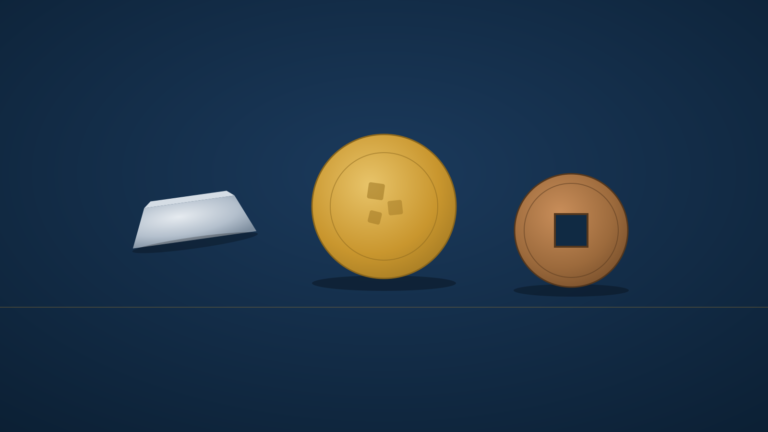
Useful commodities that nearly everyone wanted — cattle, grain, salt, cowrie shells. Metals gradually displaced them because they don’t rot, can be divided precisely, and stay scarce.
Who made the first coins?
The kingdom of Lydia, in modern Turkey, around 600 BCE — stamped pieces of electrum certifying weight and purity, so no one had to weigh and test metal at every trade.
What was the gold standard?
A system (roughly 1870s–1914) in which each major currency was defined as a fixed weight of gold, which effectively fixed exchange rates between them. It ended in the strains of war and depression.
Why did money stop being backed by gold?
Bretton Woods pegged currencies to a gold-convertible dollar, but by 1971 the US could no longer honor the promise and suspended convertibility. Currencies have floated on trust — fiat money — ever since.
Is crypto the next chapter?
It is the newest experiment: money issued and settled by a network rather than a state. Whether it becomes lasting money or remains an asset class is still an open question.
A quick-read summary of the full article below.
Money did not appear fully formed. It evolved over thousands of years, as societies searched for better ways to store and transfer value — and understanding that evolution is the foundation for understanding why FX, precious metals, and crypto exist at all. Each is simply a different chapter in the same long story about what humans are willing to treat as money.
This article tells that story briefly, from the first commodity monies to the digital experiments of the present — the connective thread running through everything else on this site.
Commodity Money
The earliest money was useful stuff that happened to be widely wanted: cattle, grain, salt, cowrie shells, beads, and tools. A commodity that almost everyone accepted could serve as the intermediate step in any exchange — the problem-solver we examined in What is Money? Its weaknesses were practical: livestock is perishable and indivisible, grain rots, and shells can be over-collected, which quietly inflates the supply.
Metals gradually won out because they are durable, divisible, portable, and relatively scarce — the qualities that would keep them at the center of money for the next several thousand years, as we saw in Gold and Precious Metals: Why They Still Matter.
The Birth of Coinage
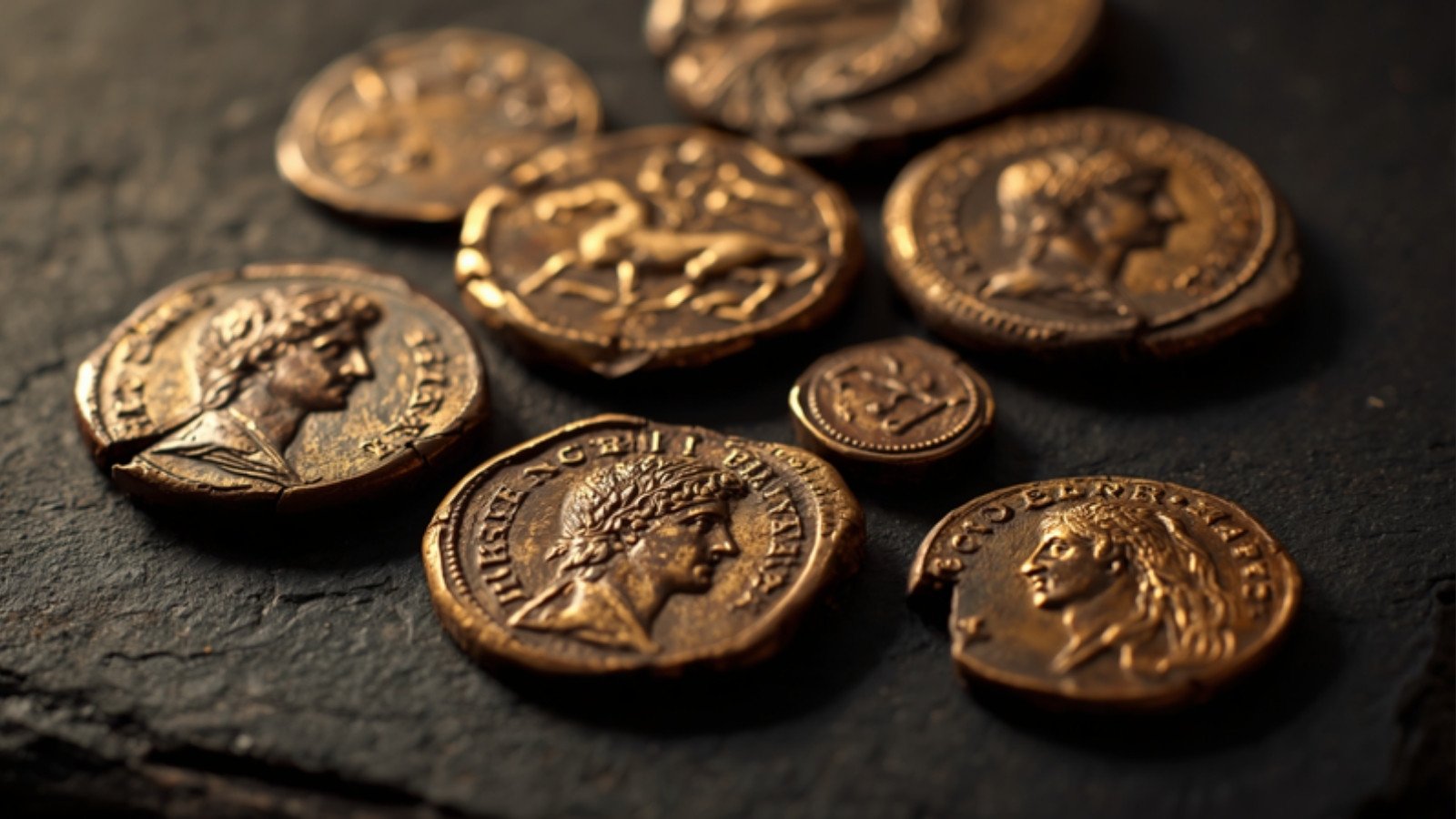
Around 600 BCE the kingdom of Lydia minted some of the first standardized coins from electrum, a natural gold–silver alloy, stamping them to certify weight and purity. Coinage spread because a trusted stamp removed the need to weigh and assay metal at every transaction — the full story is in Silver, Gold, and the Birth of Exchange.
Coinage also created a new profession. Wherever foreign coins circulated, money changers appeared to exchange one for another — the true ancestors of today’s $9.6-trillion-a-day FX market. By the 1500s, the moneychangers of Lombardy were agreeing to exchange currencies at a set rate for delivery on a future date: the first foreign exchange forwards, four centuries before anyone called them that.
Representative Money and Banknotes
Carrying metal is heavy and risky, so societies developed claims on metal instead. Chinese dynasties experimented with paper money from the Tang and Song periods, and in early-modern Europe goldsmiths issued receipts for deposited gold that began to circulate as money in their own right.
This is the origin of banking: the receipt — a promise to pay — became more convenient than the metal behind it, and the issuer could lend against the reserves it held. Money had taken its first step away from intrinsic value and toward pure trust, a layering we mapped in Types of Money in a Modern Economy.
The Gold Standard
Under the classical gold standard — roughly the 1870s to 1914 — major currencies were defined as fixed weights of gold and were freely convertible. Because each currency was tied to gold, exchange rates between them were effectively fixed: an early, rigid form of the foreign exchange market, with capital moving freely across borders.
The system delivered decades of monetary stability and imposed discipline on governments — but it removed their flexibility to respond to shocks. It broke down under the financial strains of the First World War, and the interwar attempts to rebuild it collapsed amid depression and competitive devaluation.
Bretton Woods and the Dollar
In 1944, with the war still being fought, the Allied powers met at Bretton Woods to design a more durable order. The result built the new system around the US dollar: other currencies were pegged to the dollar within narrow bands, and the dollar alone was convertible into gold at $35 per ounce. The same agreement created the International Monetary Fund and the World Bank.
This made the dollar the world’s reserve currency and the anchor of global trade — a status that still shapes markets today. For a generation the system underpinned the postwar recovery. But as US deficits grew, the promise to redeem dollars for gold became impossible to keep.
The Fiat Era
In August 1971 the United States suspended the dollar’s convertibility into gold — the “Nixon shock” — ending Bretton Woods. A patch-up agreement that December failed to hold, and by 1973 the world’s major currencies were floating, their values set by the market rather than by decree.
Money had become fiat: valuable because governments designate it as legal tender and because people trust it, not because metal backs it. Two markets were born in the same moment. The modern FX market, where floating currencies trade around the clock, is a direct product of this shift. And gold, no longer the anchor, became an independent asset — a hedge against the very currencies that had replaced it, as we explored in Gold and Precious Metals.
The fiat era has had its own experiments in fixity. Europe spent three decades linking its currencies together — through the European Monetary System and the Exchange Rate Mechanism — before taking the ultimate step: the euro, launched electronically in 1999 and as notes and coins in 2002, the most ambitious currency project of the modern era.
The Digital Frontier
Most money today is already digital — electronic entries in bank ledgers rather than notes and coins. The newest chapter pushes further. Bitcoin’s launch in 2009 introduced money issued and settled by a decentralized network rather than a state; cryptocurrencies and stablecoins created a parallel digital asset class, examined in What Is Cryptocurrency?; and central banks are now researching their own digital currencies.
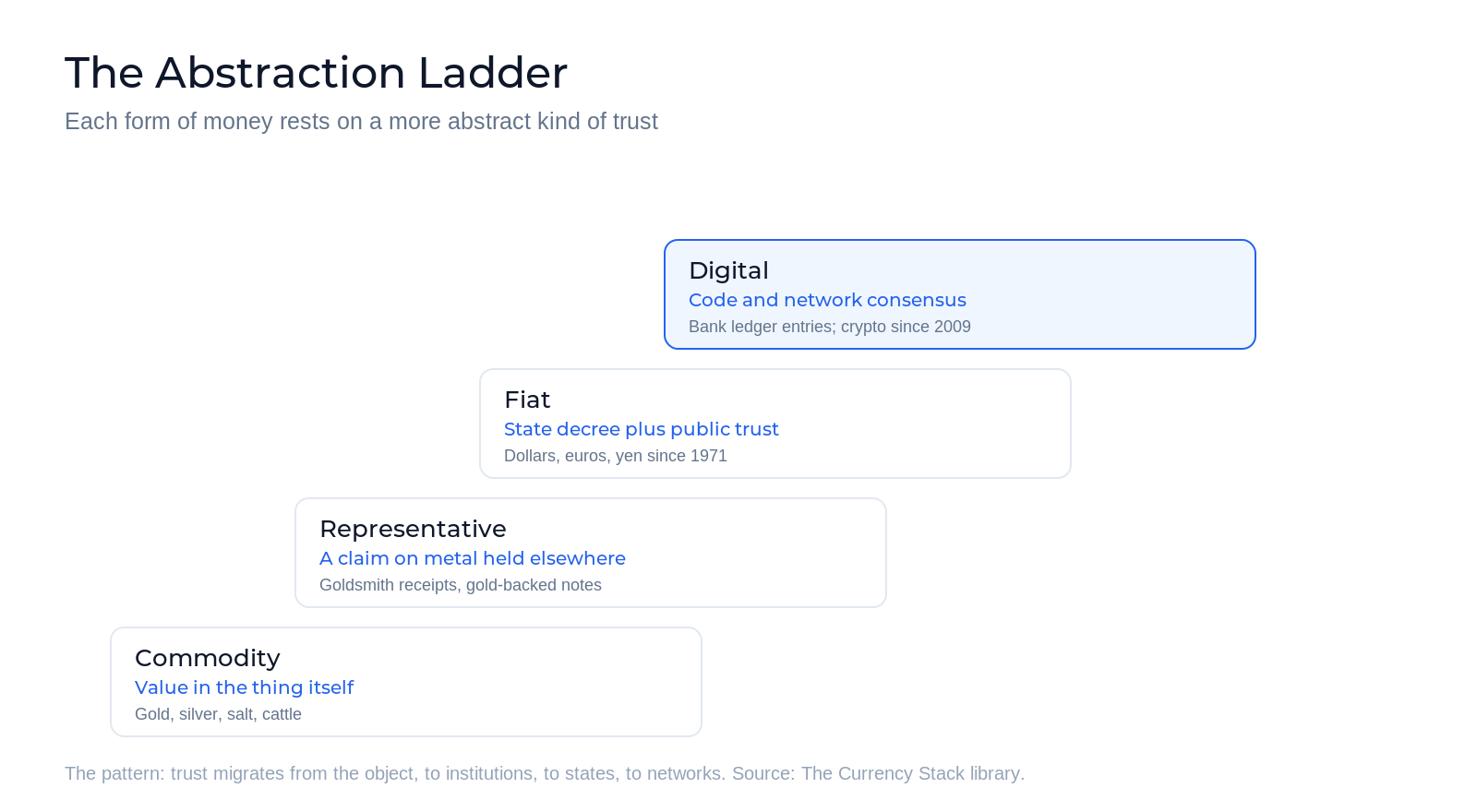
Whether these become lasting forms of money or remain speculative is still unfolding. But they extend the same theme that runs through the whole history: each era moves the anchor of trust — from the commodity itself, to institutions that hold it, to states that decree it, and now, perhaps, to networks that compute it.
The Bottom Line
Five thousand years of monetary history compress into a single pattern: money is whatever a community collectively agrees to trust, and the form of that trust keeps migrating — from cattle to coins, coins to paper, paper to promises, promises to pixels. Each migration solved a real problem, and each created new ones for the next form to fix.
That is why this site covers FX, precious metals, and crypto together. They are not three unrelated markets; they are the living descendants of money’s three great eras — metal, fiat, and digital — still trading side by side, every day. Understand the history and the daily headlines become chapters in a much older story.
Further reading: sources from the Currency Stack library (“History of FX”; ACI Dealing Certificate materials; Lehman Brothers FX Training Manual); BIS Triennial Central Bank Survey, April 2025 (market size). In this series: What is Money?, Silver, Gold, and the Birth of Exchange, Types of Money in a Modern Economy, Gold and Precious Metals: Why They Still Matter, and What Is Cryptocurrency?