What is Money?
- Money is best understood not as a thing but as a social technology — a shared agreement that works because everyone trusts it.
- It does three jobs at once: medium of exchange, store of value, and unit of account.
- Good money tends to share five traits — durability, portability, divisibility, scarcity, and acceptability.
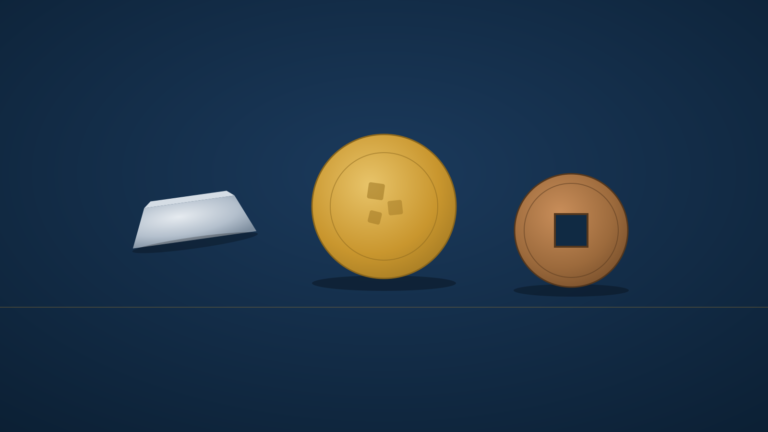
- Its history is one of steady abstraction: from commodity money (grain, gold) to paper claims to today’s fiat money, backed by government and trust rather than metal.
- Most money isn’t printed by governments — commercial banks create the bulk of it when they lend; about 97% of UK money is bank deposits (Bank of England).
What is money, in one sentence?
A widely accepted tool for exchange, saving, and measuring value — ultimately a shared agreement rather than any particular object.
What are the three functions of money?
Medium of exchange (a common tool for trade), store of value (saving purchasing power for later), and unit of account (a shared yardstick for prices).
Did societies really run on barter before money?
Probably not in pure form. Anthropologists argue early communities ran mostly on credit and reciprocity; the real problem money solved was trust failing to scale as strangers began trading.
What is fiat money?
Government-issued currency not backed by a commodity. “Fiat” is Latin for “let it be done” — it has value because the state decrees it and people accept it. Since 1971 all major currencies float free of gold.
Who actually creates most money?
Commercial banks, when they lend. Approving a loan credits the borrower with a brand-new deposit — money created in the act of lending. About 97% of UK money is bank deposits.
What makes something “good money”?
Durability, portability, divisibility, scarcity, and acceptability. Gold and silver dominated for millennia because they tick nearly all five and are easy to test for authenticity.
A quick-read summary of the full article below.
Money is everywhere. It flows through your phone, sits in your bank account, and shapes nearly every decision you make. Yet most of us have never stopped to ask: what actually is it? The answer is far more fascinating — and stranger — than it first appears.
Before Money: Barter and Its Famous Flaw
The classic story goes like this: long before coins or banknotes, people traded directly — a farmer swapped grain for a blacksmith’s tools, or exchanged goats for pottery. This system, barter, had a fatal flaw economists call the coincidence of wants. You needed to find someone who had exactly what you wanted and wanted exactly what you had, at exactly the same time. If you had spare milk and needed a cooking pot, you might search for days for a potter who happened to want milk.
It’s a neat story, but worth a caveat: anthropologists, most famously David Graeber in Debt: The First 5,000 Years, argue that no society has ever actually run on pure barter. Small communities mostly operated on credit and reciprocity — “gift economies” where favors were tracked socially and returned later. What’s not in dispute is the underlying problem: as communities grew and strangers needed to trade, informal trust stopped scaling. People needed something universally accepted in exchange. And so, money was born.
The Three Jobs of Money
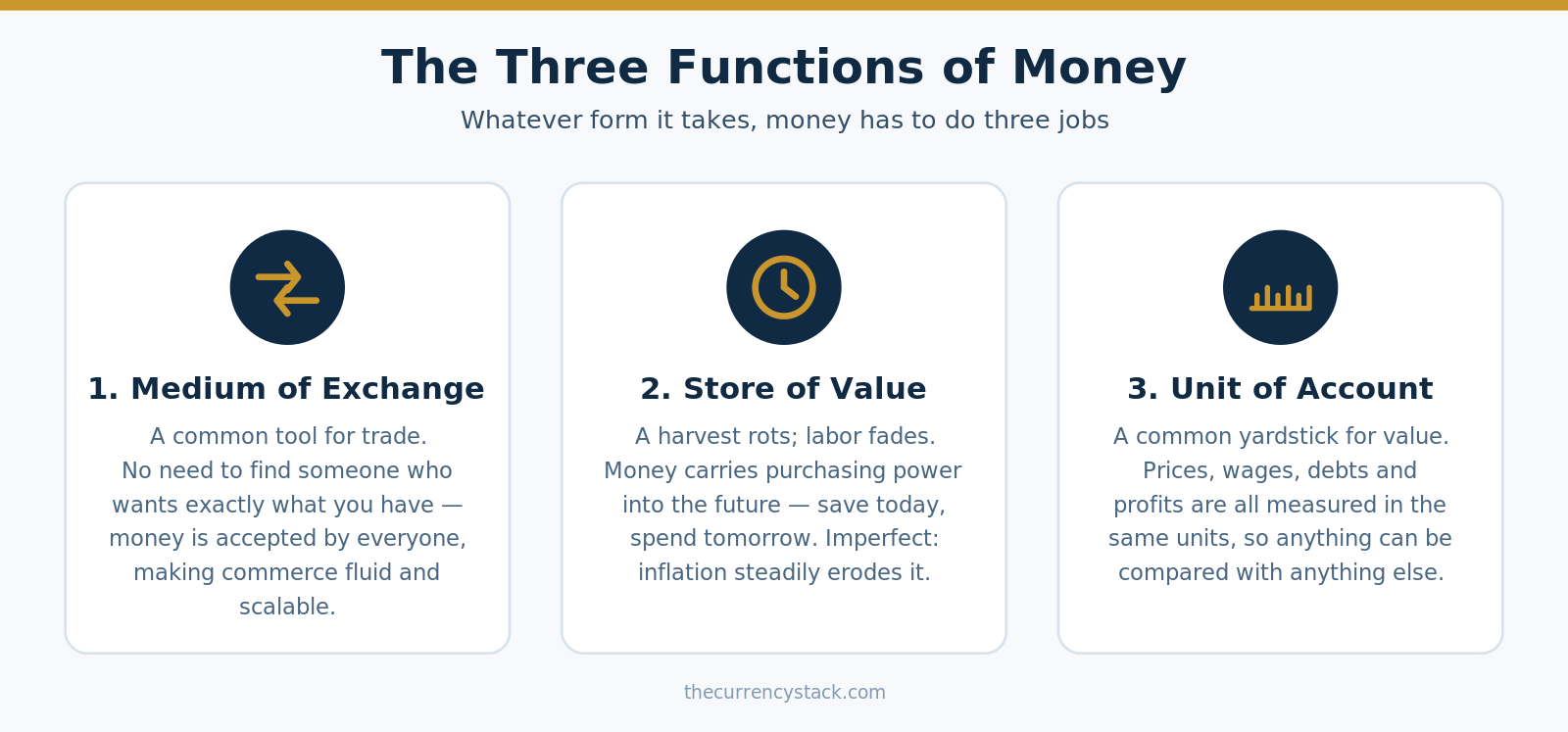
Whatever form it takes, money performs three essential functions:
1. Medium of exchange. Money solves the coincidence-of-wants problem by giving everyone a common tool for trade. Instead of hauling goats to market, you carry coins (or a card). Commerce becomes fluid, efficient, and scalable — and people can specialize in one trade, confident their wages will buy everything else they need.
2. Store of value. A farmer’s harvest rots. A craftsman’s labor fades. Money preserves purchasing power over time, allowing people to save today and spend tomorrow. It’s not perfect — inflation erodes this function — but it beats stockpiling perishables.
3. Unit of account. Money gives us a common language for measuring value. Without it, how would you compare the worth of a haircut against a pair of shoes? Prices, wages, debts, and profits all rely on this shared yardstick.
What Makes Good Money?
Not everything can serve as money. Over history, societies have used shells, salt, cattle, and even the giant stone discs of Yap. The forms that endured share five key properties:
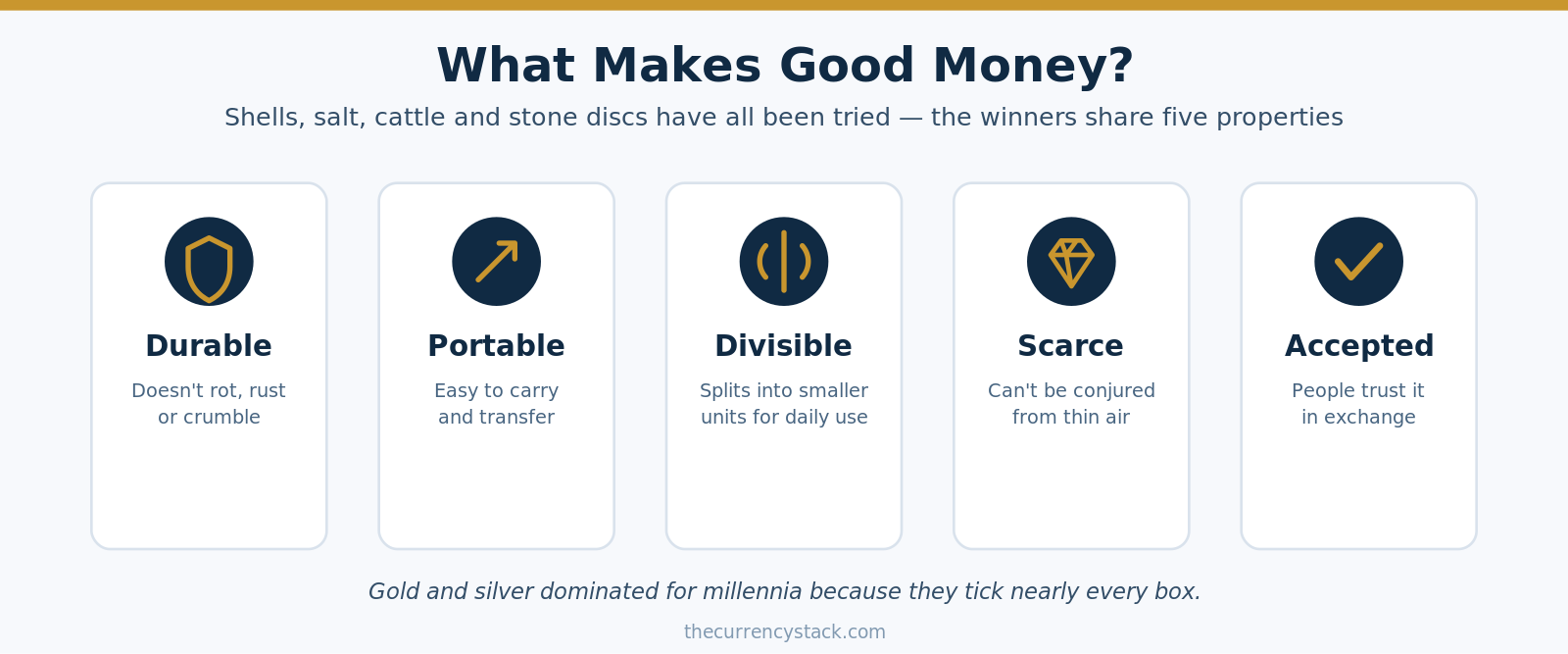
Durability — it doesn’t rot, rust, or crumble. Portability — it can be carried and transferred easily. Divisibility — it breaks into smaller units for everyday transactions. Scarcity — it can’t be conjured from thin air, which preserves its value. Acceptability — people trust it and take it in exchange.
Gold and silver dominated for millennia precisely because they tick nearly every box. They were durable, easy to mold into standard units, rare — and crucially, easy to test for authenticity. Both metals are soft enough to leave a telltale streak when scraped across a touchstone, so a merchant could verify what he was being paid with. That testability, known as assaying, was essential to making precious metals trusted money.
How Money Has Evolved
Money’s story is one of steady abstraction — moving further from physical goods toward pure trust and information.
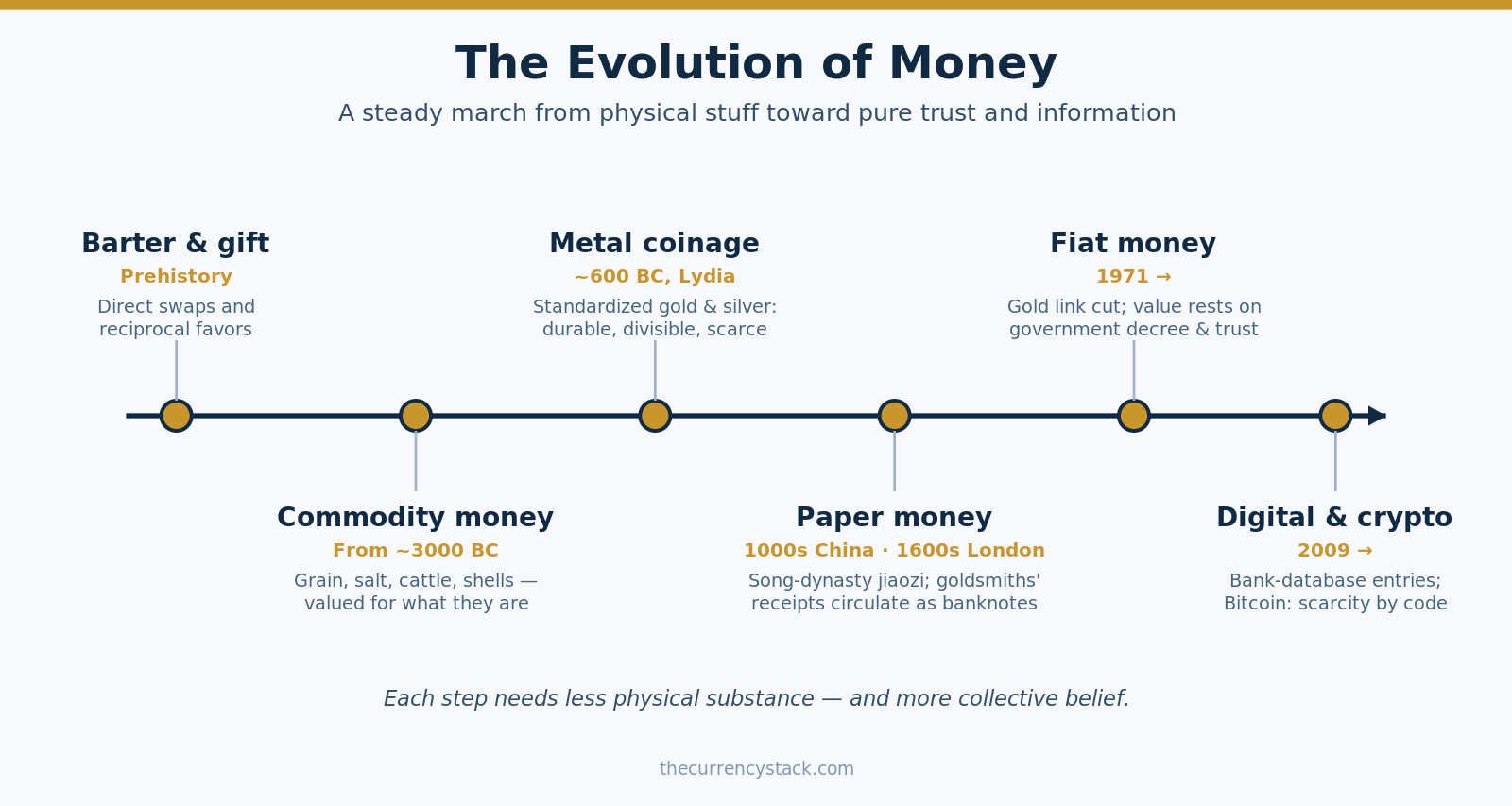
Commodity money was the starting point: items with intrinsic value, like grain, salt, livestock — and eventually standardized gold and silver coins, first struck in Lydia around 600 BC. Their worth came from what they were, not merely what they represented.
Representative money came next: paper that stood in for something physical. The first true paper money appeared in Song-dynasty China around the 11th century — promissory notes called jiaozi, issued in Sichuan to spare merchants from hauling heavy strings of coins. Europe arrived at the same idea centuries later: in 1600s London, goldsmith-bankers accepting deposits of coin and bullion issued paper receipts, and customers soon realized the receipts themselves could change hands instead of the metal. Those circulating receipts were the direct ancestors of the modern banknote.
Fiat money is what we use today. Modern currencies — the pound, the dollar, the euro — are backed not by gold or silver, but by government decree and public trust. The word fiat is Latin for “let it be done.” Since 1971, when the United States cut the dollar’s last formal link to gold, every major currency has floated free of any commodity anchor. Your $20 bill is valuable because the state says it is — and because everyone agrees to act accordingly.
Digital and crypto money represent the latest frontier. Most money today already exists as digital entries in bank databases rather than physical notes. Meanwhile, cryptocurrencies like Bitcoin attempt to create money governed by code and mathematics rather than governments — scarce by design, borderless by nature.
How Money Is Created Today
Here’s the part that surprises most people: the vast majority of money in the modern economy isn’t printed by governments — it’s created by commercial banks when they make loans. When a bank approves a loan, it doesn’t hand over notes from a vault, and it doesn’t simply pass on someone else’s savings. It credits the borrower’s account with a brand-new deposit, creating new money in the act of lending. As the Bank of England has put it, bank deposits — not notes and coins — make up about 97% of the money circulating in the UK economy.
Central banks — the Federal Reserve, the Bank of England, the European Central Bank — sit at the apex of this system. They don’t directly control how much money commercial banks create, but they shape it powerfully: by setting interest rates, which govern how attractive borrowing is, and by regulating how much capital banks must hold against their lending.
A Question Worth Asking
Money is, at its core, a social technology — a shared fiction that works because we all believe in it. That collective belief is both its greatest strength and its most profound vulnerability.
Understanding what money is opens the door to deeper questions: Why does inflation happen? What determines the value of one currency against another? Can a decentralized digital currency ever replace the dollar or pound? These are questions at the heart of modern finance — and exactly what we explore here at The Currency Stack. The rabbit hole, it turns out, goes very deep.
Further reading: Bank of England, “Money Creation in the Modern Economy” (Quarterly Bulletin, 2014 Q1); David Graeber, Debt: The First 5,000 Years (2011).