What Is Cryptocurrency? (And How It Relates to Money)
- A cryptocurrency is a digital asset secured by cryptography and recorded on a blockchain — a shared public ledger maintained by a network of computers instead of a bank or government.
- Bitcoin, launched in January 2009, was the first; it remains the largest, at roughly $1.2 trillion of a total crypto market of about $2.2 trillion (as of early July 2026).
- Crypto only partly passes the classic “money test”: it works as a medium of exchange in places, is rarely used as a unit of account, and is a volatile — though widely held — store of value.
- Stablecoins — tokens pegged to the dollar — are crypto’s fastest bridge to ordinary money, a $300 billion market now being brought under US and EU regulation.
- Unlike FX’s five-day trading week, crypto trades around the clock, every day of the year, and settles in minutes rather than two business days.
Is cryptocurrency real money?
Partly. It can be exchanged and stored, but almost nothing is priced in it, and its value swings too much for everyday accounting. Economists mostly treat it as a new asset class that borrows some of money’s features.
Who controls Bitcoin?
No one and everyone. The rules are enforced by open-source software running on thousands of independent computers; changing them requires broad agreement across the network.
What gives crypto value?
The same thing that gives any money value — collective belief — plus enforced digital scarcity (Bitcoin’s supply is capped at 21 million) and the usefulness of its network.
What is a stablecoin?
A crypto token designed to hold a fixed value, usually $1, backed by reserves of cash and short-term government debt. The two largest, Tether and USD Coin, account for about 85% of the market.
Is crypto safe?
It carries real risks: prices are volatile, lost keys mean lost coins, platforms have failed, and regulation is still settling. Nothing in this article is investment advice.
A quick-read summary of the full article below.
On January 3, 2009, a piece of open-source software quietly created the first entry in a new financial ledger. There was no launch event, no bank, no government decree — just a pseudonymous programmer, Satoshi Nakamoto, and a nine-page paper proposing “a peer-to-peer electronic cash system.” Seventeen years later, the idea that began as Bitcoin has grown into a roughly $2.2 trillion family of assets (as of early July 2026) that most people have heard of, many people own, and surprisingly few can explain.
This article is the plain-English explanation. What a cryptocurrency actually is, how it works under the hood, how it trades, and — the question this site keeps returning to — how it relates to money.
A New Entry in Money’s Family Tree
In What is Money? we made the case that money is not a thing but a shared agreement — a social technology for storing and transferring value that works because everyone trusts it. Every earlier form of money anchored that trust somewhere: commodity money in the metal itself, fiat money in the state, bank deposits in the banking system.
A cryptocurrency anchors it somewhere new: in mathematics and a network. It is a digital asset whose ownership and transfer are secured by cryptography — the same branch of mathematics that protects your online banking — and recorded on a blockchain, a public ledger maintained simultaneously by thousands of independent computers around the world. No company issues it. No central bank stands behind it. The network itself is the institution.
One distinction follows immediately, and it matters. The cash in your pocket is legal tender — issued by a state, backed by its institutions, and designed to be stable enough to spend without thinking about it. Cryptocurrency is none of those things: in nearly every country, no one is obliged to accept it, and no government stands ready to defend its value. That is not a footnote; it is the trade the whole idea makes — institutional backing exchanged for institutional independence.
That is the genuinely new idea. Everything else about crypto — the coins, the exchanges, the jargon — follows from it.
How It Works, Briefly
Strip away the terminology and a blockchain is a ledger — a list of who owns what, like the one your bank keeps. The difference is who keeps it. Instead of one institution holding the master copy, every participating computer holds a full copy, and they update it together in batches called blocks, each cryptographically chained to the last — hence the name. To rewrite history, you would have to out-compute most of the network at once, which is designed to be economically impractical.
Ownership works through a pair of digital keys. Your public key works like an account number others can send funds to; your private key is the password that authorizes spending — and whoever holds it controls the coins, permanently. A wallet is simply software (or a specialized device) for holding those keys. There are no account recovery lines in crypto: lose the private key and the coins are unreachable forever.
That is as deep as this article needs to go — the full mechanics of mining, validators, and consensus deserve their own piece later in this series. The essential point: a cryptocurrency is a bearer asset that settles machine-to-machine, with no bank in the middle.
The Crypto Family
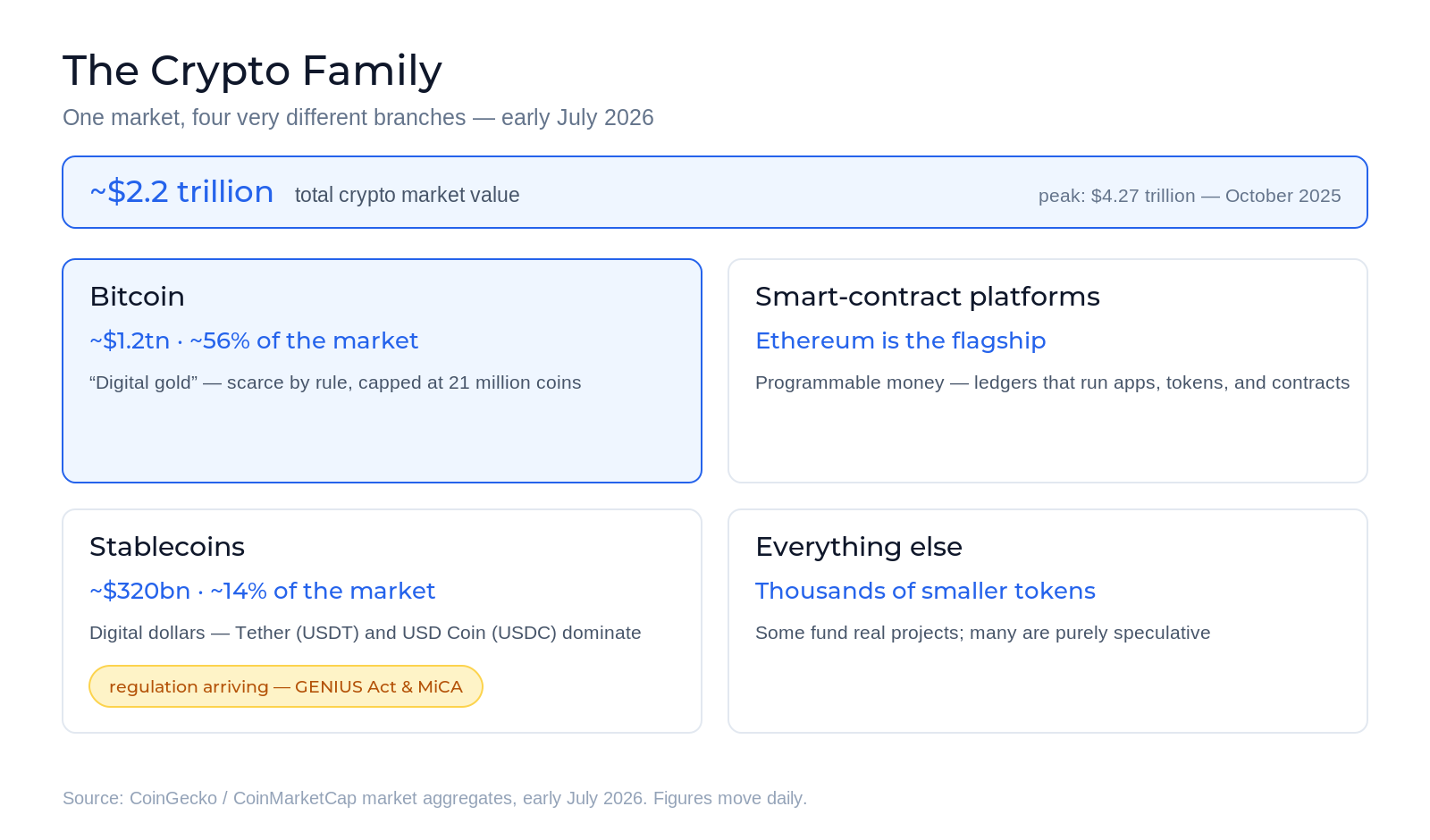
“Crypto” is a family, not a single thing, and its branches do very different jobs.
Bitcoin is the original and still the anchor — roughly $1.2 trillion of the market, around 56% of the total (early July 2026). Its supply is capped at 21 million coins by rule, which is why its advocates describe it as “digital gold”: a scarce, bearer store of value rather than an everyday payment tool.
Smart-contract platforms, led by Ethereum, extend the ledger idea from recording money to running programs. Their networks host applications, other tokens, and self-executing agreements — programmable money, in effect. Ether, Ethereum’s native coin, is the second-largest cryptocurrency.
Stablecoins are the pragmatists of the family: tokens engineered to hold a fixed value, almost always $1, by holding reserves of cash and short-term US government debt. They are crypto’s bridge to ordinary money — a digital dollar that moves at blockchain speed — and a roughly $300 billion market as of mid-August 2026, dominated by Tether (USDT, about $183 billion) and USD Coin (USDC, about $72 billion). Regulators have moved from watching to writing rules: the US GENIUS Act, enacted in July 2025, created the first federal framework for payment stablecoins, and the EU’s MiCA regime already governs them in Europe. Stablecoins matter enough to this site’s beat that they get a full article of their own soon.
Beyond these sit thousands of smaller tokens — some funding real projects, many purely speculative. The market’s own numbers enforce humility here: the total crypto market peaked at $4.27 trillion in October 2025 and stood at roughly half that nine months later. Entire categories of token have round-tripped to zero before.
Does Crypto Pass the Money Test?
In What is Money? we used the classic three-function test: real money serves as a medium of exchange, a unit of account, and a store of value. Run crypto through it and the results are mixed — and revealing.
As a medium of exchange, crypto works but is narrow. You can pay with Bitcoin in some places, and stablecoins have found genuine traction for cross-border transfers, especially where local banking is slow or local currency untrusted. But for everyday commerce, card networks and bank transfers remain faster to use and universally accepted.
As a unit of account, crypto has barely started. Almost nothing is priced in bitcoin — even crypto exchanges quote their products in dollars. When a currency’s value can move several percent in a day, no merchant wants to reprice the menu every morning. This is the function volatility hits hardest.
As a store of value, the verdict is contested — and it is where the real debate lives. Bitcoin’s fixed supply makes it provably scarce, and it has held and grown purchasing power over its lifetime in a way few assets have. It has also, repeatedly, lost half its value in months. A store of value that swings that widely is better described, for now, as a speculative one. Stablecoins invert the trade-off: they hold their dollar peg but, by design, earn the holder nothing and aspire to nothing more.
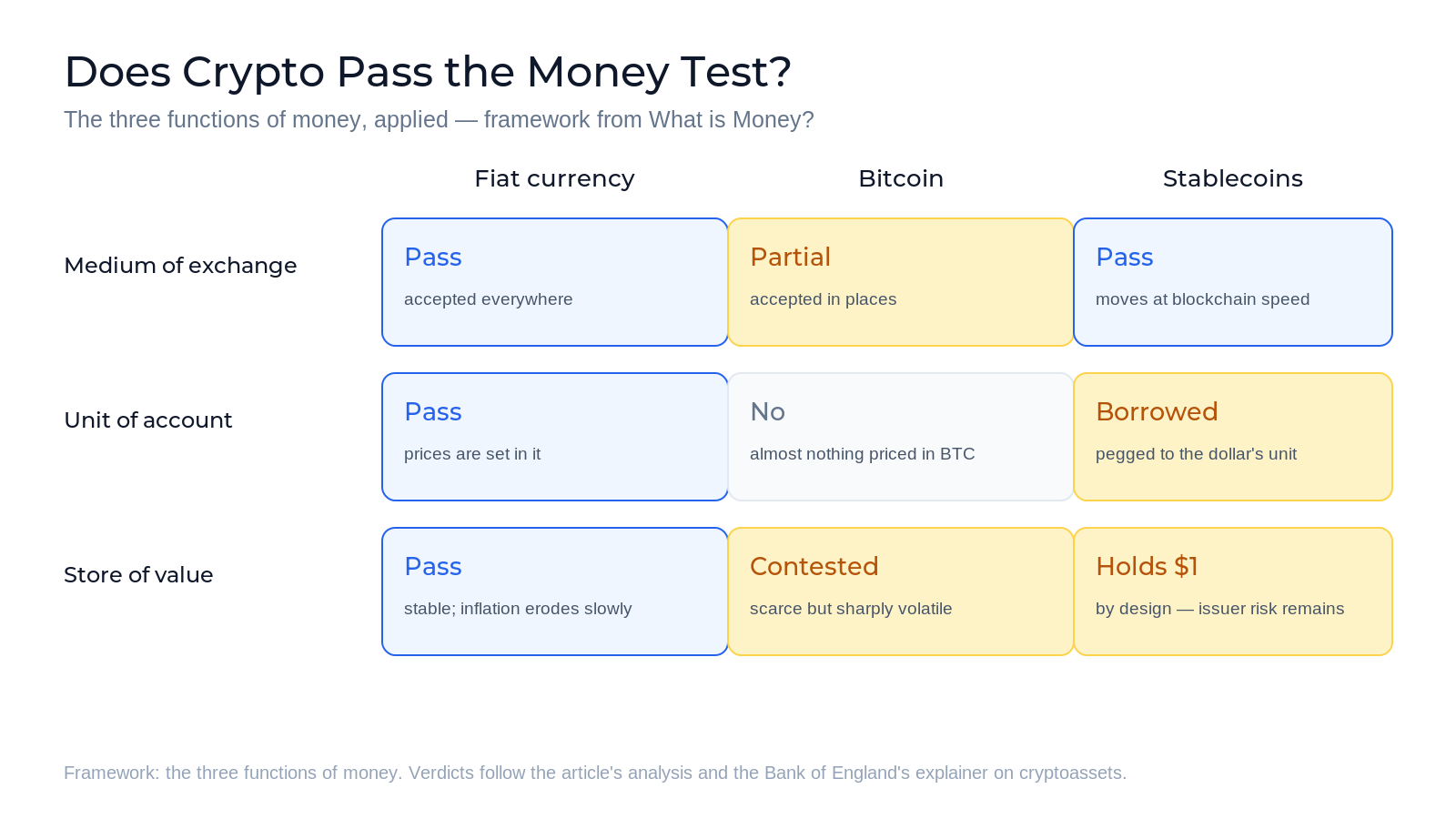
The honest summary: crypto borrows some of money’s functions without yet fulfilling them all — and different branches of the family borrow different ones. The institutions that manage actual money read it the same way: the Bank of England’s own explainer concludes that cryptoassets are not widely accepted in everyday commerce and are not money in the everyday sense, and the UK’s Financial Conduct Authority describes them as behaving more like speculative assets than currencies. That is not a dismissal. Fiat money took decades to earn trust after the gold anchor was cut in 1971; crypto is seventeen years old.
How Crypto Trades — a Market Unlike FX
For readers who followed our tour of the FX market, crypto’s market structure is a study in contrasts.
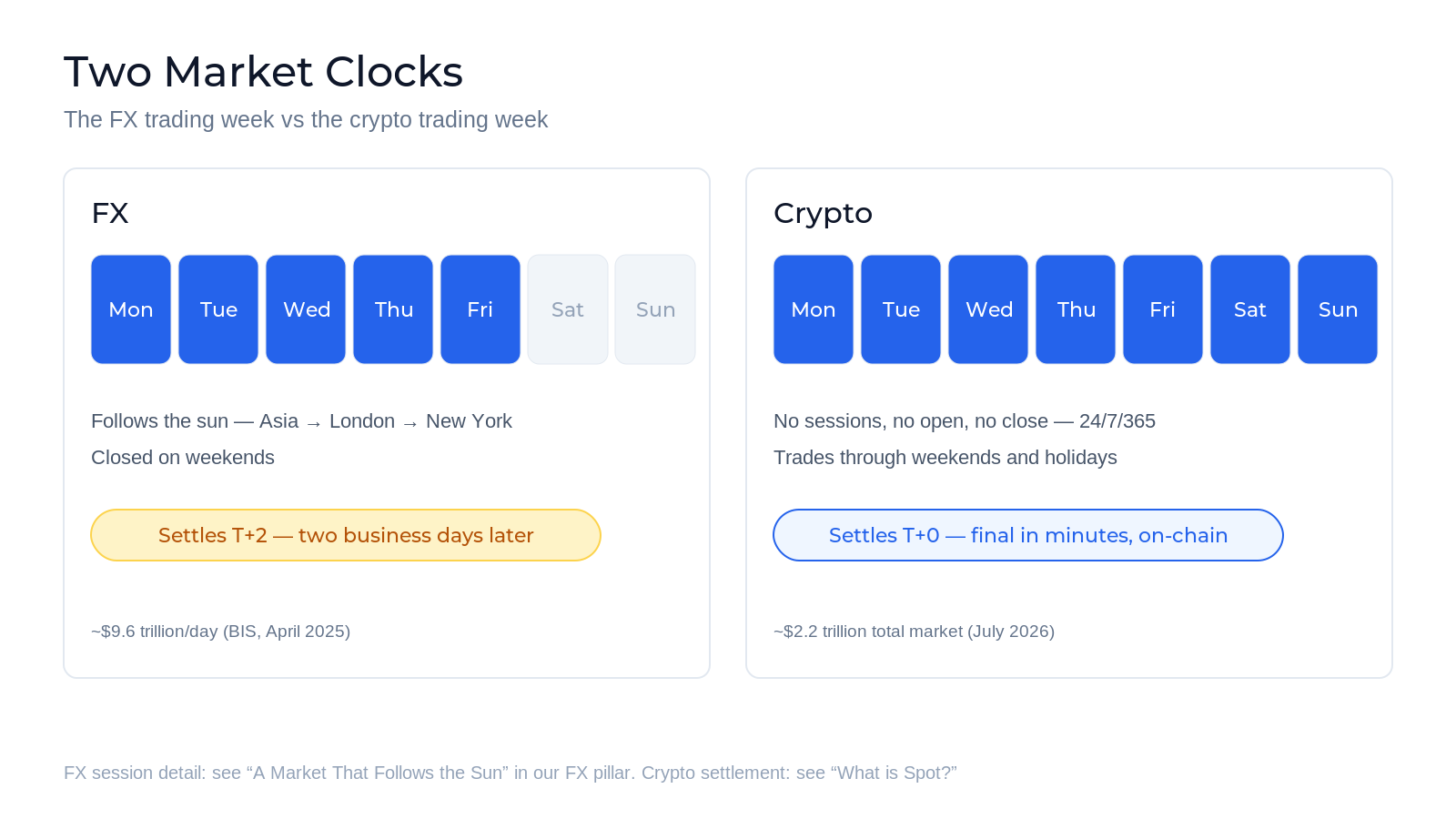
The FX market trades around the clock during the week but rests on weekends, follows the sun from Asia to London to New York, and transacts over the counter between institutions, settling two business days later. Crypto trades 24 hours a day, 365 days a year, with no sessions and no close. Most trading happens on exchanges with public order books — structurally closer to a stock exchange than to FX’s dealer network — alongside decentralized venues and OTC desks for size. And settlement is the blockchain itself: as we saw in What is Spot?, a crypto transfer is final in minutes (T+0), while an FX spot trade waits two days for the world’s banking systems to align.
Each design has costs. FX’s institutional plumbing brings deep liquidity and regulated counterparties; crypto’s always-on market means volatility can strike at 3 a.m. on a Sunday with no market maker obliged to stand in its way.
Risks and Realities
No honest introduction ends without the caution list, so here is ours — education, not advice.
Volatility is structural, not incidental: the whole market halved in the nine months after its October 2025 peak, and individual tokens routinely move further. Custody is unforgiving: crypto’s no-bank design means no deposit insurance and no password reset — lost keys or a hacked platform mean losses with no recourse, a lesson the 2022 collapse of the FTX exchange taught at scale. Regulation is arriving but unevenly: stablecoin frameworks like the GENIUS Act and MiCA are the furthest along, while rules for the broader market still vary widely by country. None of this means crypto is untouchable; it means the burden of care sits with the holder to a degree traditional finance hasn’t asked of ordinary people in generations.
The Bottom Line
A cryptocurrency is a digital bearer asset, secured by cryptography, recorded on a shared public ledger, and governed by a network rather than an institution. Bitcoin proved the idea; Ethereum made it programmable; stablecoins made it dollar-denominated and useful today; thousands of imitators tested — and mostly disproved — everything else.
This article is the front door to our crypto series — how blockchains actually work, what stablecoins really hold, and how exchanges and custody function all get their own deeper treatments in the articles ahead. But the big picture stands on its own. Whether crypto becomes lasting money or settles into life as a new asset class, it has already done something remarkable: it forced the oldest question in finance — what makes money, money? — back onto the table. Money is whatever a community agrees to trust. Crypto is the first attempt to place that trust in code and consensus instead of institutions. Understanding it, whatever you conclude, is now part of understanding money itself.
Further reading: Bank of England, “What are cryptocurrencies?” (explainer); UK Financial Conduct Authority, “Crypto basics” (InvestSmart); Satoshi Nakamoto, “Bitcoin: A Peer-to-Peer Electronic Cash System” (2008); US GENIUS Act (S.394, 119th Congress, 2025). Market figures are CoinGecko/CoinMarketCap aggregates as of early July 2026 and move daily. In this series: What is Money?, Types of Money in a Modern Economy, What Is the FX Market and Why Does It Matter?, and What is Spot?