
How a Spot FX Trade Really Works: From Quote to T+2 Settlement
- A spot FX trade looks like a single click, but it runs through a hidden chain: execution fixes the price, settlement moves the money two days later.
- Execution creates the obligation; settlement on the value date (usually T+2) discharges it — everything in between exists to carry the trade safely across that gap.
- That two-day gap is where settlement risk lives: the danger of paying away one currency before receiving the other.
- The market tames that risk with payment-versus-payment settlement (notably CLS), netting, and disciplined settlement instructions — but never removes it entirely.
- The full article follows one trade end to end, from quote to final settlement.
What’s the difference between trade date and value date?
The trade date (T) is when the deal is agreed; the value date is when the currencies actually change hands — usually T+2 for spot FX.
Is every pair T+2?
No. USD/CAD is the best-known T+1 pair, and some currencies follow local conventions. Settlement follows the pair’s value-date convention, not the trading screen.
What is settlement risk?
The risk that you pay the currency you sold but your counterparty fails before paying you the currency you bought — the principal-risk part of the two-day gap.
What are PvP and CLS?
Payment-versus-payment means one currency leg settles only if the other does too. CLS is the best-known PvP system in FX, settling 18 currencies and cutting members’ funding needs through netting.
What is netting?
Offsetting multiple same-currency, same-day obligations between two parties so only the net amount moves — sharply reducing the liquidity the system ties up.
Does all FX settle safely through PvP?
No. The BIS estimated about $2.2 trillion of daily FX turnover was exposed to settlement risk in April 2022 — some currencies and counterparties aren’t covered by PvP.
A quick-read summary of the full article below.
On a screen, a spot trade in foreign exchange (FX) looks effortless. A price flashes, you click, and the deal is done. But that click is only the visible beginning. Behind it runs a hidden chain — credit checks, trade confirmations, settlement instructions, payment systems, and, for many institutional trades, specialized infrastructure built to stop one side from paying while the other does not. The price is fixed the instant you deal; the money, for most currency pairs, does not move for two more business days. That gap is where a spot trade is really made — and where it can go wrong.
We covered why “spot” doesn’t mean “instant” in What is Spot? Here we do something different: we follow a single trade all the way through the machine, from the quote on the screen to final settlement on the value date.
The Quote: One Rate, Two Cash Flows
A spot FX quote expresses the price of one currency in terms of another. In EUR/USD, the euro is the base currency and the dollar is the quote currency. If EUR/USD trades at 1.0850, one euro costs 1.0850 dollars.
The quote normally has two sides — a bid and an offer. The bid is the price at which the quoting party will buy the base currency; the offer is the price at which it will sell. Suppose a client asks for a EUR/USD price in EUR 10 million and receives 1.0849/1.0851. Buying euros means dealing at the offer, 1.0851 — so the client will receive EUR 10 million on settlement and pay USD 10.851 million in return.
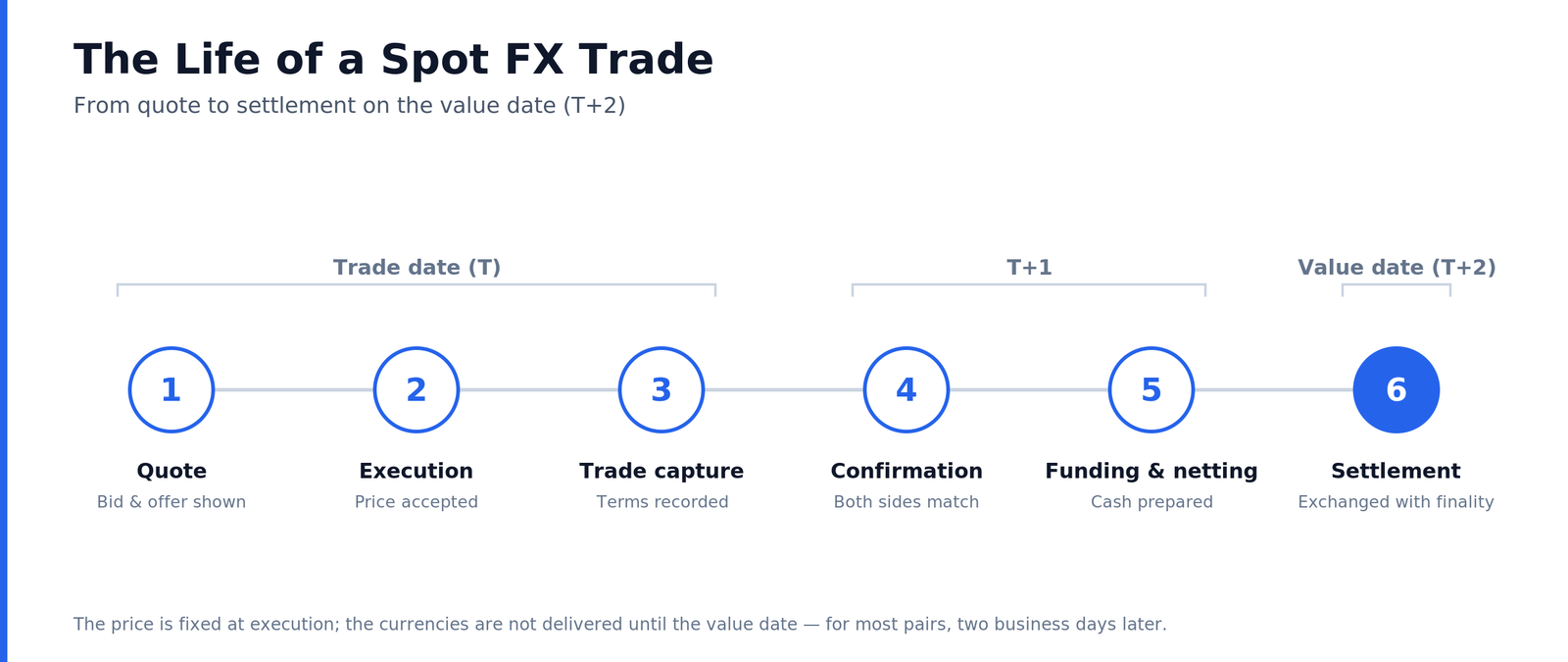
At the moment the price is accepted, the trade is done in economic terms. The counterparties have agreed the currency pair, the direction, the amount, the rate, the trade date, and the intended value date. Yet no currency has changed hands. Execution creates the obligation; settlement discharges it. Everything that follows exists to carry the trade safely across the gap between the two.
Trade Date Versus Value Date
The trade date, or T, is the day the transaction is agreed. The value date is the day the two currencies are due to be exchanged. For most spot FX pairs, standard settlement is T+2 — trade date plus two business days.
The word “business” carries weight here. Settlement does not count calendar days mechanically; the payment systems for both currencies must be open. A Monday EUR/USD trade will typically settle on Wednesday. A Thursday trade will typically settle on the following Monday, because the weekend does not count. If a public holiday falls on the expected value date, settlement rolls forward.
There are exceptions to the two-day norm. USD/CAD is the best-known T+1 pair, and some currencies follow local conventions that differ from the broad standard. The practical point is that spot settlement follows the value-date convention of the currency pair — not the speed of the trading screen.
What Happens After the Trade Is Agreed
Once the trade is executed, it has to be captured in each counterparty’s systems. The record must include the economic terms, the legal counterparty, the settlement method, and the standard settlement instructions — the standing details that specify where each currency should be paid.
Next comes confirmation. Each side checks that it holds the same trade: amount, direction, rate, value date, counterparty entity, and settlement details. A small mismatch can become a large problem if it surfaces only on settlement day. Many institutional trades are matched electronically, but the principle never changes — both parties must agree exactly what is due.
Credit and risk systems update in parallel. From execution until final settlement, the two parties are exposed to each other. Before the value date, the exposure is replacement cost risk: if the counterparty defaults, the surviving party may have to replace the trade at a worse rate. Closer to settlement, it becomes principal risk: one party may pay away the currency it owes without receiving the currency it is due. This is why FX operations are not mere administration. In a EUR 10 million trade, the market value may drift only modestly before settlement, but the settlement payments are the full principal amounts. The process exists to protect the economics of the deal.
How the T+2 Date Is Calculated
The spot value date is the first date that satisfies the pair’s convention and works for the relevant currency calendars. In a clean EUR/USD example with no holidays, a Monday trade settles Wednesday — Tuesday is T+1, Wednesday is T+2. A Thursday trade settles the following Monday, with Friday as T+1 and Monday as T+2.
The detail that trips up newcomers is the special role of the US dollar. A spot trade is only deliverable on a good business day — a day on which the payment systems of every currency in the trade are open. For the great majority of pairs, one of those currencies is the dollar, so the value date generally has to be a good business day in the United States. An intervening US dollar holiday is skipped when counting the two days, but it cannot itself be the value date. Currency pairs that do not involve the dollar — the crosses — follow the same logic against their own two payment calendars instead. So it is not that both countries must share an identical calendar; it is that the systems needed to move each currency must be open when settlement falls due.
That value date then drives the rest of the workflow. Treasury teams arrange funding. Operations teams issue payment instructions. Risk teams monitor exposures. Nostro banks — the accounts a bank holds in foreign currencies with banks abroad — and correspondent banks prepare to send or receive funds. Get the value date wrong, and the cash movements can be wrong too.
Netting: Reducing the Funding Burden
A single FX trade creates two payment obligations: one currency flows out, the other flows back. Large institutions, though, may have thousands of trades with the same counterparties, in the same currencies, settling on the same day. Paying every obligation gross would consume far more liquidity than necessary.
Netting reduces that burden. If two counterparties have multiple payments in the same currency on the same value date, they can offset those obligations and settle only the net amount. The Bank for International Settlements describes pre-settlement netting as the bilateral offsetting of payment obligations to shrink the amounts that actually need to be settled.
Netting does not erase the underlying trades — the deals still exist, and their economics still matter. It simply reduces the cash that has to move. In a market where daily settlement values are enormous, that reduction has a major effect on how much liquidity the system ties up.
Payment-Versus-Payment and CLS
The core settlement-risk question is blunt: what happens if one side pays and the other does not? Payment-versus-payment, or PvP, is the answer. In a PvP mechanism, the final payment of one currency happens only if the final payment of the other currency also happens. The two legs live or die together.
CLS is the best-known PvP settlement system in FX. By its own account, CLS simultaneously settles the payment instructions relating to FX trades through a PvP system, and settlement across the books of CLS Bank is final and irrevocable. In practice, it receives electronic payment instructions for both sides of eligible trades, authenticates and matches them, holds them until the settlement date, and then settles the matched instructions subject to risk controls. Settlement members fund and receive their net positions through central bank accounts and nostro arrangements. CLS currently settles 18 currencies, including the US dollar, euro, pound sterling, yen, Swiss franc, Canadian dollar, Australian dollar, and New Zealand dollar.
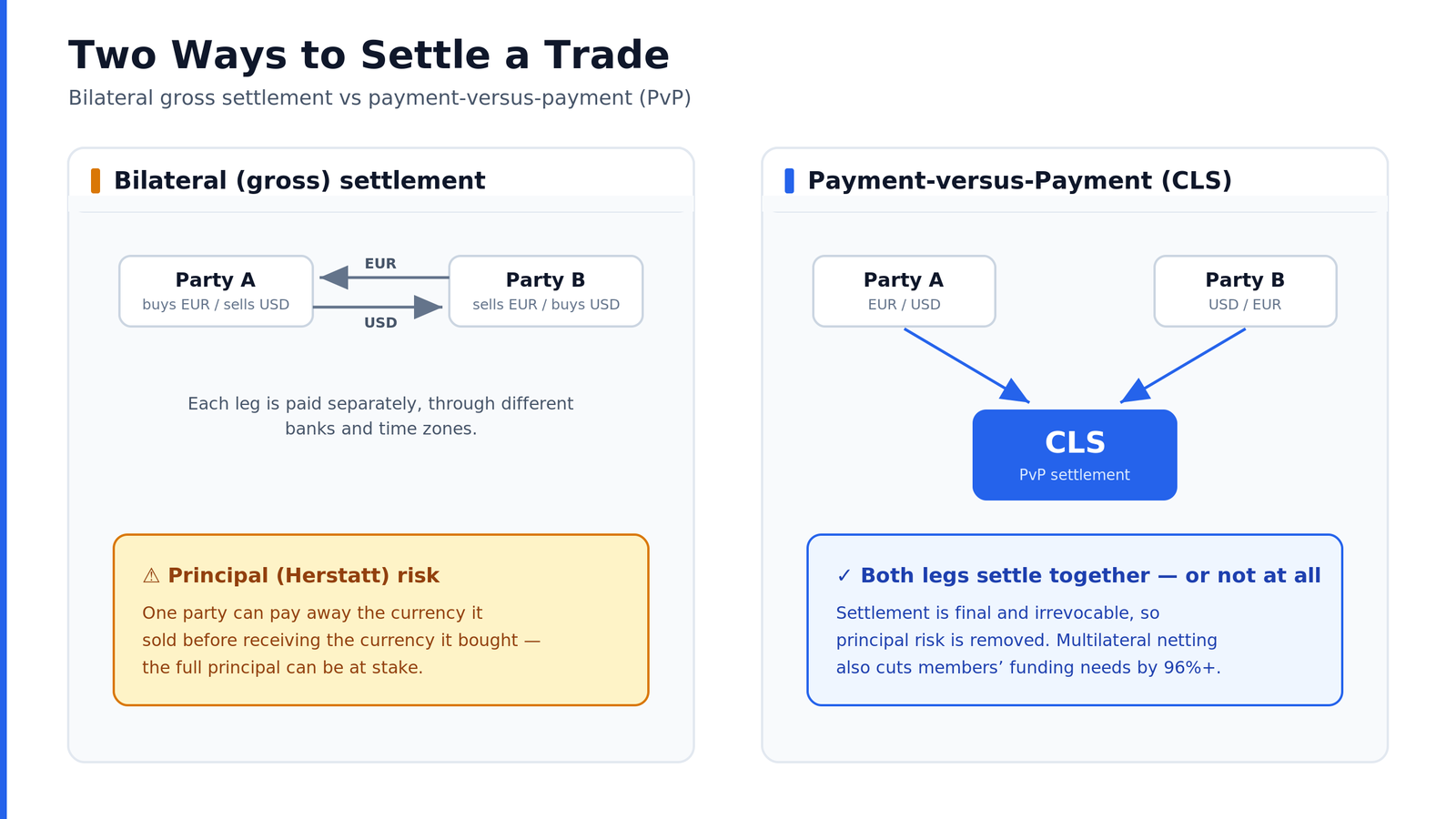
The benefit is not only safety. CLS also cuts the liquidity the system needs through multilateral netting: it reports that netting reduces members’ funding requirements by more than 96% on average, while the gross value of the instructions still settles in full. Risk falls and far less cash has to move to achieve it.
Why Settlement Risk Still Exists
Not every deliverable FX trade settles through PvP. The Bank for International Settlements estimated that, in April 2022, about $2.2 trillion of daily FX turnover was exposed to settlement risk — close to a third of deliverable FX turnover, and up from roughly $1.9 trillion three years earlier.
The reasons vary. Some currencies are not eligible for CLS. Some counterparties lack direct or indirect access to PvP arrangements. Some trades miss operational cut-offs or fail to match in time. In other cases, the parties rely on bilateral netting, correspondent banking, or on-us settlement rather than a formal PvP mechanism. Those alternatives are not automatically poor practice, but they have to be controlled deliberately. The FX Global Code, the market’s voluntary standard of good conduct, urges participants to reduce settlement risk and to use services that eliminate or reduce it wherever practicable.
Settlement Day: When the Money Actually Moves
On the value date, each party must deliver the currency it sold and receive the currency it bought. Outside PvP, payments usually move through correspondent banks and domestic payment systems: each party instructs its bank or nostro provider to send funds to the counterparty’s nominated account.
The timing is rarely symmetrical. The two currencies can settle in different time zones, with different payment-system cut-offs and different cancellation deadlines. The New York Fed frames the exposure precisely: FX settlement risk begins when a firm can no longer be certain it could cancel its outgoing payment instruction, and it ends only when the firm receives the purchased currency with finality. That window can open before the value date and persist after it — which is why the risk lasts longer than a tidy “Wednesday settlement” label suggests. Time-zone gaps, internal payment processes, and correspondent-bank arrangements all stretch its duration.
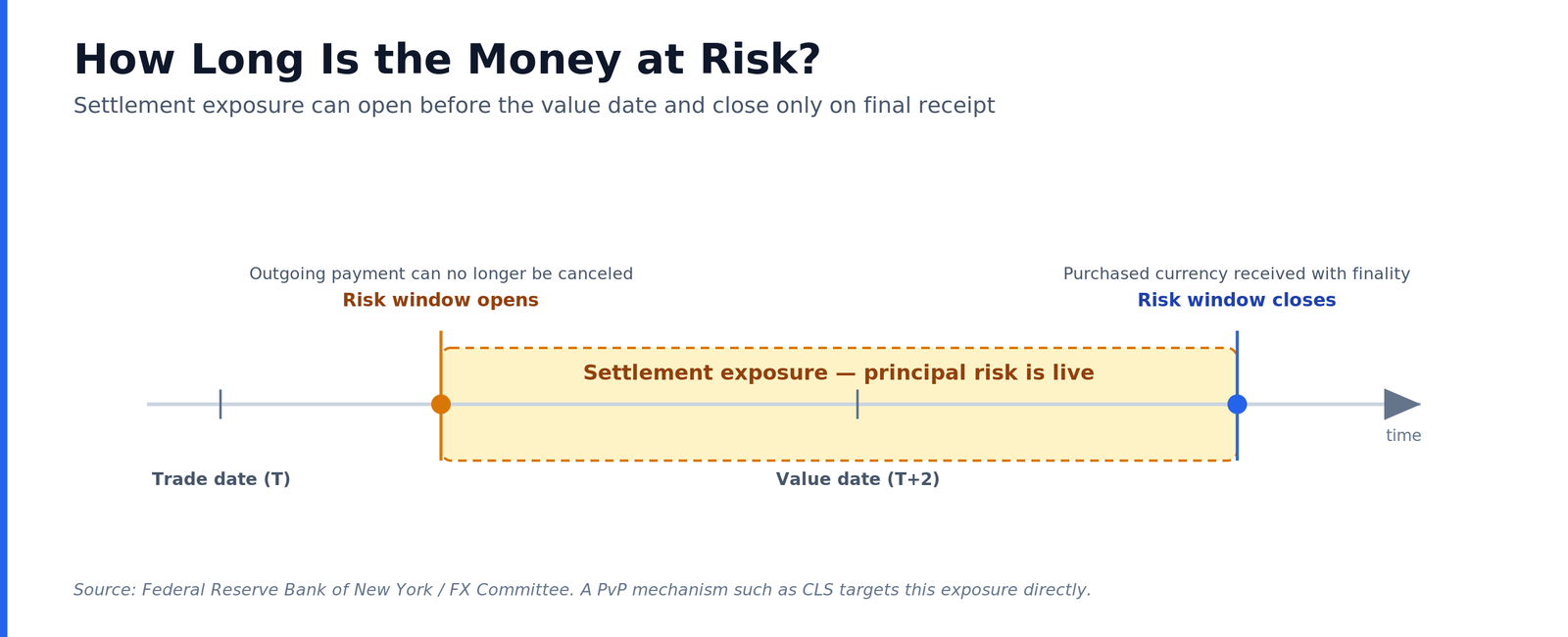
In a PvP system, the logic is different by design. One leg cannot settle finally unless the other settles too. That does not remove every operational headache, but it goes straight at the principal-risk problem that bilateral settlement leaves open.
A Simple Worked Example
Assume an asset manager buys EUR 10 million against dollars at 1.0850 on a Monday, with no holidays in the way. The value date is Wednesday. The asset manager will receive EUR 10 million and pay USD 10.85 million.
On Monday, both parties capture and confirm the trade. On Tuesday, it is matched in a settlement system or prepared for bilateral settlement: funding is checked, payment instructions are readied, and any netting is completed. On Wednesday, settlement occurs. If the trade sits in CLS, the matched instructions settle through the PvP process and members pay or receive their net currency positions. If it settles bilaterally, the dollar and euro payments move through the relevant banks and payment systems. Either way, the trade is only truly complete once both sides have received final funds and reconciled the cash.
The Bottom Line
A spot FX trade can look like a single, instantaneous act, but the market’s reliability rests on the settlement chain beneath it. The rate is fixed at execution; the cash does not usually move until the value date — for most pairs, T+2. That delay exists for sound reasons: confirming trades, arranging funding, observing currency holidays, and coordinating payment systems across time zones. The same delay is also where settlement risk lives, and it is tamed — never entirely removed — through PvP settlement, netting, disciplined settlement instructions, counterparty limits, and timely reconciliation.
The lesson worth carrying away is that spot FX is not just a price; it is a process. A trade begins with a quote, becomes a binding exchange of obligations, passes through confirmation and funding, and ends only when both currencies have been exchanged with finality. Knowing what happens in that two-day gap is part of what separates someone who simply trades from someone who understands what they are trading.
Further reading: Bank for International Settlements, “FX settlement risk: an unsettled issue” (BIS Quarterly Review, December 2022); Federal Reserve Bank of New York / FX Committee, “Foreign Exchange Settlement Risk”; CLS, “CLSSettlement Overview”; Global Foreign Exchange Committee, “FX Global Code.” Previously in this series: What is Spot? and What is Money?