Tokenized Deposits vs Stablecoins: Why Banks Want a Different Digital Dollar
- Banks are building their own digital dollars — tokenized deposits — that look almost identical to stablecoins on screen but are a fundamentally different instrument underneath.
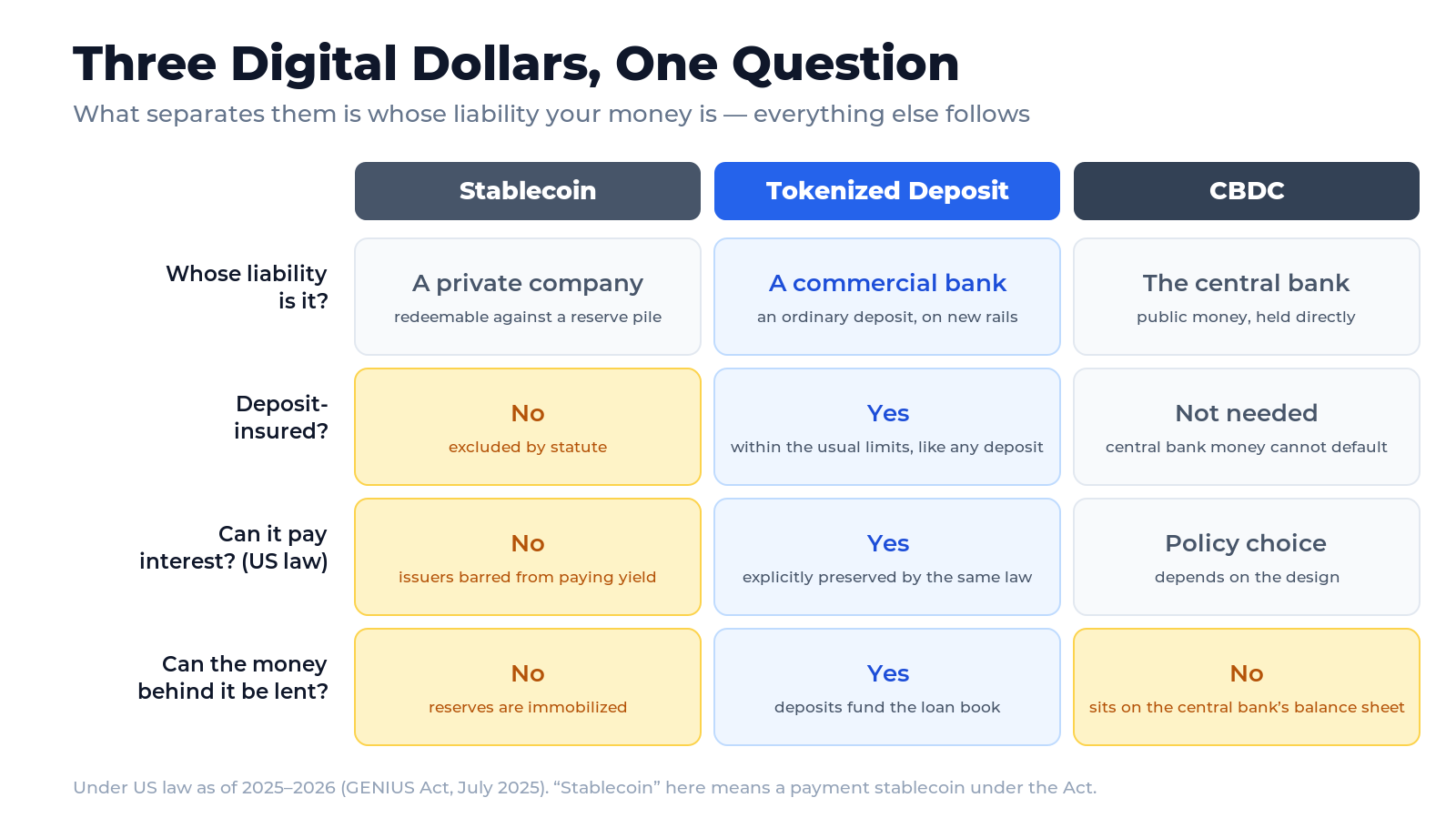
- A tokenized deposit is an ordinary bank deposit represented on a blockchain: still on the bank’s balance sheet, still insured, still able to fund lending. A stablecoin is a claim on a separate company’s reserve pile.
- The largest example is live at scale: J.P. Morgan’s Kinexys platform has processed over $3 trillion since inception, and its JPMD deposit token now runs on a public blockchain for institutional clients.
- US law has quietly drawn the battle lines: the GENIUS Act bars stablecoin issuers from paying interest, while explicitly preserving banks’ ability to issue tokenized deposits that do.
- The dispute is not really about technology. All three digital dollars — stablecoins, tokenized deposits, and central bank digital currencies — settle instantly. The fight is over whose liability your money is, and therefore who gets to lend against it.
What is a tokenized deposit?
A regular commercial bank deposit represented as a token on a blockchain, so it can settle instantly, around the clock, and be programmed like other digital assets. Legally and economically it remains a deposit — a liability of the bank, inside deposit insurance and banking supervision.
How is that different from a stablecoin?
A stablecoin is issued by a separate company against a segregated reserve of cash and Treasury bills; it is not a deposit, not federally insured, and its reserves cannot be lent. A tokenized deposit stays on the bank’s balance sheet, where it continues to fund loans.
Do tokenized deposits actually exist, or are they a concept?
They exist. J.P. Morgan’s institutional deposit token has moved real money since 2019 under the Kinexys umbrella, and in 2025 a version called JPMD went live on a public blockchain. Dozens of major banks and eight central banks tested the model together in the BIS’s Project Agorá.
Why can’t stablecoin issuers just pay interest to compete?
US law forbids it — the GENIUS Act of 2025 prohibits payment stablecoin issuers from paying holders interest or yield. Banks lobbied hard for that line, and the law explicitly preserves their own ability to pay interest on tokenized deposits.
Can ordinary savers hold a tokenized deposit?
Mostly not yet. Today’s deposit tokens are institutional products for a bank’s own vetted clients. Stablecoins, by contrast, are open to anyone with a phone — which is exactly why each side has ground the other cannot easily take.
Why do banks care so much?
Deposits are the cheap funding base that banking is built on. Money that leaves a deposit for a stablecoin stops funding bank lending and starts funding the US government instead — so the banks are defending the foundation of the credit system, and their business.
A quick-read summary of the full article below.
In June 2025, the largest bank in the United States announced it was putting a dollar token on a public blockchain — the kind of open network anyone can build on, the home turf of crypto. For institutional clients only, J.P. Morgan’s JPMD would move dollars on Base, an Ethereum layer-2 network incubated by Coinbase, twenty-four hours a day, seven days a week.
And the first thing the bank did was insist, firmly and repeatedly, that JPMD was not a stablecoin.
To most of the world this sounded like branding — a bank refusing a crypto word the way banks refuse hoodies. It was not branding. The distinction J.P. Morgan was drawing is the most consequential fault line in digital money, and both sides of it are now armed with US legislation, central bank pilots, and balance sheets in the trillions. On one side: stablecoins, private digital dollars issued against reserve piles, which we examined in Private Dollars. On the other: tokenized deposits — the digital dollar the banks actually want. This article is about what a tokenized deposit is, why the banking system is pushing it with such energy, and why the contest between the two designs is really a fight over a question most people have never thought to ask: when you hold a digital dollar, whose liability is it — and who gets to lend against it?
A Token That Refuses the Name
Start with what a tokenized deposit is, because the definition does most of the work.
A tokenized deposit is an ordinary commercial bank deposit — the same claim on a bank you hold in your checking account — represented as a token on a blockchain or similar shared ledger. The US Treasury’s borrowing advisory committee defines it plainly: a “representation of a deposit liability at a commercial bank on blockchain.” Nothing about the instrument changes. It is still a deposit: a liability on the bank’s balance sheet, covered by deposit insurance up to the usual limits, sitting inside banking supervision, backstopped ultimately by the central bank. What changes is the rail it moves on. As a token, the deposit can settle in seconds rather than days, move outside banking hours, cross borders without a chain of correspondent banks, and be programmed — released automatically when goods arrive, split among parties on delivery, locked as collateral.
From the outside, that looks exactly like a stablecoin. Both are digital dollar balances. Both settle near-instantly, around the clock. Both can be wired into smart contracts. On a phone screen, one dollar token looks precisely like another — which is why the difference gets missed, and why it matters that it doesn’t get missed. A stablecoin is a claim on a separate company, redeemable against a segregated pile of cash and Treasury bills that exists to do nothing but sit there. A tokenized deposit is a claim on a bank, and the money behind it is not sitting anywhere — it is out working in the loan book, the way bank money has worked for three centuries.
The scale of the bank version tends to surprise people who follow crypto but not payments. J.P. Morgan’s blockchain platform — rebranded Kinexys in late 2024 — has been moving tokenized deposits between institutional clients since 2019. By early 2026 it had processed more than $3 trillion in transactions since inception and was averaging around $5 billion a day. JPMD, announced in June 2025 and rolled out to institutional clients in the months after, extended the model onto a public blockchain for the first time. Other major banks run or are building equivalents, and — as we will see — dozens of them have now tested the design together with eight central banks.
So the banks’ digital dollar is not a white paper. It is live, at scale, and growing. The rest of this article is about why the banks bothered — and the answer is not “blockchain enthusiasm.” It is a defense of the single most valuable thing in banking.